

Every ongoing business relationship reaches a point where repeating the same contract discussions starts slowing things down. Terms in a master service agreement get reworked, expectations shift slightly, and small gaps begin to create bigger issues over time. This is exactly where a master service agreement becomes essential.
A master service agreement brings structure to that chaos. It locks in the core terms of the relationship, how work is handled, how payments flow, who owns what, and how risks are managed, so every new project doesn’t start from zero. Instead of constant renegotiation, both sides operate with clarity and confidence from the start.
If you’re dealing with multiple projects, long-term vendors, or recurring client work, this isn’t just helpful; it’s necessary. In this guide, you’ll understand what a master service agreement is, how to build a reliable master service agreement template, and how businesses now generate MSAs with AI while using AI Review for MSAs to make smarter, faster contract decisions.
What Is a Master Service Agreement?
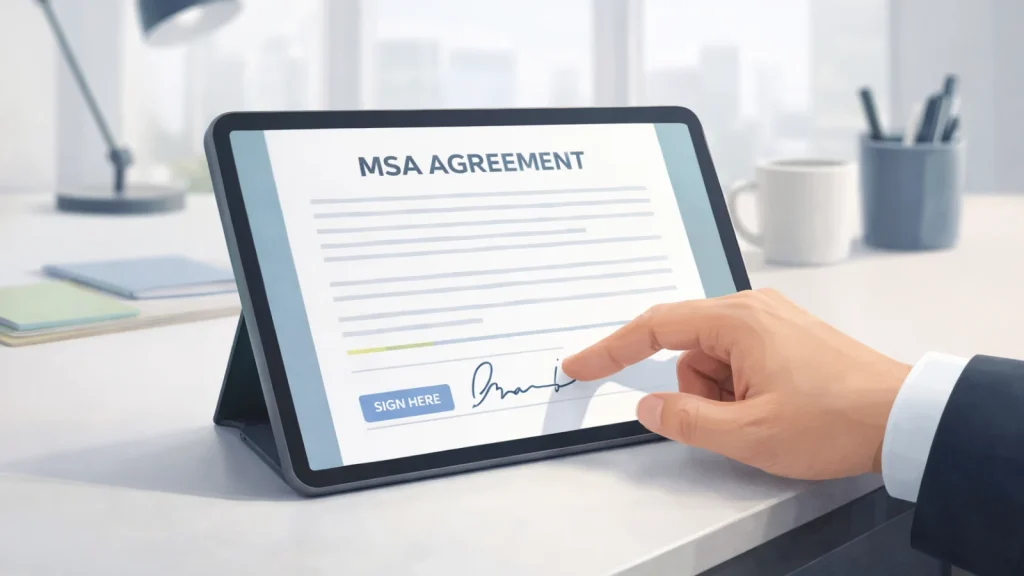
A master service agreement is a contract that sets the foundation for an ongoing business relationship between two parties. Instead of renegotiating terms for every new project, both sides agree upfront on how things will work moving forward.
It acts as a baseline. The master service agreement defines how services will be delivered, how payments are handled, who owns the work, and how disputes are resolved. Once this structure is in place, individual projects are handled separately through statements of work.
This approach is widely used in industries where long-term collaboration is common. Whether it’s technology, consulting, marketing, or staffing, businesses rely on a master service agreement to keep things consistent and efficient over time.
What Is the Purpose of a Master Service Agreement?
At its core, a master service agreement is designed to simplify ongoing work without compromising legal protection. Negotiating a full contract for every project quickly becomes repetitive and time-consuming.
By setting the core terms once, a master service agreement allows future projects to move forward faster. Teams can focus on execution instead of revisiting the same legal discussions again and again.
It also creates clarity. Both parties know their responsibilities from the beginning, which reduces confusion around payments, confidentiality, and liability.
Beyond that, it helps manage risk. A well-structured master service agreement clearly defines who is responsible for what, reducing the chances of disputes turning into costly problems.
When Do You Need a Master Service Agreement?
A master service agreement becomes essential when the relationship is expected to continue beyond a single project. If there are multiple phases, ongoing services, or repeated engagements, having a structured agreement in place makes things far easier.
For instance, a SaaS company working with a development agency over several months benefits from a master service agreement because each phase can be handled under the same terms. The same applies to consulting engagements across departments or long-term marketing partnerships.
Staffing arrangements also often depend on a master service agreement when talent is supplied over time. In each case, the agreement removes the need to restart negotiations for every new assignment.
Putting a master service agreement in place early is always the better option. Trying to define terms after issues arise usually leads to friction and delays.
Key Clauses in a Master Service Agreement
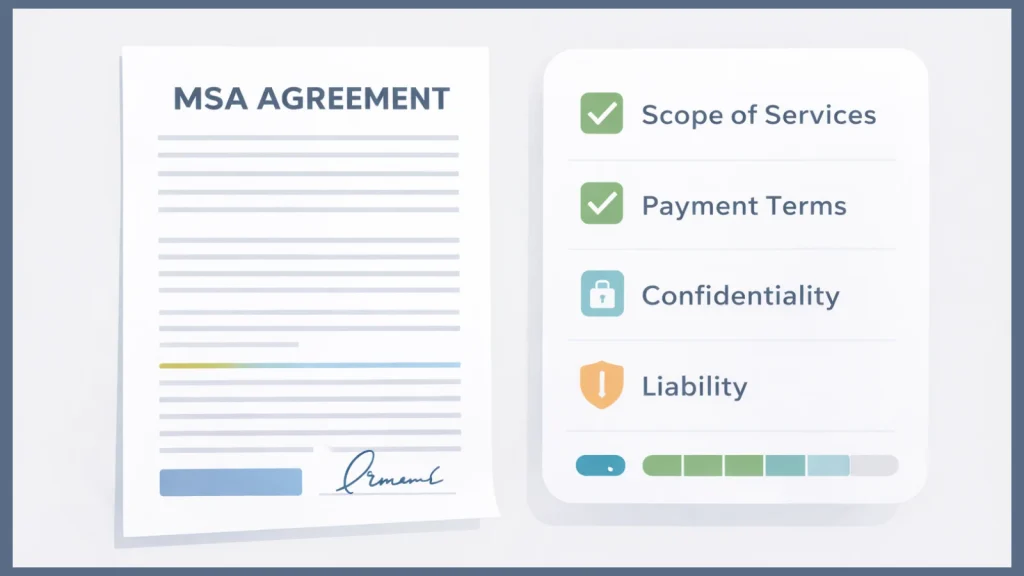
The effectiveness of a master service agreement depends on how well its clauses are written. Certain sections play a critical role in avoiding confusion and managing risk.
- Scope of services
This section defines the type of work covered under the master service agreement. It should be clear enough to avoid misunderstandings while still allowing flexibility for different projects. - Payment terms
Payment terms explain how and when invoices are issued, what payment methods are accepted, and how delays are handled. This ensures financial expectations are aligned from the start. - Confidentiality
A master service agreement should clearly define what information is considered confidential and how it must be protected. This is essential for safeguarding sensitive business data. - Liability and indemnification
These clauses determine who is responsible if something goes wrong. They also set limits on financial exposure, which makes them one of the most negotiated parts of the agreement. - Termination
This section explains how either party can end the master service agreement and what happens to ongoing work, payments, and data after termination. - Dispute resolution
Instead of going straight to court, many agreements include structured processes like mediation or arbitration. This helps resolve conflicts more efficiently. - Governing law
The governing law clause determines which legal system will apply in case of a dispute. This becomes especially important when parties operate in different regions.
How a Master Service Agreement Works

Once signed, a master service agreement becomes the framework for all future work between the parties. Each project is then defined through a statement of work that references the agreement.
This setup creates consistency across all engagements. Teams don’t need to revisit legal terms every time a new project begins, which speeds up execution and reduces confusion.
A master service agreement usually remains active until it is terminated or reaches its agreed-upon duration. During that time, multiple projects can be completed under the same structure.
Over time, this approach builds efficiency. The initial setup may take effort, but every project that follows becomes significantly easier to manage.
Benefits of Using a Master Service Agreement
A master service agreement improves both legal clarity and operational efficiency. Its value becomes more noticeable as the relationship grows.
- Faster execution of projects
Once the master service agreement is in place, new work can begin without renegotiating standard terms. This saves time and helps teams respond quickly to new opportunities. - Consistent risk management
The same legal framework applies across all projects. A master service agreement ensures that liability, confidentiality, and compliance expectations remain clear and consistent. - Stronger working relationships
Clear agreements reduce misunderstandings. When both parties know what to expect, collaboration becomes smoother and more productive. - Scalability and structure
For businesses handling multiple engagements, a master service agreement creates a repeatable system. This makes it easier to scale operations without adding unnecessary complexity.
Risks of Not Having a Master Service Agreement
Not having a master service agreement doesn’t remove risk it simply leaves it undefined.
Without clear terms, disputes over deliverables, payments, or ownership can escalate quickly. Businesses often end up relying on emails or informal discussions, which rarely provide strong legal support.
The lack of a master service agreement also increases financial exposure. Without defined liability limits or confidentiality protections, both parties may face risks they didn’t anticipate.
In many cases, the importance of a master service agreement only becomes clear when something goes wrong, and by then, resolving the issue is far more difficult.
Master Service Agreement Template
A master service agreement template offers a structured starting point for creating a contract. It typically includes sections covering the parties involved, scope of services, payment terms, confidentiality, intellectual property, liability, and dispute resolution.
It also defines how statements of work are created and how the agreement can be terminated. These elements form the core structure of most agreements.
However, a template should never be used as-is. Every master service agreement needs to be tailored to reflect the specific details of the relationship, industry, and legal requirements.
How to Generate a Master Service Agreement with AI
AI tools have made it much easier to draft a master service agreement quickly. Instead of starting from scratch, businesses can generate structured drafts based on their specific needs. Now, there are even specialized AI legal assistants that can draft comprehensive agreements, suggest standard clauses, identify potential risks, and ensure the document aligns with current legal standards; significantly reducing both time and effort while improving accuracy.
To generate an MSA with AI, the process usually follows a few clear steps:
- Define the relationship
Start by identifying the type of relationship, such as vendor-client or agency-client. This helps shape the structure of the master service agreement. - Specify service details
Clearly describe the type of services involved, whether it’s development, consulting, marketing, or staffing. - Input preferred terms
Include key preferences like payment cycles, liability limits, confidentiality duration, and governing jurisdiction. - Review and refine the draft.
Once the AI generates the master service agreement, review it carefully to ensure it matches your business needs.
Even when using AI review for MSA or drafting tools, the output should be treated as a starting point. Legal review remains an important final step.
AI Review for MSA: How It Works
AI can also be used to review an existing master service agreement and identify potential risks.
An AI review for MSA typically works through a structured analysis:
- Scanning for potential risks
The system reviews the entire master service agreement and flags clauses that may create legal or financial exposure. - Highlighting imbalanced terms
It identifies provisions that may favor one party too heavily, helping users spot areas that need negotiation. - Simplifying complex language
Legal wording is broken down into simpler explanations, making the master service agreement easier to understand. - Suggesting improvements
Some tools recommend alternative wording to strengthen weak or unclear clauses.
This approach saves time and improves visibility into potential issues. However, final decisions still require human judgment and, in many cases, legal expertise.
How to Review a Master Service Agreement Before Signing
Before signing, it’s important to review a master service agreement carefully and with the right perspective.
- Check the scope of services.
Make sure the scope is clearly defined and not open to interpretation. Conflicts later on may result from vague terminology. - Verify payment terms
Confirm that billing schedules and payment conditions match what was agreed upon. - Review intellectual property ownership.
Ensure the master service agreement clearly defines who owns the work created during the engagement. - Evaluate liability limits
Check whether the liability caps are reasonable and aligned with the level of risk involved. - Understand termination terms
Both parties should know how to exit the agreement and what happens to ongoing work and obligations.
This kind of structured review helps turn a complex document into something practical and understandable.
Common Mistakes in Master Service Agreements
Even well-intentioned agreements can include avoidable issues. These are some of the most common mistakes found in a master service agreement:
- Using generic templates without customization
Templates often miss important details specific to the business relationship, which can create gaps in the agreement. - Keeping the scope too vague
Unclear service definitions lead to confusion and repeated disagreements during execution. - Overlooking intellectual property terms
Failing to define ownership clearly can result in costly disputes later. - Ignoring liability limits
Without proper caps, one party may face excessive financial risk. - Neglecting governing law considerations
The choice of jurisdiction can significantly impact dispute resolution but is often overlooked. - Failing to update the agreement over time
A master service agreement should evolve with the business relationship to remain relevant.
Struggling to Understand Your MSA? Here’s a Smarter Approach
Reviewing a master service agreement is one thing. Fully understanding what you’ve agreed to, especially around liability, termination, or IP ownership, is where most people struggle.
This is where LawyerBuddy simplifies the process.
It’s an AI-powered legal assistant built for users, designed to explain contracts in plain language. Instead of guessing what a clause means, you can simply upload your master service agreement or ask specific questions and get clear, practical answers.
Meet LawyerBuddy: Your AI Assistant for Smarter Contract Review
- Get clear answers to legal questions in simple, easy-to-understand language without dealing with complex jargon.
- Ask contract-related questions and understand what each clause in your master service agreement actually means in real terms.
- Upload contracts, notices, or other legal documents to receive focused insights on unclear or potentially risky sections.
- Continue the same case with follow-up questions, allowing you to explore specific clauses without losing context.
- Handle a wide range of issues, including notices, challans, tax concerns, rental disputes, consumer complaints, and employment matters.
- Start for free every day, making it accessible for quick legal guidance whenever needed.
Also, LawyerBuddy supports multiple Indian languages, so you can understand legal concepts without relying entirely on English—making legal help more accessible than ever. Start exploring your documents with confidence and get the clarity you need when you need it.
Conclusion
A master service agreement is a practical tool for managing long-term business relationships. It reduces repeated negotiations, creates clarity, and helps both parties operate with confidence.
Taking the time to structure a strong master service agreement pays off over time. It makes projects easier to manage and reduces the risk of disputes.
Whether you start with a master service agreement template, choose to generate msa with AI, or rely on AI review for an MSA, the goal is the same. Build an agreement that is clear, balanced, and aligned with how the relationship will actually work.
Frequently Asked Questions
What is a master service agreement?
If you’re asking what a master service agreement is, it is a contract that defines the core terms of an ongoing business relationship. Whether you start with a master service agreement template, choose to generate an MSA with AI, or rely on AI review for MSA, the goal is the same. the parties.
What is included in an MSA?
A master service agreement typically includes scope, payment terms, confidentiality, intellectual property, liability, and dispute resolution clauses.
Can AI create a legal MSA?
AI can generate a draft master service agreement, but it should always be reviewed by a legal professional before use.
How do I review an MSA?
Understanding what a master service agreement is makes it easier to review one. Focus on scope, payment terms, liability, and ownership.