


Legal work has always been expensive, slow, and inaccessible to most people who need it. A standard contract review can cost hundreds of dollars an hour. A routine compliance audit takes weeks. Legal research that a firm bills at senior associate rates can involve hours of sifting through case law that a well-trained model can process in seconds.
The question facing every law firm, in-house legal team, and business owner in 2026 is not whether artificial intelligence will change legal services; it already has, but how to use it responsibly.
This guide explains what an artificial intelligence lawyer is, how the technology works, where it genuinely outperforms traditional approaches, and where human lawyers remain essential. It also covers the risks that any honest assessment of AI in legal contexts must address.
What Is an Artificial Intelligence Lawyer?
An artificial intelligence lawyer is not a licensed legal professional; it is a software system trained on large volumes of legal text that can perform legal tasks: reviewing contracts, conducting case research, drafting documents, identifying compliance risks, and predicting litigation outcomes with a degree of accuracy that makes it genuinely useful in professional legal contexts.
The term covers a spectrum. At one end are narrow legal tools, contract review software that flags non-standard clauses, legal research platforms that surface relevant precedents, and compliance checkers that scan documents against regulatory requirements. At the other end are general-purpose AI models like Harvey AI, built specifically for legal reasoning and capable of handling complex, multi-step legal analysis across practice areas.
The distinction from traditional legal software is significant. Earlier legal technologies, such as document management systems, billing tools, and e-discovery platforms- focused on automating the administrative and logistical aspects of legal work. In contrast, the best lawyer artificial intelligence tools 2026 go a step further by attempting to replicate legal reasoning itself.
They can read and interpret contracts to understand the meaning and implications of clauses, not just locate them, and identify relevant case law based on legal context and arguments rather than simple keyword matching.
How Artificial Intelligence Lawyers Work in 2026
The technical foundation of modern AI legal tools is large language models trained on legal corpora, case law databases, statutes, regulatory filings, contract libraries, and legal textbooks. These models develop a statistical understanding of legal language, structure, and reasoning patterns that allows them to process new legal documents in context.
Natural language processing allows the system to understand plain-language queries and translate them into legal research tasks. A lawyer can ask, “Find cases where a force majeure clause was successfully invoked in a commercial lease dispute” and receive a curated, summarized set of relevant precedents in seconds rather than hours. The same underlying capability drives contract analysis. The model reads a document, identifies its structure, and flags clauses that deviate from standard market practice or create unusual risk.
Automation extends across several workflow categories. Contract review and redlining, AI legal research and memo drafting, compliance gap analysis, due diligence document review, and litigation outcome prediction are all areas where AI tools have achieved production-grade reliability for specific, well-defined tasks. The key qualifier is specificity: AI performs best on defined tasks with clear inputs and outputs, and degrades significantly on open-ended judgment calls that require contextual understanding of relationships, strategy, and intent.
Artificial Intelligence Lawyer vs Human Lawyer: Key Differences
The comparison between AI legal tools and human lawyers is best understood as a division of labor rather than a competition. The table below maps the dimensions where each performs better:
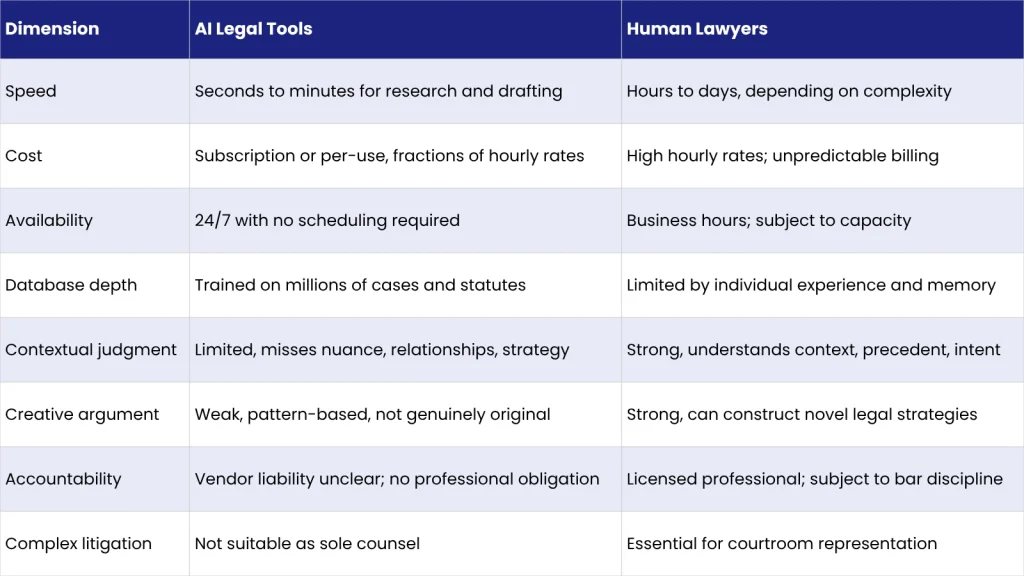
The pattern that emerges from this comparison is consistent: AI outperforms human lawyers on speed, scale, and cost for well-defined, repeatable tasks. Human lawyers outperform AI on judgment, strategy, creativity, accountability, and anything requiring understanding of context beyond the document itself. The strongest legal operations in 2026 use both, AI handling the high-volume, rule-based work; human lawyers focusing on the judgment-intensive decisions that actually determine outcomes.
Key Use Cases of Artificial Intelligence Lawyers
Contract Review and Drafting
Contract review is the most mature and most widely deployed use case for AI in legal contexts. Tools like Luminance, ContractPodAi, and Spellbook can review a standard commercial contract in minutes, flagging non-standard clauses, missing provisions, and unusual risk allocations that a human reviewer might miss after hours of document fatigue. For high-volume contract environments, procurement teams reviewing hundreds of vendor agreements, real estate teams processing lease portfolios, AI review has reduced review time by 50 to 80 percent in documented enterprise deployments.
Contract drafting has also matured. AI tools trained on market-standard clause libraries can generate first drafts of NDAs, MSAs, employment agreements, and licensing deals that serve as working starting points rather than blank pages. The drafts require human review and customization, but the elimination of the blank-page problem alone produces meaningful time savings.
Legal Research and Case Analysis
Legal research is one of the highest-leverage applications of AI in law. What previously required a junior associate spending eight to twelve hours searching databases, reading cases, and synthesising findings can now produce a preliminary memo in a fraction of the time using tools like Lexis+ AI or Harvey AI. The AI reads the relevant cases, identifies the holdings and their factual context, and presents a structured analysis with citations.
The important caveat is hallucination risk. AI models occasionally cite cases that do not exist or misrepresent holdings, a problem that has already produced documented court sanctions against lawyers who submitted AI-generated briefs without verification. Every AI research output requires human verification before it appears in any filing or client deliverable.
Litigation Support and Outcome Prediction
AI litigation support tools analyze case facts against historical case outcomes to generate probability estimates for specific claims. These tools are genuinely useful for early case assessment, helping AI lawyers and clients make informed decisions about settlement versus litigation based on statistical patterns rather than pure intuition. They should be treated as one input among many rather than a determinative forecast.
Document review in discovery is another high-impact litigation application. AI-assisted review can process millions of documents to identify relevant materials, dramatically reducing the cost and time of e-discovery in complex litigation matters.
Compliance and Risk Management
Compliance monitoring is a natural fit for AI: it involves applying known rules to large volumes of documents or transactions and flagging exceptions. AI compliance tools can monitor contracts against regulatory requirements, scan communications for policy violations, and generate compliance reports across large datasets that would take human teams weeks to process. For businesses operating across multiple jurisdictions with different regulatory requirements, AI compliance tools provide coverage that human teams cannot cost-effectively maintain.
Best Artificial Intelligence Lawyer Tools in 2026
One good example of how an artificial intelligence lawyer works in real life is LawyerBuddy.
It’s designed to streamline legal work, making it quicker and easier without requiring in-depth legal expertise.
Instead of going through long documents or searching for answers manually, tools like LawyerBuddy help you:
- Understand legal questions quickly
- Generate or review legal content
- Get structured guidance without legal jargon
Think of it like having a digital legal assistant that helps you move quickly.
This is especially useful for:
- Startups that don’t have an in-house legal team
- Founders who need quick legal clarity
- Businesses handling contracts regularly
The biggest advantage is speed + simplicity.
You don’t have to wait days for basic legal insights. You can get direction instantly and then decide if you need a human lawyer for deeper work.
Risks, Limitations, and Safe Use of Artificial Intelligence Lawyers
Any honest assessment of AI in legal contexts must give the risks equal weight to the benefits. The consequences of errors in legal contexts, missed deadlines, incorrect advice, flawed contracts, and court sanctions are significantly more serious than errors in most other professional domains.
Hallucination and Accuracy Risks
AI language models generate plausible-sounding output that is not always accurate. In legal contexts, this manifests as fabricated case citations, misrepresented holdings, incorrect statutory references, and subtle errors in clause interpretation that a non-expert reader would not detect. Multiple courts have issued sanctions against lawyers who submitted AI-generated briefs containing fictitious citations. The mitigation is non-negotiable: every AI legal output that will be used in a professional context requires verification by a qualified human reviewer before use.
Data Privacy and Confidentiality Concerns
Uploading client documents to an AI tool raises serious confidentiality questions. Many AI platforms use uploaded data to improve their models unless specifically configured otherwise. Lawyers have professional obligations regarding client data that may conflict with standard AI tool data practices. Before deploying any AI legal tool with client data, verify the vendor’s data handling policies, ensure contractual confidentiality protections are in place, and check that the tool’s data practices comply with applicable bar association rules in your jurisdiction.
Legal Liability and Accountability Gaps
When an AI tool produces an error that causes client harm, the legal liability framework is unclear in most jurisdictions. The AI vendor typically disclaims liability through terms of service. The lawyer who relied on the AI output retains professional responsibility for the advice given, regardless of how the research or drafting was produced. This means the professional risk of AI errors falls on the human lawyer, not the tool vendor, which is the strongest possible argument for maintaining meaningful human oversight of all AI-generated legal work.
When Human Oversight Is Non-Negotiable
AI legal tools should not be used as the sole source of advice in any situation with significant consequences. Court filings require human verification of all citations and legal arguments. Contracts in high-value transactions require human review of AI-suggested positions. Legal advice to individuals on matters affecting their rights, liberty, or financial security requires a licensed professional who can be held accountable. AI tools are most safely deployed as the first pass in a human-reviewed workflow, not as the final word.
Benefits Of Artificial Intelligence Lawyers For Businesses And Startups
For businesses, particularly startups and mid-market companies that cannot afford large in-house legal teams or regular outside counsel engagement, AI legal tools provide access to legal capability that was previously cost-prohibitive.
- Dramatically reduced legal costs, routine contract review, NDA generation, and compliance checks that previously required expensive outside counsel engagement can be handled at a fraction of the cost using AI tools
- Faster contract cycles, deals that previously took days of back-and-forth for contract review can move in hours, which is a meaningful competitive advantage in fast-moving commercial negotiations
- Scalability, a startup’s legal needs grow non-linearly as it scales; AI tools allow legal coverage to scale with the business without proportional headcount growth
- Accessibility, founders, and business owners can use AI tools to develop an initial legal understanding of their situation before engaging counsel, making lawyer conversations more productive and less billable
- Continuous compliance monitoring, AI tools can monitor contracts, communications, and processes continuously for compliance issues, rather than catching them in periodic manual audits
The realistic framing for startups: AI legal tools reduce the cost and time of routine legal work significantly, but they do not eliminate the need for qualified legal counsel on consequential decisions. The appropriate use is to handle high-volume, low-complexity legal tasks with AI while reserving human lawyer time for strategic decisions, complex negotiations, and any matter where the stakes justify the cost.
The Future Of Artificial Intelligence Lawyers Beyond 2026
The trajectory of AI in legal services points toward deeper integration rather than wholesale replacement. Law firms that have adopted AI tools report that the productivity gains are primarily being used to handle more matters rather than to reduce headcount, which reflects both the genuine demand for legal services and the fact that human judgment remains essential for the work that matters most.
The areas of most rapid development are multimodal AI that can process documents, images, and audio simultaneously, which is relevant for evidence analysis in litigation, and agentic AI systems that can conduct multi-step legal research workflows autonomously. These capabilities will expand what AI can handle reliably, but the accountability gap between AI tools and licensed professionals will remain until regulatory frameworks develop that govern AI legal practice directly.
The most durable shift may be in legal business models. Firms that have historically billed by the hour for work that AI can now do in minutes face structural pressure to justify their pricing. The transition toward value-based billing, charging for outcomes and judgment rather than time, is accelerating in response. The firms that will thrive are those that use AI to handle the commodity legal work efficiently while demonstrating human value in the strategic, relationship-intensive, and judgment-dependent work that clients genuinely need lawyers for.
Frequently Asked Questions About Artificial Intelligence Lawyers
Can an artificial intelligence lawyer replace a human lawyer?
Not entirely, and not for consequential legal matters. AI legal tools can replace human effort on specific, well-defined tasks, such as contract review, legal research, and compliance checking, with meaningful accuracy. They cannot replace human judgment, strategic thinking, courtroom advocacy, or the professional accountability that comes with a licensed legal professional. The practical reality in 2026 is that the strongest legal operations use AI and human lawyers together, not as alternatives.
What can an artificial intelligence lawyer legally do?
AI legal tools can assist with legal tasks, but cannot practice law independently. They can draft documents, conduct research, review contracts, and flag compliance issues, but all output requires human review before use in professional contexts. In most jurisdictions, providing legal advice to a client requires a licensed attorney; using AI to assist in that advice is permitted, but the attorney retains full professional responsibility for the output.
How accurate is an artificial intelligence lawyer?
Accuracy varies significantly by task type and tool. For well-defined tasks like clause identification in standard commercial contracts, top tools achieve accuracy rates of 85 to 95 percent in controlled testing. For open-ended legal reasoning and research, accuracy is lower, and the risk of hallucination, fabricated citations, or misrepresented holdings is real. All AI legal output should be treated as a first draft requiring human verification, particularly for anything that will be filed in court or delivered to a client as legal advice.
Is using an artificial intelligence lawyer expensive?
Most AI legal tools are significantly less expensive than traditional legal services on a per-task basis. Consumer-facing tools like DoNotPay operate on monthly subscriptions of $10 to $40. Professional tools for law firms and in-house teams typically run from a few hundred dollars per user per month to enterprise contracts in the tens of thousands annually. Compared to outside counsel billing rates of $300 to $1,000 per hour for equivalent tasks, the cost comparison favours AI tools substantially for high-volume, routine work.