


Most disputes don’t start with dishonesty; they start with different interpretations of the same conversation.
One party assumes revisions are included; the other doesn’t. One expects profit payouts; the other expects reinvestment. No one is lying; they just never wrote it down.
That gap between assumption and documentation is where avoidable conflicts begin. And when things go wrong, the question shifts from “what did we agree?” to “what can we prove?”
A written agreement document closes that gap early, capturing expectations, responsibilities, and consequences before misunderstandings turn into disputes.
What Is an Agreement Document?

An agreement document is a written record of the terms two or more parties have accepted, capturing what each side has committed to, what they expect in return, and how the arrangement will function over time.
It typically outlines rights, responsibilities, payment or performance expectations, timelines, and what happens if circumstances change or obligations aren’t met. Some contractual agreements meet the legal requirements to function as enforceable contracts. Others serve primarily as reference records or statements of intent. The legal weight of any given agreement depends on how it’s drafted, signed, and whether it satisfies the requirements of the relevant jurisdiction.
Agreement Document vs. Contract: The Difference Most People Get Wrong
These two terms are used interchangeably in everyday conversation, and that habit causes real confusion when it actually matters.
Here’s the practical distinction: an agreement is any mutual understanding between parties, written or otherwise. A contract is a specific type of agreement that meets defined legal requirements and is enforceable by law. Every contract is an agreement, but not every agreement is a contract.
In practice, many written contractual agreements function as contracts, but only if they include the right elements. Casual written arrangements, emails summarizing a discussion, or unsigned drafts may document an agreement without having the legal standing of a formal contract.
| Agreement Document | Contract | |
| Purpose | Records mutual understanding | Creates legally binding obligations |
| Formality | Varies widely | Generally more structured |
| Enforceability | Depends on content and execution | Enforceable if legal requirements are met |
| Examples | MOU, letter of understanding, informal written terms | Service contract, employment agreement, lease |
Why does this matter? Because someone who assumes their written agreement is automatically enforceable may find out too late that it isn’t.
Can an Agreement Document Be Legally Binding?
It can be, but it isn’t automatic. Enforceability generally depends on several factors: whether the parties clearly understood and accepted the terms, whether something of value was exchanged (consideration), whether the purpose of the agreement is lawful, and whether the document was properly signed and executed.
Mutual intent isn’t always enough. Two people can genuinely agree on something and still produce a document that wouldn’t hold up in court because of vague language, missing terms, or improper execution. Readers should resist the assumption that putting something in writing automatically makes it enforceable; the details of how it’s drafted matter considerably.
What Makes an Agreement Document Important in Real Life?
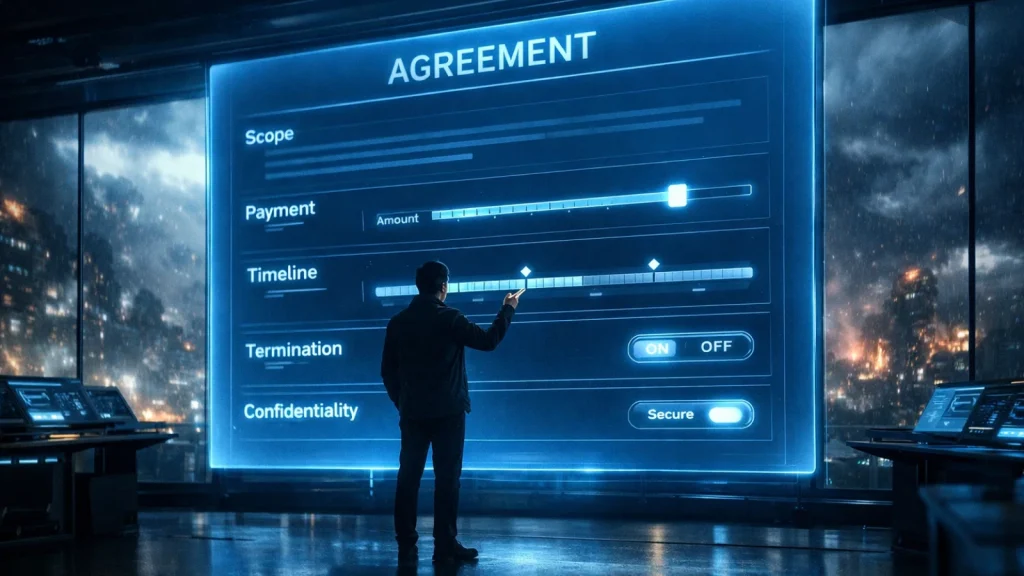
An agreement document is fundamentally a risk management tool. Its value often becomes apparent only after a dispute arises, but when used effectively, it prevents misunderstandings from escalating by clearly defining expectations at the outset.
When responsibilities are explicitly documented, each party understands their obligations. Clearly defined payment terms eliminate ambiguity around amounts and timelines. Documented deadlines make it easier to identify and address delays. This clarity does not reflect distrust; it reflects prudent planning and structured communication.
Contractual agreements also carry significant evidentiary value. In the event of a dispute, a well-drafted document provides a reliable reference point for all parties involved. It outlines the agreed terms, the scope of commitments, and the expectations established at the time, offering far greater clarity than retrospective interpretations of verbal discussions.
Why Lawyers Rely on Clear Documentation
From a legal perspective, contractual agreements serve as formal evidence of intent. In proceedings before mediators, arbitrators, or courts, the written record is often the most authoritative source for determining what the parties agreed upon.
Clear documentation minimizes interpretive ambiguity and enables legal professionals to assess, advise, and advocate with precision. Conversely, poorly drafted or vague agreements introduce uncertainty, complicate dispute resolution, and often increase the time and cost required to reach an outcome.
The Essential Clauses Every Agreement Document Should Cover
A strong legal agreement contract isn’t long; it’s complete. The goal isn’t to cover every hypothetical scenario but to address the elements most likely to cause friction if left undefined.
These are the core components most agreements should include:
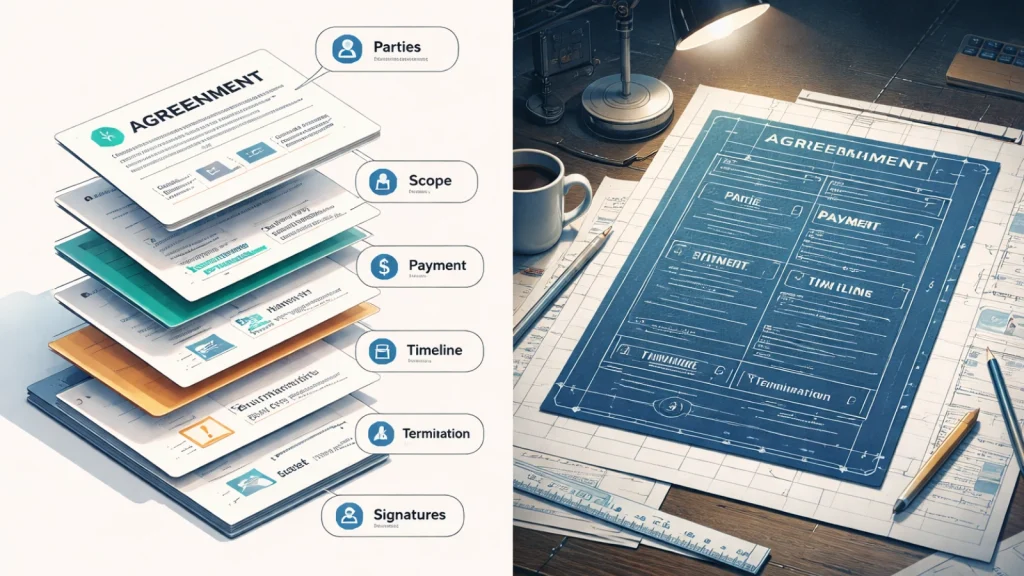
- Parties: Full legal names and relevant identifying details for everyone involved
- Purpose and scope: A clear description of what the agreement is for and what it covers
- Roles and obligations: What each party is specifically responsible for doing
- Payment or consideration: Amounts, schedules, methods, and conditions for payment
- Timelines and duration: Start dates, deadlines, renewal terms, or end dates
- Confidentiality: If either party will have access to sensitive information, how will it be protected
- Termination: The conditions under which either party can end the arrangement, and what happens when they do
- Dispute resolution: How disagreements will be handled, negotiation, mediation, arbitration, or litigation, and which jurisdiction’s law applies
- Signatures and execution: Who signs, in what capacity, and when
Missing even one of these elements doesn’t necessarily invalidate an agreement, but it does create a gap that someone may try to fill to their advantage later.
The 5 Clauses That Cause the Most Trouble When They’re Vague
Some clauses cause disproportionate problems when they’re poorly written. These five come up most often:
- Scope of work: If it isn’t specific, every additional request becomes a negotiation
- Payment terms: “Upon completion” means different things to different people.
- Deadlines: A date without consequences for missing it is just a suggestion
- Termination rights: Unclear exit terms trap parties in arrangements they need to leave
- Liability and dispute language: Vague wording here can dramatically shift exposure without either party realizing it
Common Types of Agreement Documents You’ll See in Legal and Business Matters
Agreement documents appear across nearly every kind of professional relationship. The format and formality shift depending on the context, but the underlying purpose is consistent: document what was agreed, before it becomes disputed.
Common types include:
- Service agreements — for professional or freelance work arrangements
- Partnership agreements — for business relationships involving shared ownership or decision-making
- Employment and consultant agreements — for ongoing or project-based professional engagements
- Lease and rental agreements — for property use and associated terms
- Non-disclosure agreements (NDAs) — for protecting confidential information shared between parties
- Settlement or negotiated arrangements — for resolving disputes with documented terms
Which Type of Agreement Document Fits Which Situation?
The right document depends on the nature of the relationship and what you’re trying to protect. A few quick reference points:
- Hiring someone for a project? → Service or consulting agreement
- Sharing proprietary or sensitive information? → NDA
- Forming a business with a partner? → Partnership or joint venture agreement
- Engaging professional or legal services? → Professional services agreement with clear scope and fee terms
- Documenting a resolved dispute? → Settlement agreement with specific conditions
If the relationship is complex or the stakes are significant, combining documents and an NDA alongside a service agreement, for example, is common and often advisable.
How to Draft an Agreement Document That Is Clear, Useful, and Easier to Enforce
Drafting a solid agreement doesn’t require legal expertise for every situation, but it does require a structured approach. A useful framework to follow:
- Identify the parties — Use full legal names. Avoid nicknames, abbreviations, or informal references.
- Define the purpose — State clearly what the agreement is for and what it covers. A sentence or two of scope can prevent significant disputes later.
- List specific obligations — Don’t write “Party A will provide services.” Write what services, by when, to what standard, and under what conditions.
- Add timelines and payment details — Exact dates. Specific amounts. Defined triggers for payment. Nothing approximate.
- Plan for changes, delays, or exits — What happens if a party needs to modify the arrangement? What’s the process for termination? What notice is required?
- Review for ambiguity — Read the document as if you were the opposing party looking for wiggle room. If you find any, close it.
- Sign and store properly — Execution matters. Both parties should sign. Signed copies should be retained by all parties in a format that can be retrieved later.
A Simple Review Checklist Before Anyone Signs
Before finalizing any agreement document, run through this:
- Are all obligations described specifically, not generally?
- Are dates, amounts, and deliverables exact?
- Is there a clause explaining what happens if someone breaches the agreement?
- Is the termination process clearly defined?
- Is the language clear enough that both parties would interpret it the same way?
- For high-stakes situations, has a legal professional reviewed the document?
If any of these answers is “not really,” the document needs another pass before anyone puts a signature on it.
How LawyerBuddy Makes Agreement Documents Easier to Handle
For many people, the difficulty is not understanding the importance of agreement documents; it is knowing how to interpret, review, and act on them correctly. This is where errors, confusion, and missed risks often arise.
LawyerBuddy simplifies this process by helping users understand legal documents and take informed next steps without unnecessary complexity.
Here’s how it helps in practice:
- Ask legal questions in plain language and get clear, practical guidance on agreement terms and obligations.
- Upload and review documents such as contracts, notices, rental agreements, or tax-related papers to understand key clauses and risks.
- Get structured follow-ups within the same case to clarify doubts or explore next actions.
- Receive guidance in multiple Indian languages, making legal understanding more accessible.
- Identify potential issues early, such as unclear terms, missing clauses, or obligations that may create disputes later.
The result is greater clarity, better decision-making, and a lower risk of misunderstandings when dealing with agreement documents and related legal matters.
Also Read
Which AI-Powered Lawyer Tools Are Worth Using Right Now?
How To Choose A Lawyer For Small Business And Avoid Risks?
Common Mistakes That Make Agreement Documents Weak
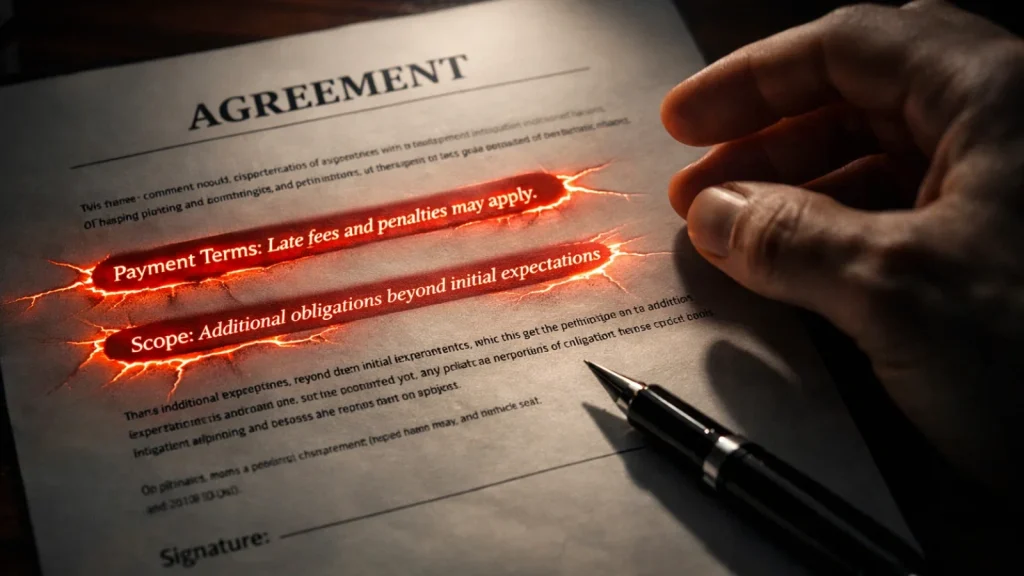
Even well-intentioned agreements can fail because of how they’re written. The mistakes below are common, and each one creates real exposure.
Using vague language. Phrases like “as discussed,” “reasonable timeframe,” or “standard terms” mean nothing once parties disagree. Every term that matters should be defined in the document itself.
Copy-pasting templates without customizing. Templates are starting points. An agreement pulled from a generic source and used without modification may not reflect the actual relationship, may include irrelevant clauses, or may omit something critical to the specific arrangement.
Leaving out payment, duration, or scope. These three elements are the source of the majority of contract disputes. Their absence doesn’t make the agreement invalid; it just makes it much harder to enforce or rely on.
Confusing an agreement with a contract. Treating a written understanding as legally binding when it doesn’t meet the requirements for enforceability is a mistake that typically surfaces at the worst possible time.
Failing to update the document when terms change. Agreements evolve. When they do, the changes need to be documented ideally through a formal amendment that both parties sign. Verbal modifications to a written agreement are notoriously difficult to prove.
Not preserving signed copies. An agreement that exists but can’t be located or verified is nearly useless in a dispute. Storage and retrieval matter as much as drafting.
Final Thought: A Strong Agreement Document Protects More Than Paper
An agreement document isn’t just administrative paperwork. At its best, it’s a communication tool—one that establishes trust, aligns expectations, and gives both parties a foundation to work from when things get complicated.
The value isn’t only legal. It’s relational. When both sides of an arrangement understand what they’ve committed to, there’s less room for resentment, confusion, or the kind of dispute that damages professional relationships beyond repair.
Review the agreements you’re currently working with. If the language is vague, the scope is undefined, or the termination terms are unclear, those aren’t just drafting issues—they’re risks that exist right now. Fixing them before a problem surfaces is always easier than trying to reconstruct intent after one has already surfaced.
Good documentation isn’t a sign of distrust. It’s a sign that both parties took the arrangement seriously enough to get it right.
FAQ
1. What are the different types of agreement documents?
Common types include:
- Service Level Agreements (SLA): Defines service expectations.
- Non-Disclosure Agreements (NDA): Protects confidential information.
- Employment Contracts: Outlines job terms.
- Sales Agreements: Details transaction terms.
- Partnership Agreements: Defines terms between business partners.
2. Can an agreement document be legally binding without signatures?
Yes, some agreements may be legally binding without signatures, especially if both parties act in a way that shows mutual consent. Electronic signatures are also valid in many cases.
3. How do I ensure my agreement document is enforceable in court?
Ensure clarity, mutual consent, and consideration (value exchange). Use written documents with signatures and ensure compliance with relevant laws.
4. What happens if one party violates the terms of an agreement document?
Violating the terms can result in damages, termination of the agreement, or legal action to enforce the terms.
5. Can a verbal agreement be turned into a written agreement document later?
Yes, a verbal agreement can be written down later. It’s recommended to do so for clarity and to ensure enforceability.