


AI is no longer optional for law firms; it’s the difference between staying competitive and falling behind.
For decades, the legal industry ran on long hours, billable pressure, and mountains of manual work. Associates drafted documents from scratch. Partners spent evenings reviewing contracts. Entire teams sifted through case law, hoping to find the one precedent that mattered. The work was necessary. But so much of it didn’t have to be that hard.
Today, AI for law firms is changing that reality, fast.
Firms that adopt AI are cutting research time from hours to minutes. They are reviewing contracts in a fraction of the time. They are onboarding clients automatically and managing workflows without the administrative chaos. Meanwhile, firms still relying on purely manual processes are watching their margins shrink and their competition grow.
This guide is for any legal professional who wants to understand AI for law firms clearly, without the jargon, without the hype, and with real, actionable insight. Whether you’re a solo practitioner or part of a 200-person firm, by the end of this guide, you will know exactly what AI can do, which tools are worth your time, and how to start using AI in your practice today.
What Is AI for Law Firms?
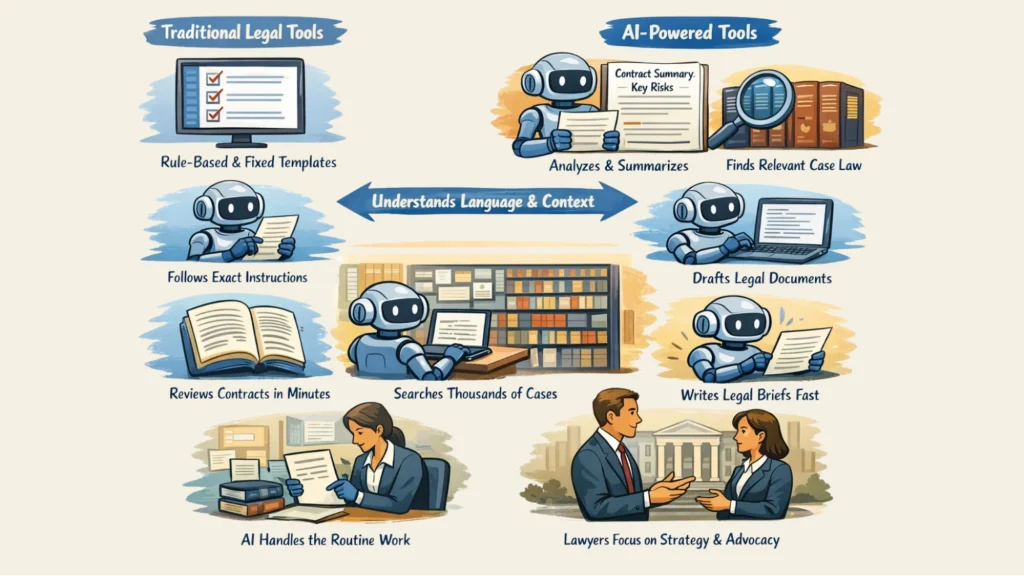
AI for law firms refers to the use of artificial intelligence technology to support, automate, or enhance legal tasks. That might mean using a tool to draft a contract, search through case law, review documents for risk, or manage a client intake process.
Unlike traditional legal software, which follows fixed rules and templates, AI-powered tools can understand context, learn from data, and generate output that adapts to the specific situation.
They can read a 200-page contract and summarize the key risk clauses.
They can search thousands of case files and surface the most relevant precedents.
They can draft a first version of a legal brief in minutes, ready for attorney review.
The difference between traditional tools and AI-powered tools is meaningful:
- Traditional tools are rule-based. They do exactly what they’re told, every time.
- AI tools understand language, context, and intent, and can handle tasks that previously required human judgment.
AI for law firms doesn’t replace lawyers. It handles the repetitive, time-consuming groundwork so lawyers can focus on what they’re actually trained for: strategy, judgment, and advocacy.
Why AI for Law Firms Is No Longer Optional in 2026
The legal industry is under more pressure than ever.
Client expectations are higher. People want faster responses, transparent pricing, and real-time updates on their cases. At the same time, the volume of work, compliance requirements, contract reviews, litigation support, and immigration filings continues to grow.
And your competition?
Many of them are already using AI for law firms.
They are delivering faster turnaround, lower costs, and better capacity. If you are still relying entirely on manual workflows, you are not just working harder; you are working at a structural disadvantage.
Here’s the honest reality:
- Firms using AI are completing document review 60–80% faster than those that aren’t.
- Legal research that used to take a junior associate a full day can now be completed in under an hour.
- Client intake that required back-and-forth emails can now run on autopilot.
The shift from manual to automated workflows isn’t coming; it’s already here. The question isn’t whether to adopt AI for law firms. It’s how quickly you can do it without disrupting your existing practice.
Key Use Cases of AI for Law Firms

AI for Legal Research
Legal research has always been one of the most time-intensive parts of legal work. Searching through case databases, reading through precedents, and cross-referencing statutes are essential, but it’s brutally slow when done manually.
AI for legal research changes the equation entirely. Modern AI tools can search across millions of cases, statutes, and regulations in seconds, returning ranked, relevant results that a human researcher would take hours to compile.
They can also identify patterns across rulings, flag contradictory precedents, and summarize lengthy judgments into clear, usable insights.
For firms handling high volumes of research, litigation boutiques, appellate practices, and compliance-heavy areas, AI for law firms in this space alone can deliver transformative ROI.
AI for Legal Document Drafting
The best AI for legal document drafting doesn’t replace your attorneys; it gives them a running start. Instead of drafting NDAs, contracts, or motions from a blank page, lawyers can generate a well-structured first draft in minutes, then apply their expertise to refine and finalize it.
This dramatically reduces time on lower-complexity documents and frees up attorney hours for higher-value work.
Tools built specifically for legal drafting are trained on legal language, so the output is far more accurate and contextually appropriate than generic AI tools.
For firms that produce high volumes of standardized documents, such as real estate, corporate, and employment, the best AI for legal document drafting is one of the fastest wins available.
AI for Contract Review and Analysis
Contract review is where AI for law firms delivers some of its most immediate, measurable value. AI contract review tools can scan lengthy agreements in seconds, flagging unusual clauses, missing provisions, non-standard language, and potential liability risks.
What previously took a paralegal or junior associate several hours can now be completed in a fraction of the time, with greater consistency. The attorney still makes the final call, but they’re working from an AI-generated analysis rather than reading every paragraph from scratch.
AI for Client Communication and Intake
First impressions matter. AI-powered intake tools allow law firms to respond to prospective clients instantly, gathering information, answering FAQs, scheduling consultations, and qualifying leads, without requiring a staff member to be available at all hours.
For firms that receive high inquiry volumes, AI for law firms in the intake space reduces drop-off, improves client experience, and frees up reception and paralegal time for more substantive work.
AI can also help draft client communications, generate status update emails, and manage follow-up sequences, keeping clients informed without adding to the attorney’s workload.
AI for Case Management and Workflows
AI is increasingly being used to streamline case management, automating deadline tracking, document organization, task assignment, and billing workflows.
Rather than relying on manual updates and human memory to keep a case moving, AI-powered platforms can surface what needs attention, flag upcoming deadlines, and keep the entire team aligned.
For small and mid-sized firms, especially, where administrative bandwidth is limited, AI software for law firms in this category can be the operational backbone that keeps everything running smoothly.
Best AI for Law Firms in 2026 (Tools & Software)
When looking at AI software for law firms, the focus is usually on tools that can handle everyday legal work without adding complexity.
Most firms don’t want to overhaul their entire system. They want something that fits into what they already do and helps them work more efficiently.
LawyerBuddy is one such tool that is specifically for legal professionals. It aims to support common tasks like drafting, research, and workflow management, making it relevant for firms that are starting to explore AI practically.
Key Capabilities
Legal document drafting: Assists in creating drafts for contracts, agreements, and other legal documents, helping reduce repetitive writing work.
Research assistance: Helps in quickly accessing and summarizing legal information, saving time on manual research
Workflow support: Supports day-to-day legal tasks by simplifying routine processes and improving overall efficiency
Ease of use: Designed to be accessible for legal teams without requiring advanced technical knowledge
Consistency in work: Helps maintain a more uniform structure and tone across documents
These capabilities reflect how tools in the best AI for law firms category are focusing on saving time, improving accuracy, and supporting lawyers in their daily work rather than replacing them.
Read More!
How AI for Law Is Changing Legal Work?
Top 7 Benefits of Using an AI Lawyer Free Tool
AI Tools for Immigration Lawyers (2026 Use Case)
Immigration law is one of the most document-heavy practice areas in the profession. Filing USCIS forms, preparing supporting documents, tracking visa timelines, and managing client records across multiple petitions, it’s a volume business that runs on precision.
AI tools for immigration lawyers 2026 are purpose-built to address exactly this workload.
Docketwise and Cerenade are platforms specifically designed for immigration practices. They automate form preparation, flag missing or inconsistent information before filing, and track case deadlines across a client portfolio.
For firms handling dozens or hundreds of active immigration cases, this level of automation is no longer a luxury; it’s a necessity.
Here’s how AI tools for immigration lawyers 2026 make a real difference:
Form preparation: AI pre-fills immigration forms using stored client data, reducing manual entry errors and saving hours per case.
Document checklist management: AI generates and tracks required supporting documents, flagging gaps before they cause delays.
Status tracking and client updates: Automated communication tools keep clients informed without requiring staff to manually respond to every inquiry.
Case processing automation: AI-powered platforms can flag cases approaching filing windows, reducing the risk of missed deadlines that could have serious consequences for clients.
For immigration attorneys handling high volumes of family petitions, employment-based visas, or asylum cases, integrating AI tools for immigration lawyers in 2026 is one of the clearest paths to scaling capacity without proportionally scaling headcount.
Manual Work vs AI for Law Firms: Real Impact
The practical difference between manual legal workflows and AI-assisted ones isn’t theoretical; it’s quantifiable.
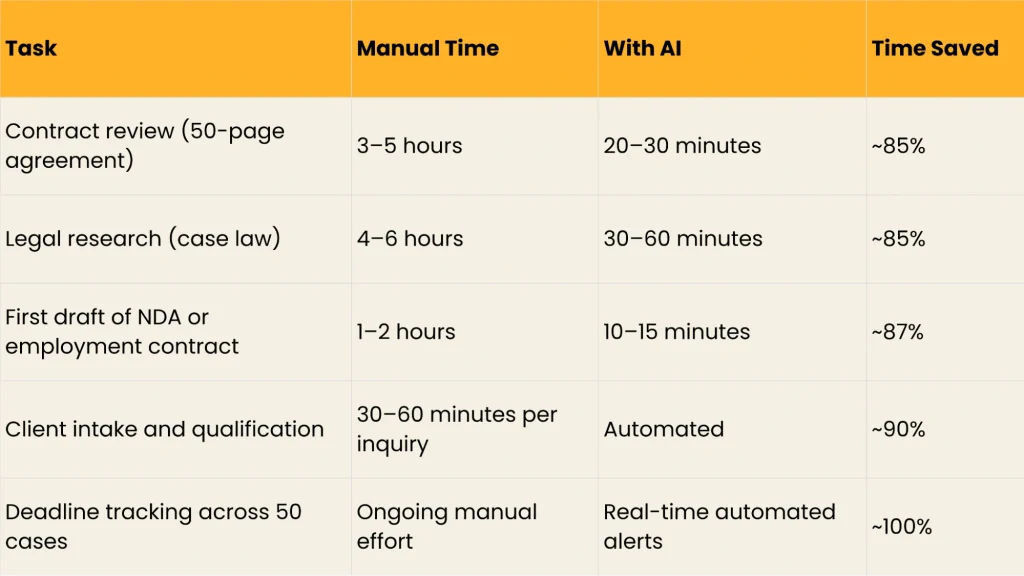
Beyond time savings, the accuracy argument is compelling. AI for law firms in document review, for example, catches inconsistencies and non-standard language with far greater consistency than a fatigued attorney reviewing a stack of agreements at the end of a long day.
The combination of time savings, accuracy improvement, and capacity increase is why the best AI for law firms pays for itself quickly, often within the first few months of adoption.
How to Start Using AI for Law Firms: Step-by-Step

Step 1: Identify Repetitive Tasks
Start by mapping out the tasks in your practice that are high-volume, repetitive, and time-consuming, such as document drafting, research, intake, contract review, and deadline tracking. These are your best starting points for AI adoption. The goal isn’t to automate everything at once; it’s to find where the time cost is highest, and the value of AI is most immediate.
Step 2: Start with One AI Tool
Resist the temptation to implement multiple platforms simultaneously. Choose one area, research, drafting, or intake, and select a tool built specifically for legal workflows in that space. Run it alongside your existing process for 30–60 days to evaluate the time savings and output quality before expanding.
Step 3: Train Your Team
AI for law firms only delivers value if your team actually uses it. Invest time in proper onboarding; most platforms offer training resources, and many have dedicated customer success support. Make it clear that the goal isn’t to replace anyone; it’s to make everyone’s job easier and more productive.
Step 4: Build AI into Daily Workflow
Once a tool is working well, formalize it. Update your standard operating procedures to include AI steps. Assign a team member to stay current on the tool’s new features. Set benchmarks so you can measure the impact over time. AI for law firms works best when it’s a consistent part of how your team operates, not a tool that gets used occasionally.
Common Mistakes Law Firms Make with AI
Over-reliance without review. AI output, whether a contract draft, a research summary, or a client communication, always needs attorney review before it’s used. AI tools are highly capable, but they’re not infallible. The attorney remains responsible for the final product.
Choosing the wrong tools. Generic AI tools (not built for legal workflows) often produce output that requires significant correction. Invest in purpose-built AI software for law firms rather than trying to adapt general-purpose tools to legal tasks.
Ignoring compliance. AI tools process data, and that data often includes confidential client information. Choosing platforms that meet legal industry data security standards and reviewing their terms of service carefully is not optional. This is especially true for firms subject to specific bar association guidelines on technology use.
Not training the team. A tool that nobody uses is a wasted investment. Adoption requires change management, not just a software license.
Is AI Safe for Law Firms? Risks, Ethics, and Compliance
This is one of the most important questions for any firm evaluating AI, and it deserves a straight answer.
Data privacy is the primary concern. When you upload client documents to an AI tool, you need to understand exactly how that data is stored, processed, and protected. Look for tools that offer data processing agreements (DPAs), are compliant with relevant regulations, and explicitly commit to not training their models on your client data.
AI hallucinations are a real risk. AI tools can generate plausible-sounding but factually incorrect information, including fabricated case citations. This has already resulted in sanctions against attorneys who filed AI-generated briefs without proper verification. Every AI output must be reviewed and fact-checked before use.
Legal responsibility always rests with the attorney. AI is a tool; you are still the professional of record. Ethical obligations around competence, confidentiality, and accuracy don’t shift because AI was involved in the work.
Best practices for safe AI adoption:
- Choose vendors with legal-specific data security commitments
- Always verify AI-generated research citations against primary sources
- Establish internal review protocols for all AI-assisted work products
- Stay current on your bar association’s guidance on AI use
AI for law firms is safe when used responsibly and with appropriate oversight. The risk isn’t in the technology, it’s in using it carelessly.
The Future of AI for Law Firms
Let’s be direct about where this is heading.
AI won’t replace lawyers. But lawyers who use AI will replace those who don’t.
The value of an attorney has never been in the hours spent drafting routine documents or running database searches. It’s in judgment, strategy, advocacy, and the ability to navigate complex human situations. AI is taking on the mechanical work so attorneys can do more of what only attorneys can do.
The practical implications over the next three to five years:
Billable hour models will evolve. As AI compresses the time required for routine work, firms will need to rethink how they price and package services. Value-based billing will become increasingly common.
Smaller firms will compete more effectively. AI levels the playing field. A boutique firm with the right AI software for law firms can produce the same quality output and turnaround that previously required a large associate workforce.
Specialization will become more valuable. As AI handles generalist tasks, the premium on deep expertise in niche practice areas, complex litigation, and nuanced regulatory work will increase.
The firms that thrive will be the ones that treat AI as a strategic capability, not just a productivity tool.
Final Thoughts on AI for Law Firms
The legal profession is at an inflection point.
AI for law firms isn’t a trend to monitor from a distance; it’s a shift already underway. The firms adopting AI today are building a structural advantage in capacity, efficiency, and client experience that will be increasingly difficult for slower movers to close.
The good news: getting started doesn’t require a major IT overhaul or a six-figure technology budget. It starts with identifying one time-consuming workflow, selecting a purpose-built legal AI tool, and committing to 30 days of consistent use.
The best AI for law firms isn’t the most expensive or the most complex; it’s the one your team actually uses, consistently, to produce better work faster.
If you’re ready to take the next step, start by exploring the tools covered in this guide, or dive into our dedicated breakdowns of the best AI for legal document drafting, AI tools for immigration lawyers 2026, and the leading AI software for law firms in research and automation.
The future of legal practice is already here. The only question is whether you’ll be part of building it.
Law Firm AI: Quick FAQs
1. Is my client’s data safe with these tools?
It depends on the setup. To keep data private, you must use “Closed” or “Enterprise” AI that guarantees your data won’t be used to train their public models. Always check for a “Zero-Retention” policy.
2. Can I still bill hourly if the AI does the work in minutes?
Ethically, no. You cannot bill for “ghost hours.” Most firms are switching to flat-fee or value-based billing for AI-assisted tasks to maintain profitability without overcharging.
3. Do I have to tell my clients I’m using AI?
Yes. In 2026, it is best practice to include a disclosure clause in your engagement letters stating that you use AI for research and drafting, but that a human attorney performs the final review.
4. What if the AI cites a case that doesn’t exist?
This is called a “hallucination.” You are legally and ethically responsible for every citation. Never file a document without manually verifying every case name and volume number.
5. Does AI replace junior associates?
No, it changes their role. Instead of spending 10 hours drafting from scratch, they spend 1 hour auditing and refining AI output, allowing them to handle a much higher volume of cases.