
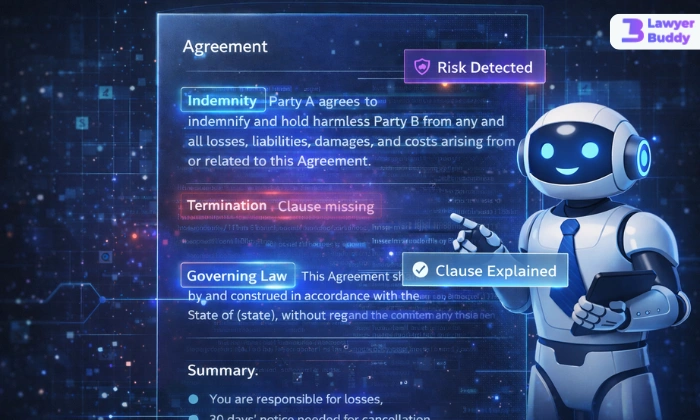
AI lawyer free tools are built for a very specific moment that most professionals eventually face. A contract lands in your inbox, the language is dense, and you are not entirely sure what you just agreed to. Getting an attorney on the phone can cost upward of $300 an hour, and often the question is not complex enough to justify that expense.
These tools step in to handle everyday legal questions that do not require a licensed attorney, while freeing you to focus on higher-stakes decisions. Whether you manage an HR team, run a small business, or review brand deals for a marketing agency, they offer immediate clarity without adding to your costs.
What follows breaks down seven practical benefits, a clear framework for using these tools effectively, the most common misunderstandings, and an honest look at where they reach their limits.
What Is an AI Lawyer Free Tool?
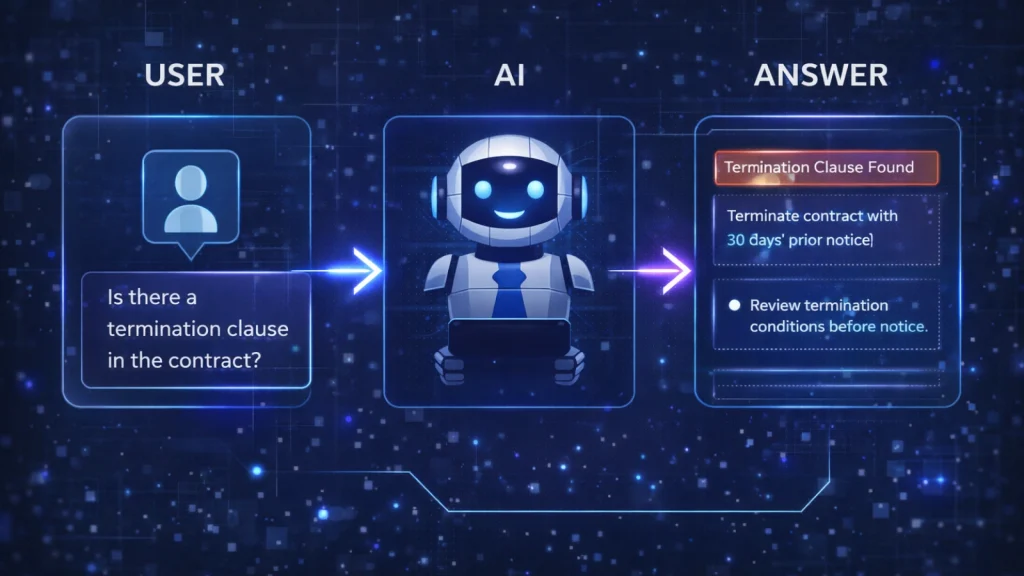
Strip away the buzzwords, and the concept is simple. An AI lawyer tool is a conversational platform trained on legal texts, case law, statutes, and contract databases. You ask a question in ordinary language. It gives you a structured, plain-language answer drawn from how those questions have been addressed in legal practice.
What it does not do is give you a formal legal opinion. What it does give you is legal understanding, which is what most professionals actually need most of the time. Think of it the way you might think of a solid medical reference platform. It will not diagnose you or prescribe treatment, but it will help you understand what you are dealing with, what questions to ask, and whether the situation actually warrants a doctor’s visit.
Quick Answer
“An AI lawyer free tool is a web-based platform trained on legal sources. It answers legal questions, reviews documents, and translates contract language into plain terms without charging by the hour. Built for professionals who need reliable legal clarity on routine matters without engaging a licensed attorney every time.”
Who Actually Uses These Tools
There is a common assumption that AI legal tools are mainly for people who simply cannot afford an attorney. That misses the real picture. According to the Clio Legal Trends Report, U.S. attorneys charge around $313 per hour on average. Most businesses skip legal review not because of cost alone, but because the question is too routine to justify the process.
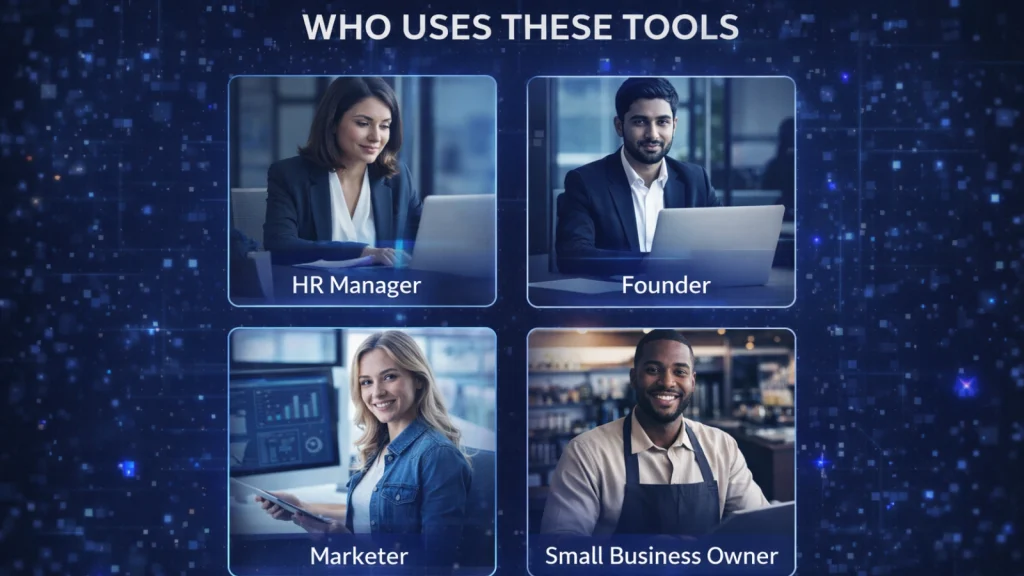
HR teams run employment policy language through these tools before distributing it company-wide. Marketing departments use them to flag non-standard clauses in brand partnership agreements. Founders use them to understand what they are signing before handing the final version to their attorney. In many cases, starting with an AI Lawyer Free tool helps teams get initial clarity before involving legal counsel. The tool does not replace legal counsel. It makes legal counsel faster, cheaper, and more focused when you do need it.
How It Actually Works
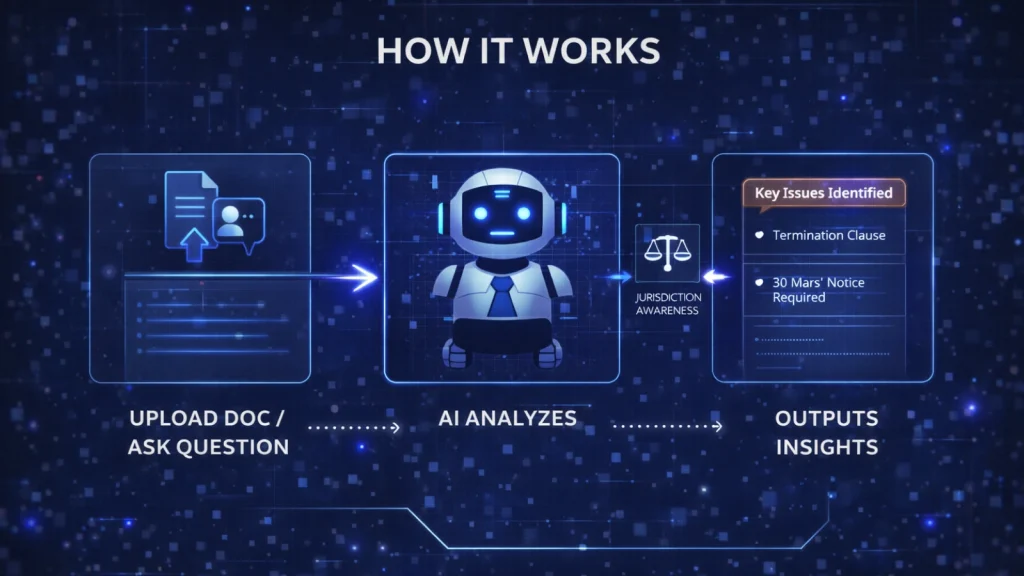
Most platforms run on a large language model that has been fine-tuned specifically on legal content. Submit a question or upload a document, and the model identifies the relevant legal context, cross-references its training on applicable statutes and contract conventions, and returns a structured answer based on that context. This is the underlying process that powers an AI Lawyer Free platform and enables quick, accessible legal insights.
The better tools go further. They accept follow-up questions within the same session, and they flag when a question has a materially different answer depending on where you are located. A non-compete clause that is practically unenforceable in California carries real weight in Texas. Any tool that ignores jurisdiction is giving you an incomplete and potentially misleading answer.
Top 7 Benefits of Using an AI Lawyer Free Tool
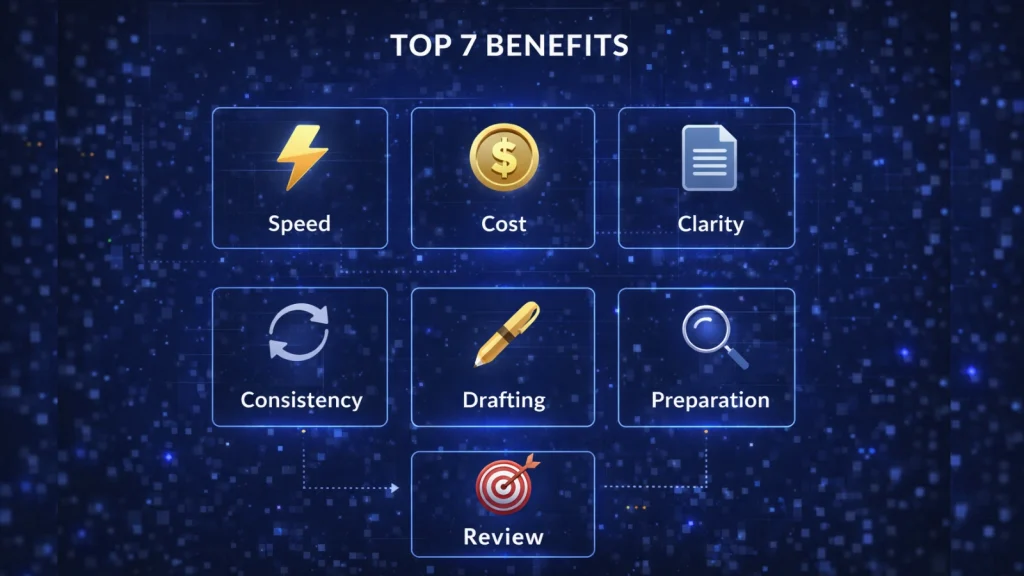
01- Immediate Access to Legal Clarity
Legal questions do not wait for business hours. A vendor sends over a revised contract at 9 pm. An employee raises a termination concern on Friday afternoon, right before a long weekend. In both cases, waiting for a callback is not really an option.
A free AI lawyer online removes that bottleneck. You can ask the question, get a structured breakdown of the relevant clause, and decide your next move, all within a few minutes. For professionals managing time-sensitive decisions, that kind of immediacy is not just convenient. It actually reduces risk. Many teams now rely on an AI Lawyer Free tool for quick, after-hours clarity before escalating issues further.
Distributed teams feel this benefit most sharply. An HR manager in Mumbai handling a UK employment matter at midnight cannot reach a London attorney at that hour. An AI tool gives them a reliable, informed answer they can act on before morning.
02- Significant Cost Reduction for Routine Matters
Not every legal question is worth $300 of attorney time. A lot of them are worth $0, because the answer is well-established, the document is standard, and the task is really just understanding what you already agreed to.
AI lawyer tools handle this tier of legal work well. Checking whether a contractor agreement is missing standard protections, understanding what an indemnification clause obligates you to do, reviewing a basic NDA before sending it – these are repeatable, predictable tasks. Many businesses now turn to an AI lawyer free solution for these routine checks before involving a professional. They do not require professional legal judgment every time.
For small businesses and marketing agencies, that changes the economics entirely. Firms that previously skipped legal review on mid-sized contracts because the fee did not make sense can now build review into their standard process without any additional cost.
03- Document Review in Minutes
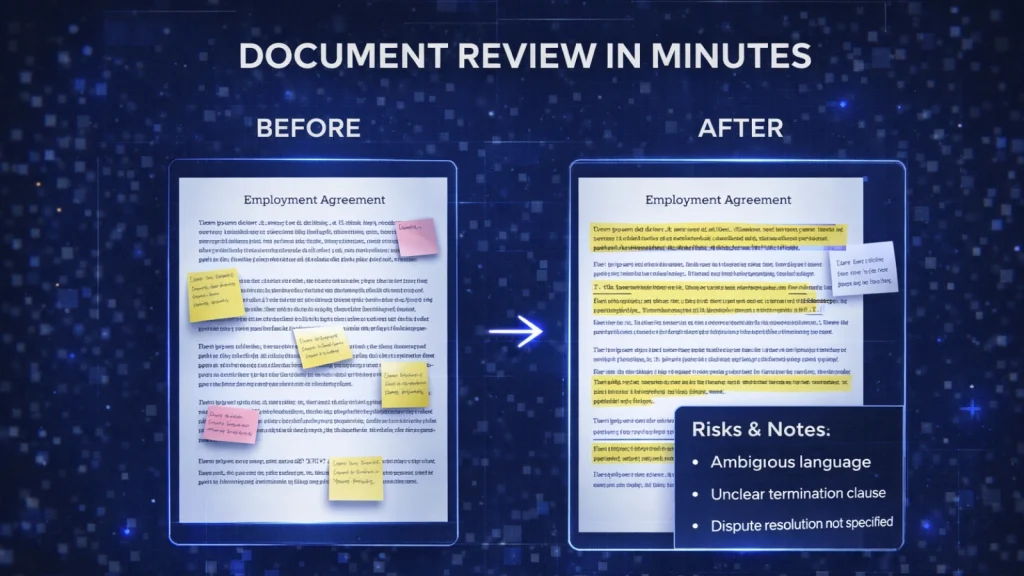
For HR teams, this pays off most during high-volume hiring periods. Offer letters, confidentiality agreements, and contractor onboarding documents all follow recognizable patterns. When something deviates from those patterns, the AI flags it immediately, so the team only needs to escalate the documents that genuinely require legal attention. Many teams rely on an AI Lawyer Free platform at this stage to filter routine documents before legal review.
Marketers see a similar benefit. Licensing agreements, content usage rights, and exclusivity clauses contain standard language for a reason. Spotting a non-standard clause before you sign is far easier than untangling it afterward.
04- Plain-Language Translation of Legal Documents
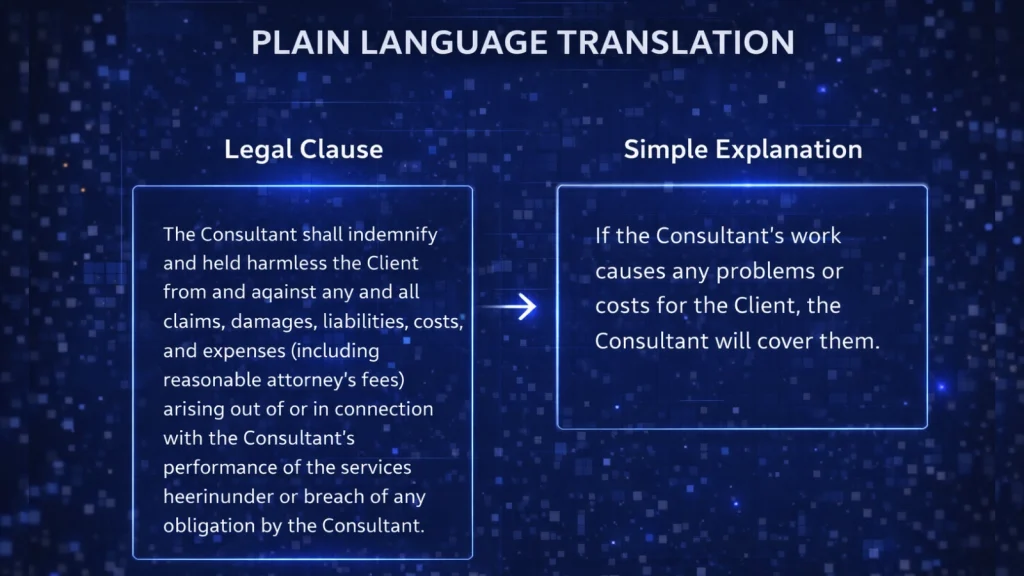
Legal documents are drafted for attorneys, not for the people who sign them. That gap is where most misunderstandings happen. Dense language, nested clauses, and implications that only become obvious if you know what to look for – all of it compounds until someone signs something they did not fully understand.
AI tools cut through that. The output is not a vague summary. It is a specific explanation: this clause means you cannot solicit the client’s other vendors for 24 months after the contract ends, regardless of who terminated the relationship first. That kind of precision matters. Many professionals use an AI Lawyer Free tool here to translate complex clauses into clear, actionable language before making decisions.
Generic summaries create a false sense of security. Precise, context-specific translations create the kind of understanding that actually protects you.
Tip: Instead of asking ‘Is this NDA okay?’ try ‘Does this NDA include a mutual confidentiality obligation, and does the definition of confidential information cover verbal disclosures?’ The more specific your question, the more actionable the answer.
05 Consistent Compliance Guidance Across Teams
One of the quieter risks in HR and marketing operations is inconsistency. Different managers interpret the same policy differently. Over time, that inconsistency accumulates into real liability exposure. Using an AI tool as a shared first-pass reference helps standardize how teams apply legal frameworks across departments.
GDPR consent language, at-will termination basics, IP ownership clauses in freelance agreements – these are areas where the answers are well-established and a reliable AI tool handles them consistently. Teams often turn to an AI Lawyer Free solution to ensure everyone starts from the same baseline understanding. The human judgment layer still applies. But it is better judgment when it starts from accurate, consistent foundational information.
06 First-Draft Generation for Standard Documents
Building an NDA, a contractor services agreement, or a content usage policy from scratch without legal training is slow, and the result often reflects whatever template the person found online rather than current legal standards. Most professionals either skip the documentation entirely or produce something that leaves gaps.
AI lawyer tools generate structurally complete first drafts of standard documents in under a minute. The draft is a starting point, not a finished product, and anything high-stakes should still go through formal review. Many teams begin with an AI Lawyer Free draft to speed up this process before refining it with legal input. But handing your attorney a working draft rather than a blank page compresses the review cycle and produces a better final document.
For teams picking up lawyer AI tools for the first time, this drafting feature often provides the most immediate, visible value.
07 Better-Prepared Attorney Conversations
This one tends to get overlooked, but it may be the highest-value benefit for businesses that work with attorneys on a regular basis. Arriving at a legal consultation without context is expensive. The first part of the session becomes an orientation, with the attorney getting up to speed on what you need and why.
When you use an AI tool for the first time, that dynamic changes. You arrive knowing what the document says, which clause is the actual concern, and what specific question needs answering. Many professionals use an AI Lawyer Free tool beforehand to clarify their concerns and structure the conversation more effectively. The consultation becomes a focused, strategic conversation rather than an educational one.
How LawyerBuddy Supports Legal Clarity for Business Teams
LawyerBuddy is an AI-powered legal assistant built for businesses, legal teams, and early-career lawyers navigating the Indian legal system. Rather than positioning itself as a substitute for professional legal counsel, the platform functions as a structured support layer – helping users understand their legal situation clearly enough to make informed decisions and ask better questions when they do engage a lawyer.
Key capabilities include:
Structured legal analysis – Users describe a legal situation or scenario, and the platform breaks it down into clearly defined components, drawing on relevant Indian legal principles and procedural frameworks
Indian law context – Analysis is grounded in Indian statutes, regulations, and judicial processes, so guidance reflects how a given issue actually sits within the country’s legal system rather than a generic international framework
Plain-language explanations – Legal terminology and procedural concepts are translated into straightforward language, making the output usable for professionals without a legal background.
Issue and category identification – Based on the details provided, LawyerBuddy identifies the relevant legal domain, whether that is corporate law, employment disputes, contractual matters, or a compliance-related concern.
Support for legal professionals and organizations – Beyond individual users, LawyerBuddy assists companies and junior lawyers with research support and structured legal insights that accelerate early-stage analysis.
LawyerBuddy does not provide formal legal advice and does not replace qualified legal representation for complex or disputed matters. What it addresses is the gap between having a legal question and knowing what to do with it – particularly for teams operating within the Indian legal context who need clarity before committing time and budget to professional counsel. Many users approach it as an AI Lawyer Free starting point before deciding whether to consult a lawyer.
How to Use a Free AI Lawyer Tool Effectively
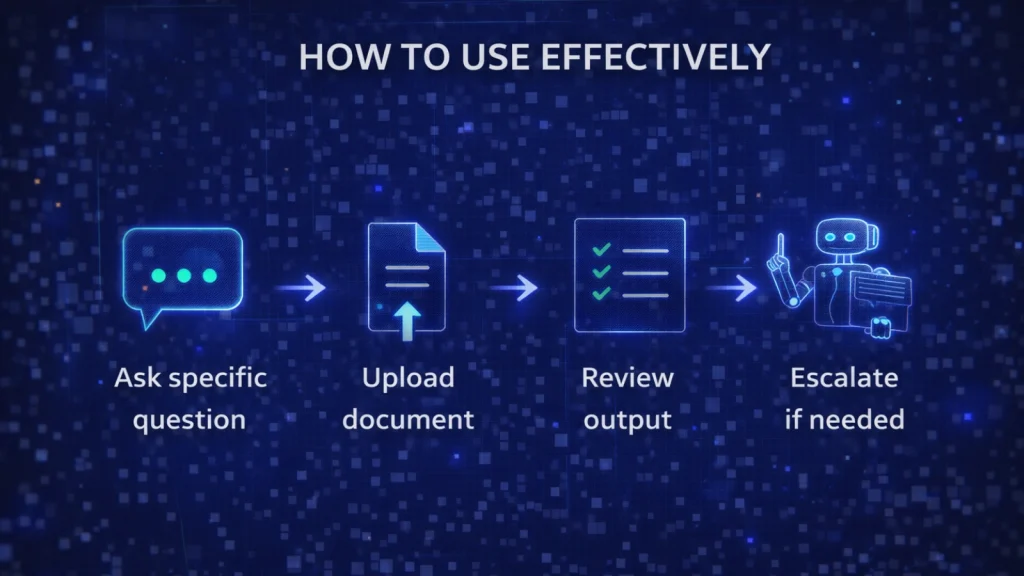
The quality of what you get from these tools depends almost entirely on how you engage with them. Professionals who come away disappointed are usually asking questions that are too broad. The framework below reflects how people who use these tools daily actually get reliable results.
Step 1: Make Your Question Specific
Broad questions return broad answers. ‘Is this contract okay?’ produces a general response that is not particularly useful. ‘Does this service agreement include an automatic renewal clause, and what notice period is required to cancel?’ gives you something you can act on.
Before submitting a question, identify the specific clause, obligation, or scenario you need clarity on. Include the contract type, the relevant jurisdiction if you know it, and the precise concern you are trying to resolve. The more context you provide, the more targeted the response.
Step 2: Upload the Document Directly When Possible
If the platform supports document uploads, use that feature. Pasting a clause in isolation strips the context that affects how it should be interpreted. Uploading the full document lets the AI evaluate the clause within the structure of the agreement as a whole.
For long documents, directing the tool to a specific section or clause tends to produce more focused, accurate analysis than asking it to assess the entire contract at once.
Step 3: Treat the Output as a Starting Point
AI legal output is a first-pass review. It is highly useful for building understanding, identifying risks, and preparing for a more formal human review. It is not a substitute for that review when the stakes are significant.
Read the response, identify what is most relevant to your situation, and use those insights to sharpen your next question or to prepare for a conversation with your attorney.
Step 4: Know When to Escalate
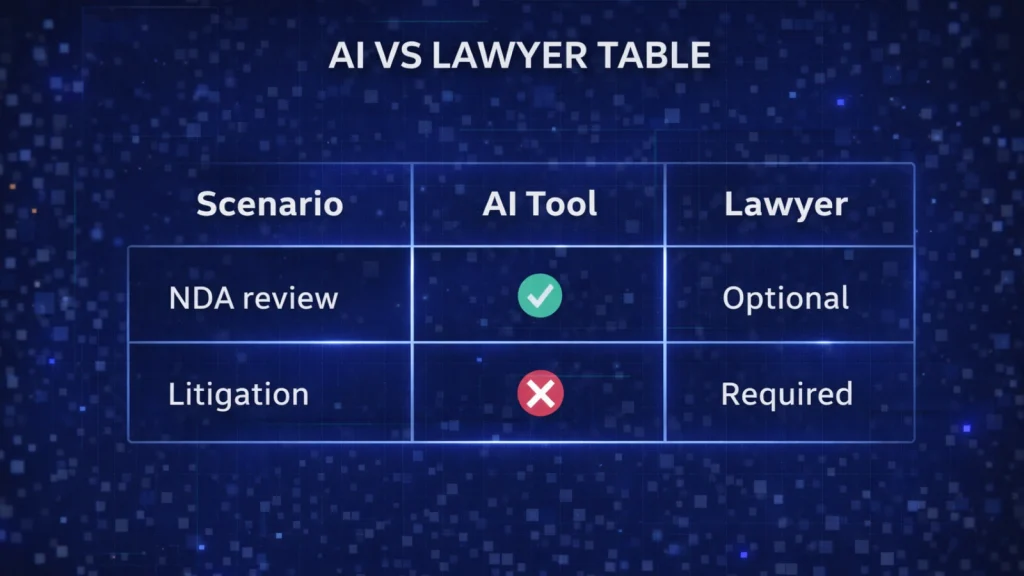
AI tools work well on standard legal terrain. They are less reliable on matters that are complex, contested, or heavily jurisdiction-specific. As a practical rule, bring in a licensed attorney when the contract value is substantial, when the other party has legal representation, when the matter could involve litigation, or when the tool itself signals that the question exceeds its scope.
| Scenario | AI Tool | Licensed Attorney |
| Reviewing a standard NDA | Appropriate | Optional |
| Understanding a contract clause | Appropriate | For high-stakes contracts |
| GDPR compliance check | Appropriate (general guidance) | Required for a formal audit |
| Employment termination letter | Appropriate (first pass) | Recommended |
| Active litigation or dispute | Not appropriate | Required |
| High-value contract final review | First pass only | Required |
Common Misconceptions About AI Lawyer Tools
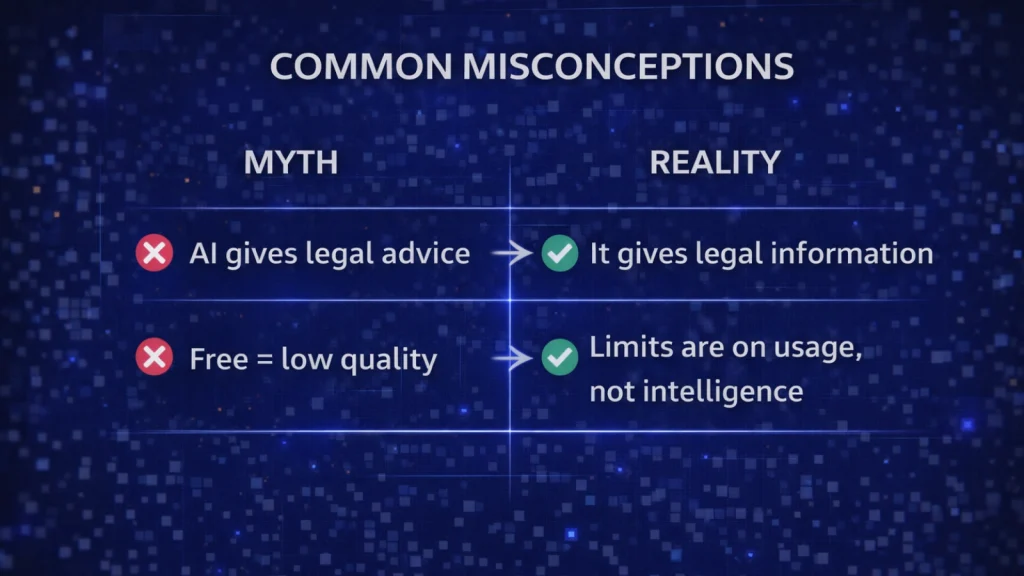
“Free Means Low Quality”
The free tier on most established AI legal platforms uses the same underlying model as the paid version. The limitation is on volume, usually a cap on how many queries or documents you can process per month, not on the quality of the analysis itself. For professionals with moderate, recurring legal review needs, free tiers are often entirely sufficient, especially when using an AI Lawyer Free option for routine queries.
The more meaningful distinction is between general-purpose AI and legal-specific platforms. A general model answers legal questions adequately. A platform fine-tuned on annotated legal content and built with jurisdiction awareness tends to produce more reliable analysis on document-heavy work.
“AI Gives You Legal Advice”
It does not. Formal legal advice comes from a licensed attorney who accepts professional responsibility for the guidance they provide. AI tools offer legal information: well-grounded, educational, and useful, but not binding and not subject to professional accountability, even when accessed through an AI Lawyer Free platform.
“These Tools Are Only Useful for Lawyers”
The opposite is closer to the truth. Attorneys already understand the law. They benefit from AI tools primarily through faster research and more efficient drafting. The professionals who gain the most from AI legal tools are those without legal training – HR managers, marketers, founders, and anyone who regularly encounters legal documents and previously had no practical way to understand them without paying for help, often starting with an AI Lawyer Free solution.
“The AI Legal Space Has Already Peaked”
A number of articles still reference early products that have since pivoted away from AI legal services entirely, which creates a skewed picture of where the market actually stands. Legaltech Hub mapped over 855 generative AI products operating in legal technology as of late 2025. The market has not stalled. It has matured, and the current generation of tools is meaningfully more accurate, jurisdiction-aware, and role-specific than anything that existed two years ago, with many users first engaging through an AI Lawyer Free tier.
Read More!
The Rise of the AI Lawyer: How AI Is Streamlining Legal Workflows
What Is An AI Legal Assistant and How Does It Work?
Conclusion
The legal friction most professionals face is not a shortage of attorneys. It is the gap between having a legal question and knowing what to do with it- when the cost of getting help exceeds the value of clarity.
AI lawyer free tools close that gap. They are built to give you the legal understanding you need to make informed decisions and know when professional counsel actually matters. For HR teams, marketing departments, founders, and small business owners, these tools work because they handle recurring, predictable legal questions that consume time and create unnecessary risk when left unaddressed.
The framework is straightforward: ask specific questions, upload documents when possible, treat the output as a starting point, and escalate when complexity demands it.
Frequently Asked Questions
What can a free AI lawyer tool actually help me with?
Routine legal questions, contract clause explanations, compliance basics, and first-draft generation for standard documents all fall comfortably within scope. These tools are especially strong at identifying what a document says, flagging language that deviates from standard terms, and pointing out what might be missing from an agreement. Litigation support, court filings, and complex multi-party disputes require licensed legal representation.
Is it safe to upload my contracts to an AI legal tool?
Established platforms use encrypted data transmission and publish clear data handling policies. Before uploading any sensitive commercial agreement, verify whether the platform retains uploaded documents, whether that content is used for model training, and who has access to it. For highly sensitive materials, apply additional caution regardless of the platform’s stated policies.
What are the best lawyer AI tools for small businesses?
When assessing what the best lawyer AI tools are for a business context, the factors that matter most are plain-language output, jurisdictional awareness, document upload capability, and transparent data privacy practices. General-purpose AI models handle basic questions well. Legal-specific platforms with structured document review perform better for contract-heavy work. The right choice depends on whether your primary need is Q&A, document review, or drafting assistance.
Can I use a free AI lawyer tool for HR matters?
Yes, and HR is one of the most natural use cases. Reviewing offer letters, checking that termination documentation aligns with employment law basics, and understanding what a non-disclosure or non-compete clause actually commits an employee to are all tasks these tools handle effectively. For formal disciplinary proceedings, EEOC matters, or anything that could become a dispute, qualified employment counsel remains the right call.