

Signing the wrong types of contracts or misreading what you’ve signed can cost you more than money. It can cost you legal standing entirely. A job offer, a lease, a service agreement: these happen every day, yet most people don’t think twice about the kind of contract they’re actually entering into.
Not all agreements are contracts. This distinction is central to understanding an agreement in contract law. And among contracts, not all carry the same legal weight. Under Indian contract law, specifically the Indian Contract Act, 1872, every contract you sign falls into specific categories, and those categories determine your rights, your remedies, and your obligations.
This guide covers the five most important types of contracts, how Indian law classifies them, and what each one means for you.
Quick Answer: Contracts are classified by validity (valid, void, voidable), formation (express, implied, quasi-contract), and performance (executed, executory, bilateral, unilateral). Under the Indian Contract Act, 1872, a valid contract needs free consent, lawful consideration, competent parties, and a lawful object.
To fully understand what is contract law, you need to look at how agreements become legally enforceable.
Read Aloud!
What Is a Contract and Why Does the Type Matter?
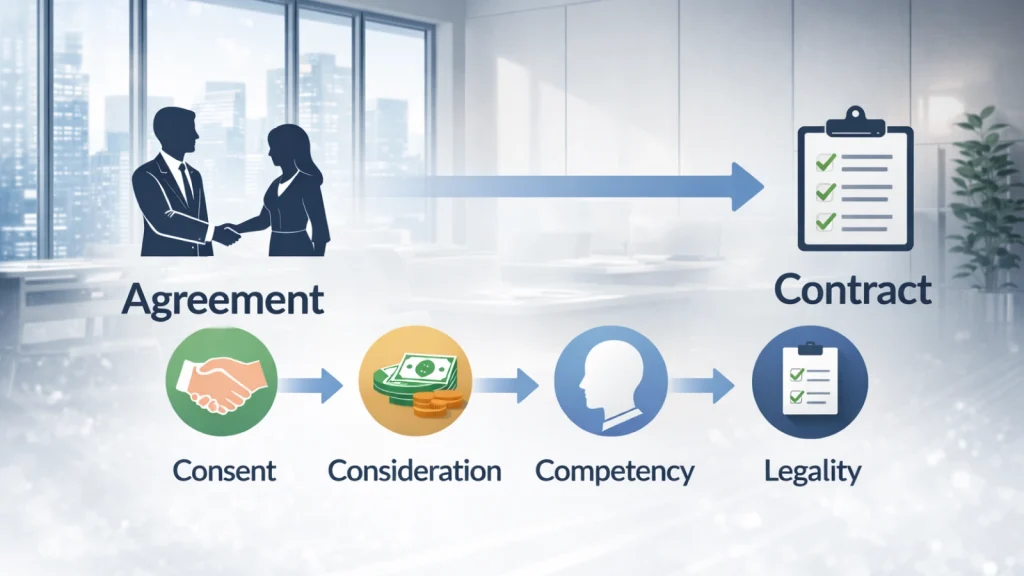
The types of contracts determine what happens when things go wrong- who can sue, what relief is available, and what each party is actually obligated to do.
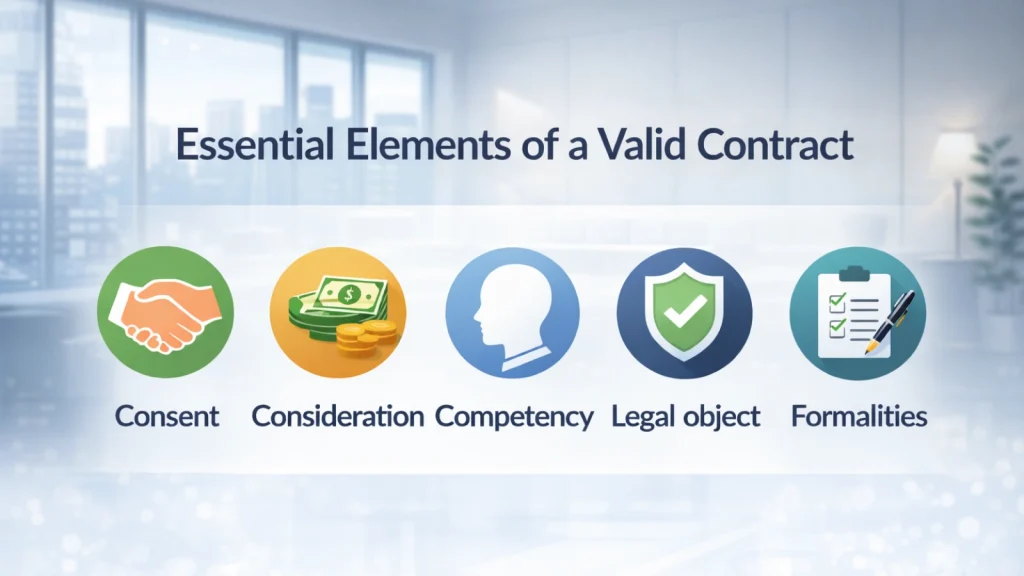
Essential Elements of a Valid Contract (Section 10, ICA)
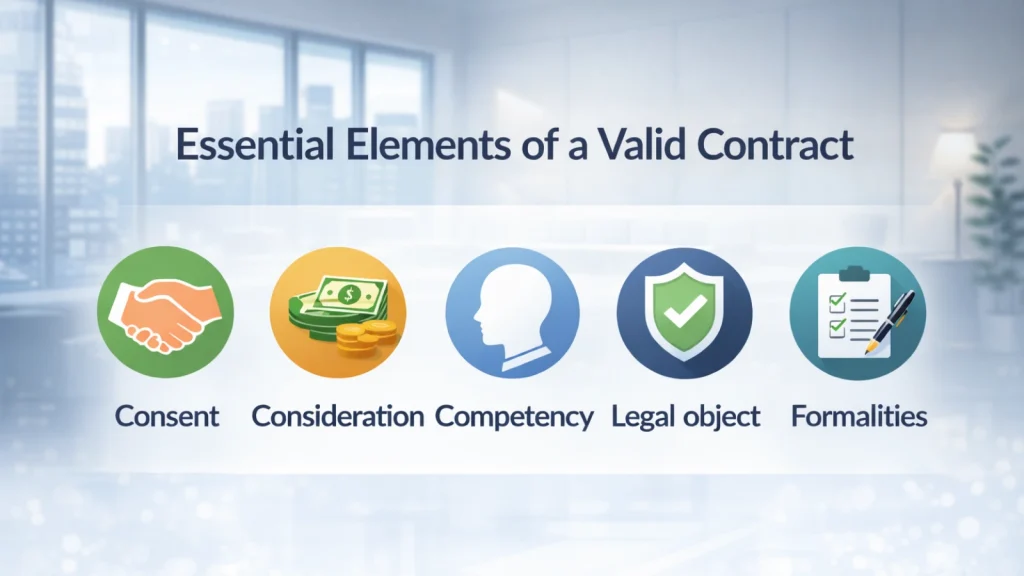
For an agreement to become an enforceable contract, it must clear five conditions:
- Free consent: voluntary agreement, free from coercion, fraud, or misrepresentation
- Lawful consideration: something of value exchanged, and it must be legal
- Competent parties: both must be 18+, of sound mind, and legally eligible
- Lawful object: the purpose cannot be illegal, immoral, or against public policy
- Legal formalities: some contracts, like property transfers, require a written or registered form
Miss even one, and what you have isn’t a valid contract – it’s just paper.
Agreement vs Contract: What’s the Difference?
At first glance, an agreement and a contract seem like the same thing. In everyday language, people use them interchangeably. In law, they are not identical, especially when you start looking at different types of contracts.
An agreement is simply a mutual understanding between two or more parties. It could be casual, informal, or even social. For example, agreeing to meet a friend for lunch is an agreement.
A contract goes a step further. It is an agreement that the law recognizes and enforces. Here’s the simplest way to think about it:
Agreement = a promise between parties
Contract = a promise that the law will enforce
This distinction is central to understanding an agreement in contract law. For an agreement to become a contract, it must meet certain legal conditions. These include free consent, lawful consideration, and competent parties.
If those elements are missing, the agreement may still exist — but it won’t be legally binding. That’s why not every agreement turns into a contract. But every contract begins as an agreement.
How Are Types of Contracts Classified? The Three-Axis Framework
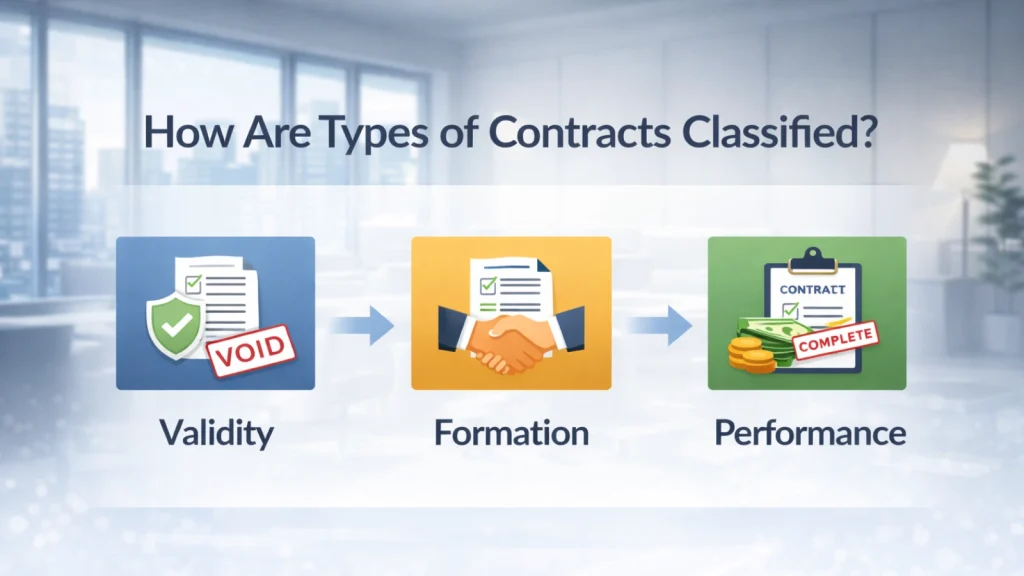
Indian contract law organizes contracts along three axes. These categories represent the core types of contract law used to classify agreements.
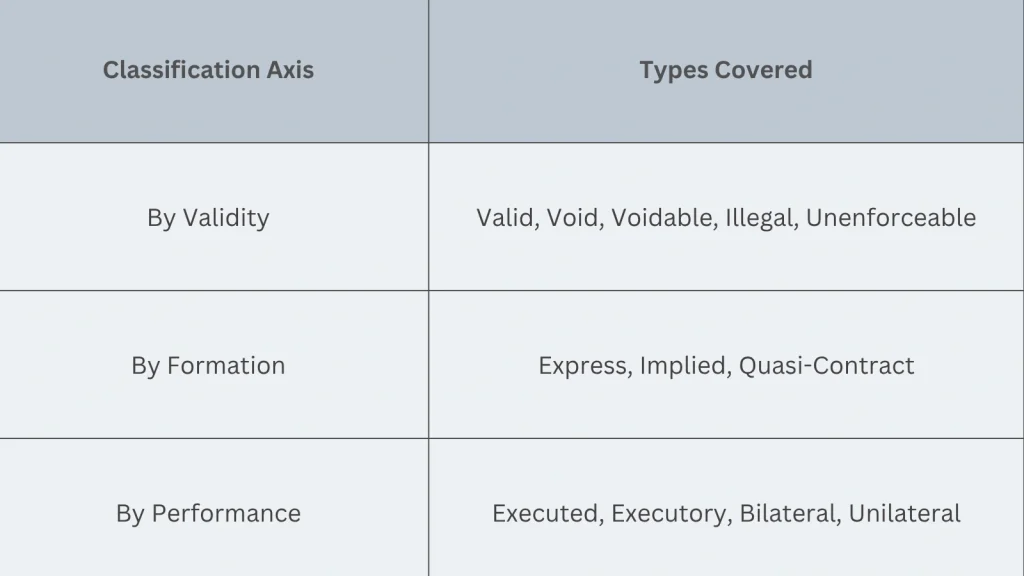
One contract can fit multiple categories simultaneously. An employment agreement might be valid, express, bilateral, and executory all at once. These aren’t competing labels – they describe different dimensions of the same document.
The 5 Most Important Types of Contracts Explained
1. Valid Contract
A valid contract satisfies every requirement under Section 10 of the ICA. Both parties agreed voluntarily, the consideration is lawful, and neither side is disqualified from entering the agreement.
Picture a supplier and retailer signing a written agreement on delivery schedules, payment terms, and penalty clauses. The object is legal. Both parties consented. Consideration flows both ways. That’s a valid contract – and only a valid contract gives both parties the right to seek legal remedies if the other defaults.
Without validity, the agreement is unenforceable. It’s worth nothing in court.
2. Void and Voidable Contracts
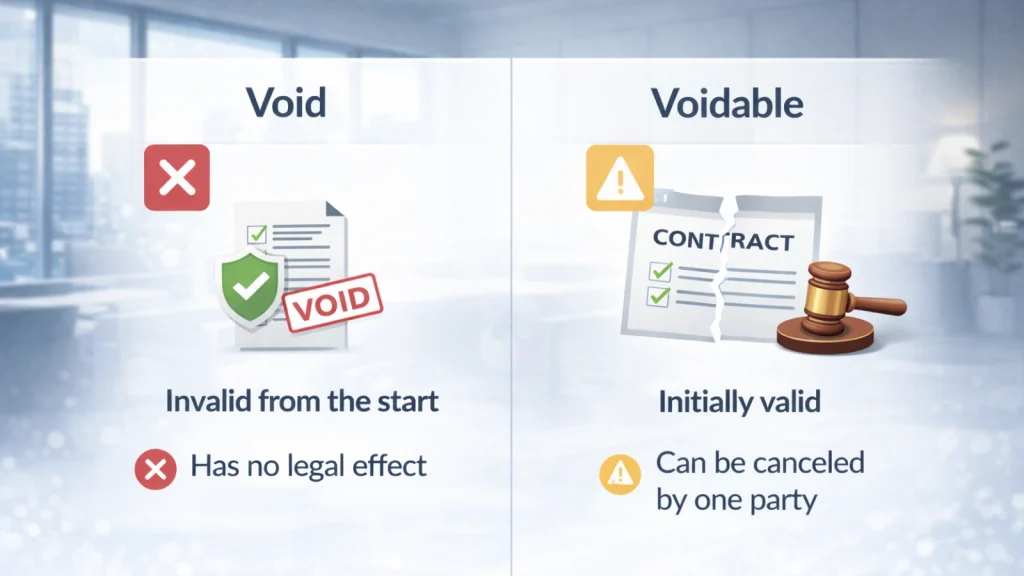
Among the different types of contracts, these two are often confused. The distinction matters a great deal.
A void contract under Section 2(j) has no legal effect. Neither party can enforce it. Common reasons: unlawful consideration, restraint of trade, agreements to commit crimes, or performance that was impossible from the start. Often, a void contract is void ab initio – invalid from day one.
A voidable contract under Section 2(i) is different. It looks and functions like a valid contract – until the aggrieved party chooses to cancel it. This typically happens when consent was obtained through fraud, coercion, misrepresentation, or undue influence. The contract doesn’t fall apart on its own. The affected party must act.
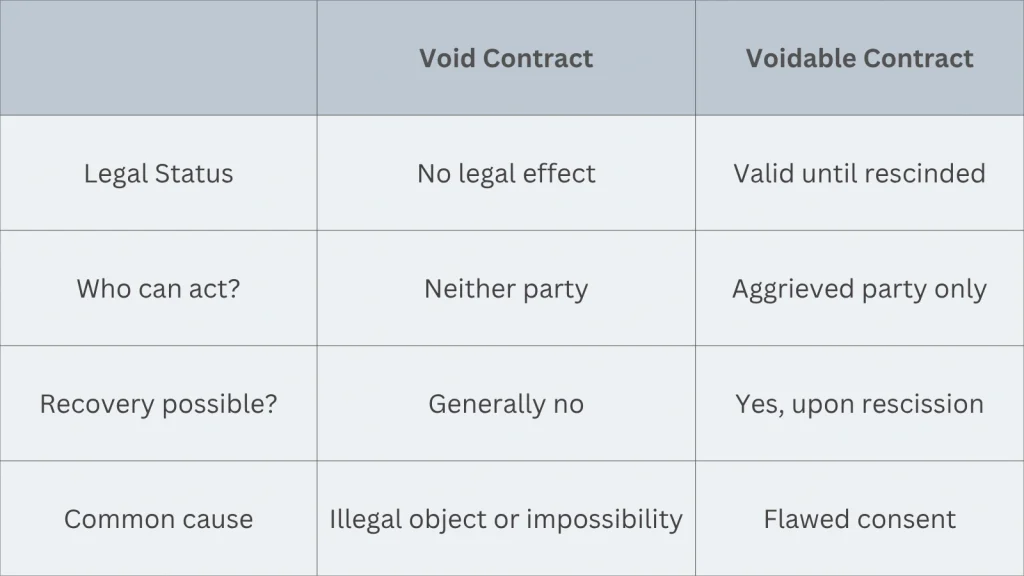
These types of contracts differ significantly in how and when they can be enforced. Here’s where fraud in contract law becomes particularly relevant. A contract obtained through fraud is voidable, not automatically void. The defrauded party has the right to rescind, but must exercise it. Waiting too long, or choosing not to act, can mean the contract stays in force.
3. Express and Implied Contracts
This classification of types of contracts is about how a contract forms.
An express contract puts everything in words – written or spoken. Both parties consciously agree to specific terms. Employment agreements, lease deeds, vendor contracts: all express.
An implied contract forms through conduct, not words. You sit down at a restaurant, order a meal, and eat it. You haven’t signed anything, but an obligation to pay exists. The contract is inferred from the situation.
Quasi-contracts are a separate category entirely. They’re not real contracts but designed to prevent unjust enrichment. Say a courier delivers goods to your door by mistake. There’s no agreement between you and the sender, but you’re still obligated to return or pay for those goods. The law creates the obligation, not the parties.
4. Bilateral and Unilateral Contracts
These types of contracts focus on how promises are exchanged between parties. Bilateral contracts involve mutual promises. A buyer commits to pay; a seller commits to deliver. Most business contracts, service agreements, employment contracts, and purchase orders are bilateral. The binding moment is when both parties exchange their promises.
Unilateral contracts work differently. Only one party makes a promise, and the other party accepts by performing an act, not by promising anything back. A reward offer for a lost dog is the textbook example. You don’t bind yourself by saying you’ll look. You accept the offer by actually returning the dog. Performance is acceptance.
This distinction determines when a contract becomes legally enforceable – and when a breach can actually be claimed.
5. Executed and Executory Contracts
Think of this as a progress marker.
An executed contract is finished. Both parties have fulfilled their obligations. You paid; you received the product. Done.
An executory contract still has obligations outstanding. A SaaS subscription, a construction contract, a long-term employment arrangement – these remain executory until every commitment is fulfilled. They’re binding, but incomplete.
The types of contracts determine what remedy is available for breach, depending on where you are in this lifecycle.
Types of Contracts in Business Law – The Practical Layer
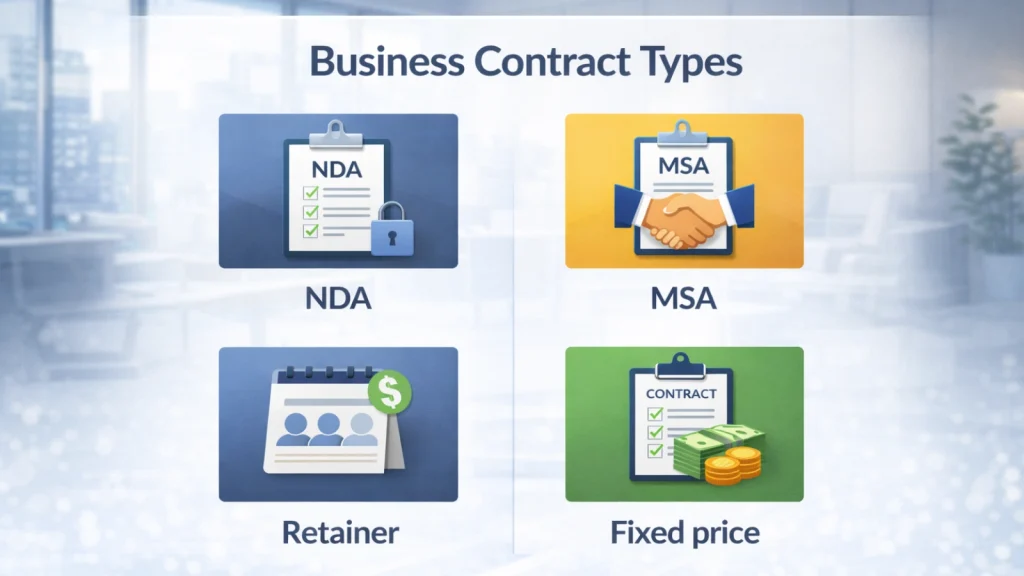
Beyond the ICA framework, these are common types of contract in business law categorized by pricing model and risk allocation. Most still qualify as express, bilateral, and executory contracts under Indian law – the labels just reflect how financial risk is divided.
To understand what is contract in business law, it helps to see how different agreements allocate risk and responsibility.
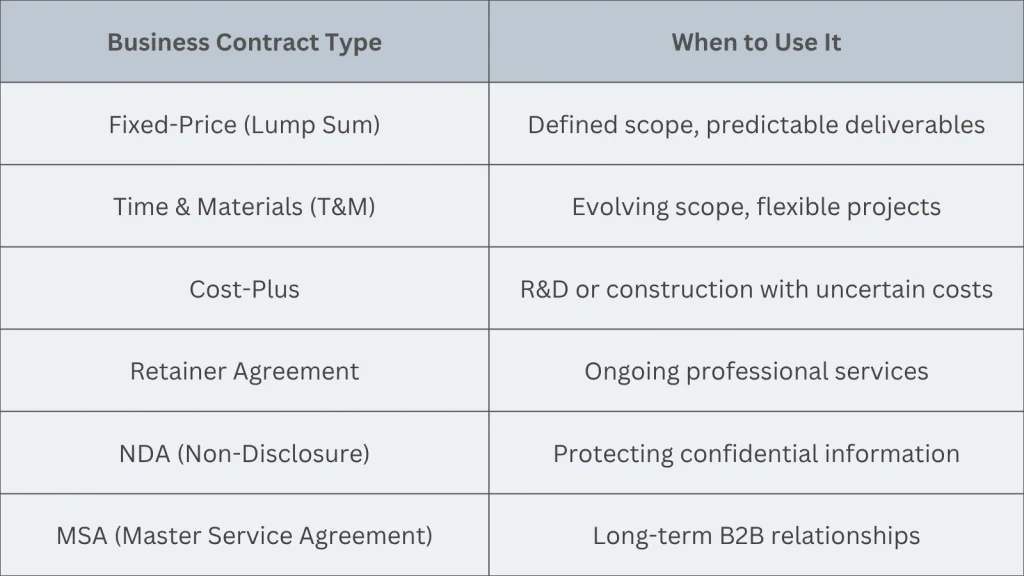
Picking the wrong structure among different types of contracts for a project’s nature is an avoidable and often expensive mistake. A fixed-price contract gives both sides clarity. A time-and-materials arrangement offers flexibility but shifts financial risk to the client. Picking the wrong structure for a project’s nature is an avoidable and often expensive mistake.
How LawyerBuddy Helps You Navigate Types of Contracts
Understanding different types of contracts is one thing. Knowing what to do in a real situation is another.
Ask Legal Questions
Get clear answers in simple language, along with practical next steps for your situation.
Review Documents
Upload contracts, rental papers, or notices and get focused insights on what matters.
Continue the Same Case
Ask follow-up questions in the same thread without starting over.
How It Helps
- Understand notices, tax issues, rental disputes, and employment matters
- Start free daily and continue with follow-ups
- Upload documents and get targeted feedback
When you’re dealing with real contracts, having the right guidance can make all the difference.
Also Read!
How To Choose The Best AI Tools for Lawyers
How To Use AI Tools For Legal Research Effectively?
Common Mistakes and Misconceptions About Contract Types
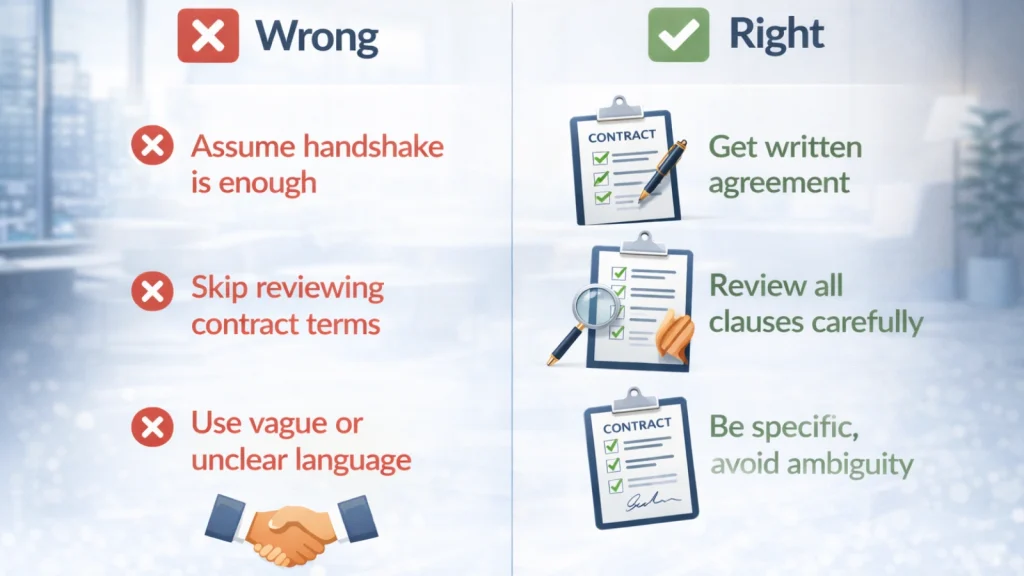
Misunderstanding different types of contracts is one of the most common reasons people face legal issues.
“Void and voidable contracts are the same.” They’re not. A void contract has no legal standing from the start. A voidable contract is valid until the aggrieved party actively cancels it. Confusing the two can mean missing your window to act.
“Only written contracts are enforceable.” Oral and implied contracts can be fully binding. Writing matters for proof, not always for validity.
“A contract signed under pressure is automatically cancelled.” A contract obtained through coercion is voidable, not void. The affected party must take action to rescind it. Inaction can mean the contract holds.
“Quasi-contracts are real contracts.” They’re legal obligations imposed by courts to prevent unjust enrichment. No actual agreement exists between the parties.
“Illegal contracts and void contracts are the same thing.” All illegal contracts are void. But a contract can be void for non-illegal reasons too – impossibility of performance, for instance.
Advanced Insights – Contract Law in a Changing Business Landscape
As business evolves, different types of contracts are also adapting to new technologies and legal challenges.
E-Contracts: The Information Technology Act, 2000 (Sections 4 and 5) gives legal standing to electronically formed contracts in India. Clickwrap agreements and digital purchase confirmations are enforceable – and most qualify as express, bilateral, and executory contracts under the ICA.
Adhesion Contracts: Standard-form contracts – app terms of service, insurance policies – leave one party with no real ability to negotiate. Indian courts have grown more willing to scrutinize unconscionable terms in these agreements.
Contingent Contracts (Section 31, ICA): These are contracts tied to the occurrence of an uncertain future event. Insurance is the most common example. Fully valid – but performance is conditional.
Trend to Watch: AI-drafted contracts and automated contract management are raising new questions about consent and authorship. As these tools become standard practice, courts will need to weigh in on whether algorithmically generated agreements satisfy the ICA’s free consent requirements.
Conclusion
Contracts shape every professional and commercial relationship you enter. Knowing the types of contracts and what each one means in practice is how you protect yourself before a problem starts, not after.
The void-voidable distinction can mean the difference between compensation and nothing. Choosing the wrong pricing structure for a business contract can derail an entire project. These aren’t abstract legal concepts; they show up in real situations with real consequences.
When you’re ready to go from understanding to action – drafting, reviewing, or resolving a contract dispute – LawyerBuddy bridges that gap.
Frequently Asked Questions
1. What are the different types of contracts in business law?
Contracts in business law include valid, void, voidable, express, implied, bilateral, unilateral, executed, and executory contracts.
2. What is a valid contract under Indian contract law?
A valid contract meets all legal requirements like free consent, lawful consideration, and competent parties.
3. What is the difference between void and voidable contracts?
A void contract has no legal effect, while a voidable contract is valid until one party cancels it.
4. What are express and implied contracts?
Express contracts are clearly stated, while implied contracts are formed through actions or conduct.
5. What is a unilateral contract in types of contracts?
A unilateral contract involves one party making a promise that is accepted through an action.