

Negotiable instruments are signed, transferable orders or promises to pay a fixed sum, cheques, promissory notes, and bills, payable on demand or at a set date. This beginner guide negotiable instruments gives you the answer-first basics: what they are, how transfer and endorsement work, and why holder-in-due-course rules reduce risk so you can move money safely without cash.
Get instant legal guidance, free today →
Last month, Meera’s cheque bounced the day before rent was due. This guide gives you the plain-English basics to avoid that stress in 2026 and beyond.
Negotiable instruments are written, transferable promises or orders to pay a fixed sum, either on demand or at a set date. They keep money moving without lugging cash. In India, the Negotiable Instruments Act, 1881 lays the rules. In the United States, UCC Article 3 does the same job. If you learn the core ideas, transferability, unconditional payment, and who counts as a holder in due course, you cut risk and speed up payment.
What Are Negotiable Instruments and Why Do They Matter?
Think of a negotiable instrument as cash on paper with rules. It’s a signed document that promises money to whoever holds it, or to a named person who can pass it on. Because it’s transferable, it works as a safe stand-in for cash, with proof baked into the paper.
Legal frameworks at a glance
Under India’s Negotiable Instruments Act, 1881 (NI Act), cheques, promissory notes, and bills of exchange are the classic types. In the US, Article 3 of the Uniform Commercial Code (UCC) defines similar paper, notes and drafts. The idea is old but still useful in 2026: money can move by handing over one document, not hauling a briefcase of cash.
Core features and transfer
Transferability means you can pass the instrument to someone else by delivery or by endorsement (signing the back). An unconditional promise or order means a statement like “I will pay Rs. 10,000” stands on its own and should not depend on side deals such as “if the fridge works for 6 months.” A fixed amount removes ambiguity, so the sum is certain and appears on the face of the paper. Together, these features let the instrument function like portable value with clear obligations.
Holder in due course (HDC)
Moreover, the “holder in due course” (HDC) rule protects trust in these papers when a person takes the instrument for value, in good faith, and without notice of problems like forgery or fraud. If you meet those three, you often get better rights than the person before you. For example, if Pooja sells a valid promissory note to Vivek, and he takes it for value, in good faith, without knowing of any dispute, Vivek can claim payment even if Pooja had a separate contract fight with the maker. This helps the paper “circulate” like money.
Why they still matter
Negotiable instruments still matter because they let you pay or get paid fast without bank wires, keep a reliable paper trail, and rely on legal shortcuts such as presumptions of consideration and the HDC shield in many cases. When used properly, they reduce friction in everyday transactions and in trade. That efficiency is the reason these old tools remain relevant in 2026.
For a straightforward primer, the Wikipedia overview of negotiable instruments maps the global basics. Domestically, read your local statute text (India’s NI Act, 1881) and, for the US, look to UCC Article 3 (consult the Uniform Commercial Code text from a university or your state’s official site). As you read, keep this beginner guide negotiable instruments idea in mind: the law treats these documents a bit like “mini-cash,” so they can pass from hand to hand, with predictable results.
Key features in plain English
These instruments are transferable, so you can hand them over and the next person can claim the money. They must be unconditional, meaning payment does not hinge on extra conditions. The sum must be fixed, with no hidden math, and the instrument is payable on demand or at a set time (for example, “on sight” or “on 30 June 2026”). Finally, the maker or drawer signs so the obligation is clear and traceable.
Also Read!
The Three Main Types — Cheques, Promissory Notes, and Bills of Exchange
Let’s break the three big ones with everyday examples you can picture.
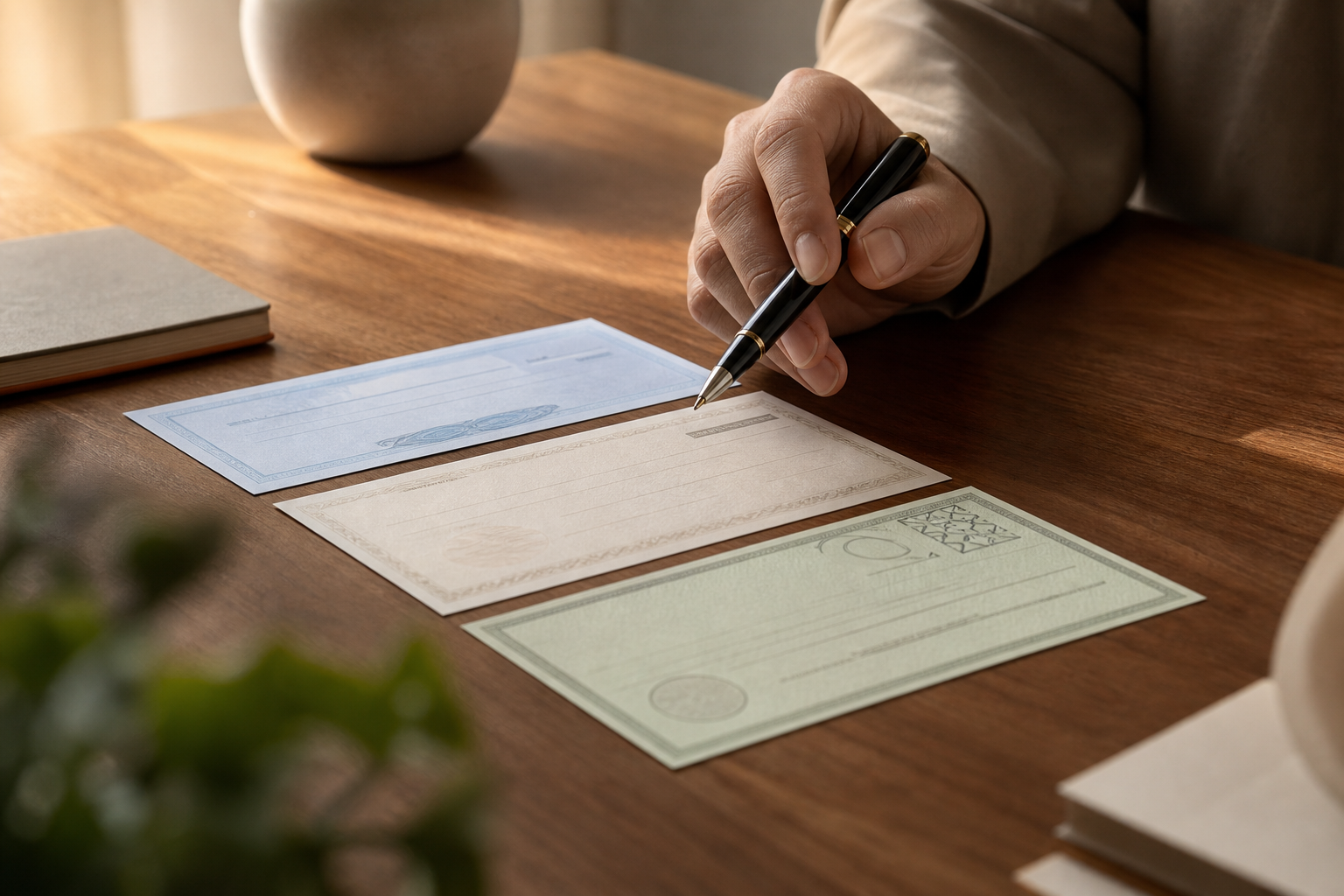
- Cheque: You tell your bank to pay your landlord Rs. 20,000. You write a cheque to “Anita Mehta,” date it, sign it, and she deposits it. If funds are there, her bank collects from your bank. In India, cheques are usually valid for 3 months from the date written on them.
- Promissory Note: Arun borrows Rs. 1,00,000 from a friend and signs a written promise: “I will pay Rs. 1,00,000 to Priya on 31 December 2026.” That’s a note—two parties: maker and payee.
- Bill of Exchange: A supplier (drawer) orders a buyer (drawee) to pay a transporter (payee). For example: “Pay Rs. 50,000 to XYZ Logistics 60 days from sight.” If the drawee accepts, it becomes their binding promise.
In addition, you’ll hear about demand drafts, which are prepaid instruments issued by a bank and payable to a named person at another branch or city. Because the money is already with the issuing bank, a demand draft avoids “insufficient funds” issues. You may also encounter bearer instruments, which are payable to whoever holds the paper; they move like cash but carry theft risk, so many people add “Account Payee” crossing on cheques to reduce that risk.
| Instrument Type | Parties Involved | Payment Timing | Common Uses |
|---|---|---|---|
| Cheque | Drawer (you), Drawee (your bank), Payee (recipient) | On demand, within validity (often 3 months in India) | Rent, salaries, vendor payments |
| Promissory Note | Maker (borrower), Payee (lender) | On demand or at a stated date | Personal/business loans, credit sales |
| Bill of Exchange | Drawer (seller), Drawee (buyer), Payee (seller or third party) | On demand or after acceptance at set term | Trade/commerce, supply chains |
| Demand Draft | Issuing Bank, Paying Branch, Payee | On demand (prepaid) | Inter-city secure payments |
| Bearer Instrument | Varies by type | On demand | Cash-like transfers (higher risk) |
For clarity, a cheque is an order to your bank, a note is your promise to pay, and a bill is your order to someone else to pay a third party. If the instrument says “pay bearer,” whoever holds it can present it. If it says “pay order,” the named person (or their endorsed transferee) can claim.
Furthermore, endorsements steer how paper travels. A blank endorsement (just a signature) can make the instrument payable to bearer. A special endorsement names the next holder. A restrictive endorsement like “Account Payee Only” tells the bank to credit the named person’s account and not pay cash over the counter.
As you compare, keep the beginner guide negotiable instruments lens on: choose the tool that matches your need, on-demand rent (cheque), dated loan repayment (note), or trade terms secured by acceptance (bill).

Common Mistakes People Make with Negotiable Instruments
Mistakes here can cost you weeks. Or a case. Here are pitfalls to avoid, with the India NI Act, 1881 in view and practical notes you can use in 2026.
- Post-dated cheque confusion: A cheque dated 15 July 2026 is valid from that date, not earlier. If deposited before the date, banks usually refuse it. Present it within the 3-month validity counted from the date written on the cheque.
- Ignoring endorsement rules: Signing the back without thought can convert an “order” cheque into “bearer” for the next person. If you intend to lock it to a bank account, write “Account Payee Only” and avoid blank endorsements.
- Not understanding Section 138 (cheque bounce): If a bank returns a cheque for “insufficient funds,” the payee must act fast.
- Present the cheque within its validity (often 3 months in India).
- Send a written demand notice to the drawer within 30 days of receiving the bank’s return memo.
- Wait 15 days after the notice. If there’s no payment, a cause of action arises.
- File the complaint within 30 days from the day the cause of action arises.
Missing one of these windows can sink the case. - Failing to present within validity: A stale cheque (presented after the validity period) won’t support a Section 138 case. Track dates. A quick calendar reminder saves you a legal headache.
- Assuming all IOUs are negotiable: A casual “IOU for Rs. 10,000 if the work is great” is conditional and vague. It’s not a promissory note under the Act. A valid note states a fixed sum and a clear promise to pay, without “ifs.
- Mixing “security cheques” with payment cheques: If a cheque was given only as security, facts matter. Courts will check whether a “legally enforceable debt or liability” existed on the presentation date. Keep paperwork that shows why the cheque was issued.
Additionally, mind the content on the face. Make sure the amount in words and figures matches. Avoid overwriting and, if you must correct something, countersign the change. Use the same ink for the date and amount when possible because banks and courts look for clarity.
Therefore, make a short checklist: write a clear date, match words and figures, choose “bearer” vs “order” wisely, and store bank return memos. Small care up front beats a long dispute later. Add this to your beginner guide negotiable instruments toolkit and you’ll sidestep most traps.
Tools and Resources for Handling Negotiable Instrument Disputes
You don’t need to guess your next step. Use authoritative texts, public bodies, and vetted help to stay on track in 2026.
- NI Act, 1881 bare text: Read the unedited law on India Code. Search for “Negotiable Instruments Act 1881 India Code” and bookmark the official page for quick reference.
- RBI guidance: For cheque validity (3 months) and banking processes, refer to official circulars on the Reserve Bank of India site. Search “RBI cheque validity circular.
- Consumer forums and courts: If the dispute ties to deficient service or consumer issues, look up your state consumer commission or district forum. For criminal complaints under Section 138, check your local magistrate court’s filing rules.
- Free legal aid: State Legal Services Authorities run legal aid and lok adalats (mediation forums). Search “[Your State] Legal Services Authority.gov.in” for helplines and schedules.
- Legal tech platforms: Tools like LawyerBuddy connect you with verified advocates and help you act within deadlines. Its stack includes AI-powered legal and tax help for India, five free legal questions answered daily, a 100% Bar Council verified panel you can trust, a secured escrow payment system ensuring payment after regulatory cooldown, a 24/7 live mandate feed across India, and two follow-up questions per case with a secure 1-on-1 workspace.
“The 100% Bar Council verified panel gave me confidence to upload my documents and move fast without phone-tag.” — Real user feedback (authority and speed in one line)
Registration and next steps
Moreover, it’s free to register with no subscription fee (risk reversal that makes it easy to try). If you’re an advocate reading this, there’s also a transparent wallet ledger so you don’t chase fees line by line.
**Join as a Lawyer, free today →
As you build your own beginner guide negotiable instruments stack, keep two tabs open: the bare NI Act text and your calendar. The law gives you timelines. Your calendar makes you meet them.
Also Read!
Tribunal vs Court in India: Key Differences Every Citizen Should Know Before Filing a Case
What to Do Next If You’re Dealing with a Negotiable Instrument Issue
Here’s a simple, stepwise plan you can follow right now. Keep copies of everything. Dates decide cases.
- Gather documents
- Collect the original instrument, bank return memo (if any), deposit slip, and any emails or WhatsApp chats about the payment. Scan them into a single PDF with clear file names like “Cheque-123456-Anita-2026-07-15.pdf”.
- Check limitation and validity
- For notes and bills, the general limitation period to sue for money is 3 years from the date the amount became due. For cheques, ensure presentation within validity (often 3 months from the date on the cheque).
- If it’s a bounced cheque (Section 138 track)
- Present within validity. On dishonour, send a written demand notice within 30 days of the bank’s memo. Give the drawer 15 days to pay. If they don’t pay, file the complaint within 30 days from when the cause of action arises. Use a courier or speed post that gives you a delivery record, and keep the receipt.
- Consider civil recovery in parallel
- You may file a civil suit for recovery of money while or instead of pursuing a criminal complaint. Ask a lawyer about interest claims and costs. Collect proof of the debt—invoice, loan note, or ledger.
- Choose negotiation or mediation when speed beats a fight
- If cash flow matters more than a verdict, propose a one-page settlement. Use mediation through a court-annexed center or local legal services authority. Write dates and amounts clearly (for example, “Rs. 60,000 on or before 30 September 2026”).
- Consult a lawyer for higher-value or complex disputes
- If the amount is significant, or there are allegations like forgery or lost instruments, talk to a professional. Check your district court’s pecuniary jurisdiction threshold to know where the case belongs. Tools like LawyerBuddy can connect you with a verified advocate and an escrow-backed workflow so both sides feel safe moving ahead.
- Guard against repeat issues
- Request “Account Payee Only” crossings on cheques you accept. Prefer demand drafts for large sums when practical. For promissory notes, write the amount in words and figures, keep signatures clear, and store a signed copy in a safe place.
 → Send Notice → Choose Civil/Criminal → Mediate or File → Track Dates; modern icons, Indian legal context)
Therefore, do first things first: secure the paper trail, calendar your limits, and choose the right track (notice, mediation, or court). With this beginner guide negotiable instruments process, you remove guesswork and act on facts.
 , key timelines (3 months, 30 days, 15 days), and holder in due course definition; accessible colors and large labels)
Key Takeaways
Before you close this tab, lock in these points so you don’t need to relearn them under pressure.
- A negotiable instrument is a signed, transferable promise or order to pay a fixed sum, on demand or at a set time. In India, the NI Act, 1881 governs this; in the US, check UCC Article 3.
- Cheques (drawer → bank → payee), promissory notes (maker → payee), and bills of exchange (drawer → drawee → payee) differ by who promises and who orders. Demand drafts are prepaid and safer against “insufficient funds.
- Holder in due course matters: if you take the paper for value, in good faith, without notice of defects, you may have stronger rights than earlier holders. That’s why these papers can “move like money.
- Timelines win cases: present cheques within 3 months (in India); send the Section 138 notice within 30 days of dishonour; wait 15 days for payment; then file within the next 30 days if needed. Dates on your calendar are as important as signatures on the paper.
- Use tools and verified help: keep the bare law handy, consider mediation for speed, and, if needed, use a platform with a 100% Bar Council verified panel and secured escrow so payments clear after the regulatory cooldown. This beginner guide negotiable instruments approach turns a vague hassle into a clear, stepwise plan.
What to Do This Week
Set aside one hour. You can change your 2026 outcomes with small, concrete moves.
- Day 1: Make a folder—both physical and digital—named “Negotiable Instruments.” Drop in recent cheques, notes, bills, and any bank memos. Scan anything that’s only on paper.
- Day 2: Create a single-page checklist with four lines: “Type,” “Date,” “Validity end,” and “Next action.” Fill it for each instrument. Add calendar reminders 10 days before each deadline.
- Day 3: Draft a simple Section 138 notice template with your letterhead and placeholders for dates, amounts, and bank memo numbers. Save it as “NI-138-Template-2026.docx.
- Day 4: Pick one live issue and decide: mediate or proceed to court. If you choose to mediate, write two payment dates with exact figures (e.g., Rs. 25,000 on 15 Aug 2026; Rs. 25,000 on 15 Sep 2026). If you choose to file, list the documents you’ll annex.
- Day 5: If you need professional help, shortlist two advocates by area and experience. Aim for one consult next week. Bring your checklist and scanned bundle to save time and reduce fees.
Finally, protect future payments: where sums are large, ask for a demand draft; where cheques are used, cross “Account Payee Only,” and for notes, keep sums fixed and promises unconditional. Small habits now will save hours later.
Start a free case check this week →