


Law has always been a profession built on knowledge, precision, and time, and right now, all three are under pressure. Caseloads are growing, client expectations are rising, and the administrative side of practice is consuming hours that should be spent on actual legal work. Legal AI tools are changing this reality fast. From automated research and contract review to instant document drafting and multilingual client communication, these platforms are giving lawyers something they have always been short of: time.
Whether you are a solo practitioner, part of a mid-sized firm, or working in-house at a corporation, the right platforms can meaningfully shift how much quality work you produce in a day. This guide covers what these tools do, how to evaluate them, and which ones are worth your attention in 2026.
Listen to this podcast!
What Are Legal AI Tools?
Legal AI tools are software platforms that use artificial intelligence, particularly natural language processing and machine learning, to automate or assist with tasks that lawyers typically do manually. This includes legal research, contract drafting and review, document summarisation, compliance monitoring, and client intake.
AI legal research tools are among the most widely adopted categories: instead of spending hours searching databases manually, lawyers type a plain-English query and receive relevant case law, statutes, and commentary in seconds. Beyond research, these platforms can scan hundreds of pages of contracts for risk clauses, generate first-draft legal notices, and summarise lengthy judgements into bullet-point summaries.
For Indian legal professionals specifically, these platforms increasingly support Indian statutes, High Court and Supreme Court case law, and multilingual queries, making them genuinely accessible and practical rather than just impressive in a demo.
How Legal AI Tools Are Changing Law Practice
The traditional model of legal practice, a junior associate spending two days on a research task that a senior then spends half a day reviewing, is quietly being disrupted. AI is compressing that workflow into hours or even minutes. The change is happening across every practice area. Litigation teams use AI to analyse precedents and predict case outcomes. Corporate counsel use it to speed up due diligence and contract review.
Tax practitioners use AI platforms to stay current with evolving GST and income tax regulations without reading every circular manually. What makes these platforms genuinely transformative is not just speed; it is consistency. An AI tool does not get tired at midnight before a filing deadline. It applies the same analytical rigour to the hundredth clause as to the first. For lawyers, this means fewer human errors, higher output quality, and the ability to take on more clients without burning out.
Key Ways Legal AI Tools Boost Productivity
Here is where the productivity gains actually show up in daily practice:
- Research acceleration: AI tools for legal research cut down case-law research from hours to minutes, surfacing relevant precedents and statutory references instantly
- Document drafting: AI can generate first-draft contracts, notices, plaints, and agreements based on plain-language inputs, which lawyers then review and refine
- Contract review: AI platforms scan agreements for non-standard clauses, missing provisions, and risk flags far faster than human review alone
- Document summarisation: Long judgments and regulatory orders are condensed into clear summaries, saving significant reading time per matter
- Client communication: AI tools can draft client-facing explanations in plain language or regional languages, improving communication without extra time investment
- Compliance tracking: Platforms monitor regulatory changes and flag updates relevant to active matters, so nothing falls through the cracks
- Billing and time capture: Some platforms integrate with practice management software to automate time entries based on completed tasks
These gains compound over time, freeing lawyers to focus on high-value strategic work.
Top Legal AI Tools to Know in 2026
The market for these tools has grown significantly, and the strongest platforms in 2026 offer more than just search:
Harvey is popular with large law firms for its GPT-based legal reasoning, document drafting, and research capabilities across multiple jurisdictions. Casetext CoCounsel integrates with existing legal workflows and is well regarded for its deposition preparation and contract review features.
Manupatra AI remains a go-to for Indian practitioners, offering AI-powered case law research across Indian courts with strong citation support. BharatLaw AI brings multilingual capability and voice-enabled research for Indian statutes and regulations. For solo practitioners and smaller firms, affordable platforms like LawyerBuddy and LAWFYI. IO offers accessible entry points with India-first features.
The right choice depends on your practice area, client base, budget, and whether your primary need is research, drafting, or end-to-end practice management. No single platform wins across all dimensions.
Which AI Tools Are Best for Legal Services?
Lawyers frequently raise this question, and the honest answer is that it depends on what you actually need. For pure research depth on Indian case law, Manupatra and SCC OnLine AI remain benchmarks. Contract review at scale: Kira Systems and Diligen handle high-volume due diligence.
Individual clients, consumers, or small business owners who need quick, affordable legal and tax guidance in their own language, conversational platforms like LawyerBuddy fill a genuine gap that traditional tools do not address. The best approach is to identify your top three time drains in daily practice, then choose legal AI tools specifically built to address those rather than picking the most hyped platform and adapting your workflow around it.
Get Instant Legal and Tax Guidance with LawyerBuddy
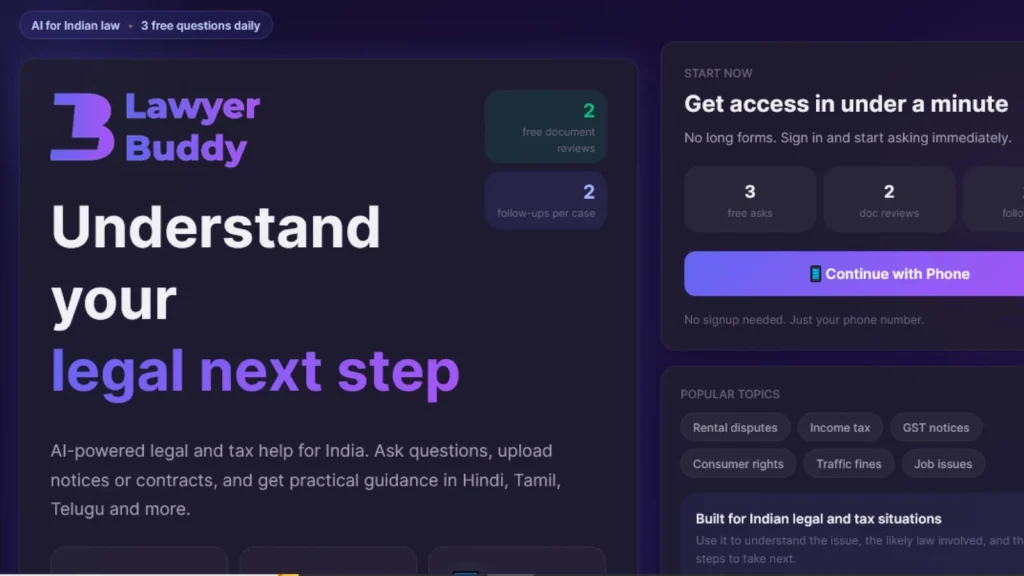
LawyerBuddy is an AI-powered legal and tax advisor built specifically for India, delivering instant guidance in multiple Indian languages without appointments or high consultation costs. Here is what it offers:
- Instant legal advice: Covering IPC, consumer rights, rental agreements, and property disputes
- Tax guidance: GST, income tax, and everyday tax queries for individuals and businesses
- Multilingual support: Ask in Hindi, Tamil, Telugu, and other Indian languages
- Consumer complaint guidance: Step-by-step support for filing and navigating consumer complaints
- Rental and property queries: Guidance on rental agreements and landlord-tenant disputes
- Affordable Access: To reliable legal and tax information at a fraction of traditional consultation costs
LawyerBuddy is especially useful for legal teams handling high volumes of routine client queries without adding overhead.
How to Choose Legal AI Tools for Your Practice
Choosing the right legal AI tools is less about features and more about fit. Start by listing the tasks in your practice that consume the most time but require the least strategic thinking; these are the highest-priority candidates for AI assistance.
Then evaluate platforms on four dimensions: accuracy (especially for Indian law if that is your jurisdiction), ease of use, integration with your existing software, and cost relative to time saved. Trial periods matter; most serious platforms offer a demo or free trial, and you should use it on a real matter from your practice, not a hypothetical one.
Pay attention to how the tool handles edge cases, ambiguous queries, and the specific practice areas you work in most. The goal is not to adopt as many platforms as possible; it is to adopt the two or three that genuinely replace the most frustrating, time-consuming parts of your current workflow.
Conclusion
Legal AI tools are no longer a future consideration for progressive firms; they are a present necessity for any practice that wants to stay competitive, serve more clients, and deliver better work without burning out its team. Start with the tasks that cost you the most time, choose tools built for your specific context, and build from there.
FAQ
Q: Are legal AI tools accurate enough to trust for real cases?
Most leading platforms are accurate for research and drafting assistance, but outputs should always be reviewed by a qualified lawyer before use in any live matter.
Q: Can these tools handle Indian law?
Yes, several platforms, including LawyerBuddy, BharatLaw AI, Manupatra, and SCC OnLine, are specifically built for Indian statutes and case law.
Q: Are these tools affordable for solo practitioners?
Many platforms offer tiered pricing, and tools like LawyerBuddy are specifically designed to be affordable for individual practitioners and consumers in India.
Q: Will AI tools replace lawyers?
No. Legal AI tools handle research, drafting, and routine queries, but legal judgement, negotiation, and advocacy remain firmly human skills.