

Artificial intelligence is rapidly changing the legal industry and how research, contracts, and compliance are handled. What once required hours of manual work by legal professionals can now be supported and, in some cases, accelerated by intelligent software. This shift has led to the rise of AI legal assistance, a category of tools that support lawyers, businesses, and legal teams in handling complex legal tasks more efficiently.
AI legal assistance refers to software powered by technologies such as machine learning and natural language processing that can analyze legal documents, extract insights, and automate repetitive workflows. These tools are not lawyers and do not replace legal expertise. Instead, they act as assistants, helping professionals reduce costs and improve productivity while still requiring human judgment for critical decisions.
However, alongside these benefits, there are important limitations and risks to consider. Issues such as inaccurate outputs, data privacy concerns, and AI hallucinations make it essential to use these tools carefully, especially in high-stakes legal contexts.
In this guide, we will break down everything you need to know about AI legal assistance in 2026
How it works, where it is being used, its advantages and risks, and how to choose the right tools for your needs.
What Is AI Legal Assistance, and How Does Legal AI Assistance Work?
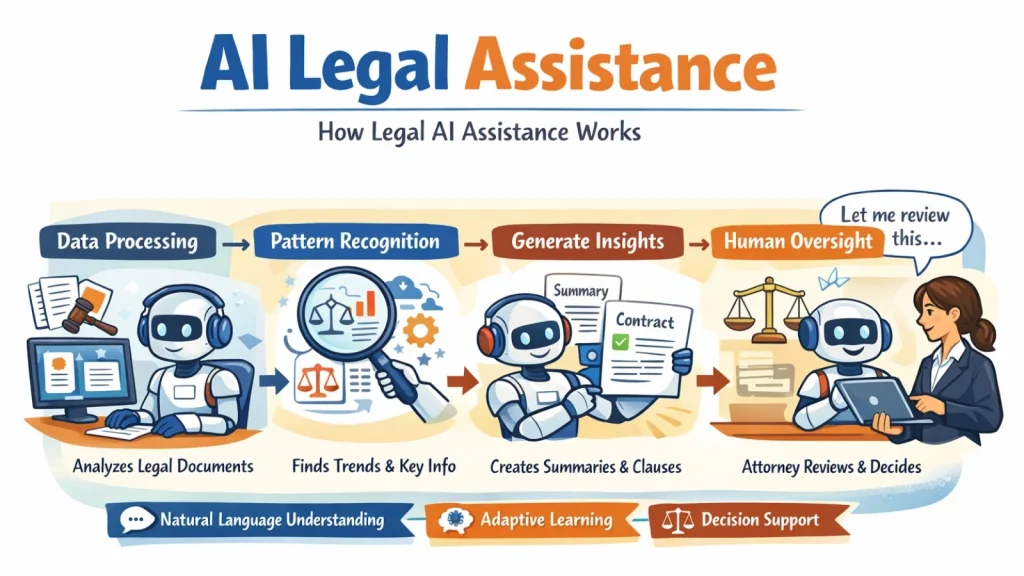
AI legal assistance refers to software systems that are designed to support legal work. These tools use artificial intelligence to process large volumes of legal data, identify patterns, and generate useful outputs such as summaries, contract clauses, or research insights. In simple terms, legal assistance AI helps reduce manual effort in tasks that are repetitive, time-consuming, or data-heavy.
Unlike traditional legal software, which relies on fixed rules, modern legal AI assistance adapts and improves based on data. It can understand context, interpret language, and assist with decision-making support, but it still depends on human oversight for accuracy and judgment.
Definition of AI Legal Assistance
AI legal assistance tools are built to augment legal professionals, not act as independent decision-makers. They are commonly used by:
- Law firms handling large volumes of documents
- In-house legal teams managing compliance and contracts
- Startups and businesses seeking legal support
These tools can review contracts, highlight risks, suggest edits, and even answer legal research queries. However, they do not hold legal authority, cannot represent clients, and should not be relied on as a sole source of legal advice.
How Legal AI Assistance Works (ML, NLP, Legal Data)
At a technical level, legal AI assistance is powered by a combination of:
- Machine Learning (ML): Enables systems to learn from past legal data and improve over time
- Natural Language Processing (NLP): Allows AI to understand and interpret complex legal language
- Legal Knowledge Bases: Structured datasets of case law, regulations, and contracts
When you upload a document or ask a question, the AI analyzes the input, compares it with its training data, and generates a response, such as identifying risky clauses or summarizing a case.
Automation vs Human Lawyers: Key Differences
While AI can automate many legal tasks, there is a clear distinction between automation and professional legal judgment:
- AI excels at speed, scale, and pattern recognition
- Lawyers provide context, interpretation, and accountability
For example, an AI tool can flag unusual contract terms, but a lawyer determines whether those terms are legally acceptable in a specific situation. This balance is critical, especially in complex or high-risk legal issues.
Evolution of AI in the Legal Industry
Legal AI has evolved significantly over the past decade. Early tools focused on basic keyword searches and document storage. Today, AI-powered systems can:
- Analyze thousands of documents in minutes
- Provide contextual legal insights
- Assist in drafting and reviewing contracts
As the technology continues to improve, AI legal assistance is becoming a standard part of modern legal workflows, not as a replacement for lawyers, but as a powerful support system that enhances how legal work gets done.
Key Use Cases of AI-Powered Legal Assistance In 2026
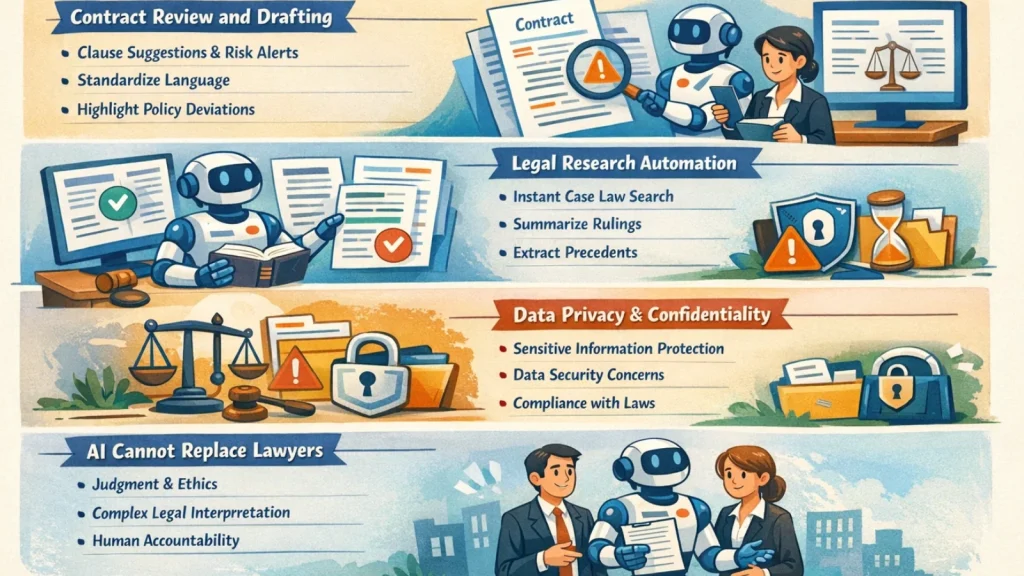
AI legal assistance is most valuable when applied to real, high-impact legal tasks. Instead of thinking of it as a general-purpose tool, it’s better understood through its use cases, where it saves time, reduces manual effort, and improves consistency. Each of the following applications shows how legal AI assistance delivers practical value in day-to-day legal work.
Contract Review and Drafting
One of the most widely adopted use cases is contract analysis. AI tools can quickly scan agreements, identify key clauses, and flag potential risks such as missing terms, ambiguous language, or non-standard provisions.
In drafting, AI can:
- Suggest clause templates based on context
- Standardize contract language
- Highlight deviations from company policies
This significantly reduces the time lawyers spend on repetitive drafting while improving consistency across documents. However, the final review still requires human expertise to ensure legal validity.
Legal Research Automation
Legal research traditionally takes hours of reading case law, statutes, and precedents. AI legal assistance tools can compress this process into minutes by:
- Searching vast legal databases instantly
- Summarizing judgments and legal opinions
- Extracting relevant precedents for specific queries
This allows legal professionals to focus more on analysis and strategy, rather than manual research. That said, AI-generated summaries should always be verified against sources.
AI-generated legal content must be cross-checked against trusted sources or reviewed by a qualified professional.
Accuracy, Bias, and Data Limitations
AI systems are only as reliable as the data they are trained on. This creates several challenges:
- Outdated information: Legal systems change frequently, and AI may not reflect the latest regulations
- Bias in training data: Historical legal data can contain biases that AI may replicate
- Context limitations: AI may struggle with nuanced or highly specific legal scenarios
This means legal AI assistance can provide helpful insights, but it cannot fully understand the contextual complexity of law in the way humans can.
Data Privacy and Confidentiality Concerns
Legal work often involves sensitive and confidential information. Using AI tools introduces risks related to:
- Data storage and handling
- Third-party access to legal documents
- Potential data leaks or misuse
Before using any AI-powered legal assistance tool, it’s important to evaluate:
- Whether data is encrypted
- How information is stored and processed
- If the tool complies with relevant data protection laws
Failure to manage these risks can lead to breaches of confidentiality, which are especially serious in legal practice.
Also Read!
How Legal Advice AI Is Making Justice Accessible To Everyone
What Happens When You Ask AI Lawyer Tools for Legal Advice?
Why AI Legal Assistance Cannot Replace Lawyers
Despite its capabilities, AI legal assistance cannot replace human lawyers. Legal work requires:
- Judgment based on context and experience
- Ethical responsibility and accountability
- The ability to interpret complex, ambiguous situations
AI can assist with analysis and automation, but it cannot take responsibility for legal decisions or represent clients. It cannot apply judgment in unpredictable, real-world scenarios.
AI legal assistance should be viewed as a support tool, not a decision-maker. Used correctly, it can enhance productivity and streamline workflows. Used blindly, it can introduce risks that outweigh its benefits.
AI Legal Policy Assistance: Compliance, Regulations, and Ethics
As AI becomes more integrated into legal workflows, policy, regulation, and ethical use are becoming just as important as functionality. AI legal policy assistance focuses on helping organizations stay compliant while also ensuring that AI tools themselves are used responsibly within legal boundaries.
Role of AI in Legal Compliance
Compliance is a moving target; laws and regulations change frequently, and businesses must adapt quickly. AI legal assistance can support compliance efforts by:
- Tracking regulatory updates across jurisdictions
- Mapping internal policies to current legal requirements
- Identifying gaps or risks in compliance documentation
- Automating routine compliance checks
This is especially valuable for companies operating in multiple regions, where manual compliance tracking can be complex and resource-intensive.
Regulatory Landscape in 2026
Governments and regulatory bodies are increasingly focusing on how AI is used in sensitive industries like law. In 2026, key trends in regulation include:
- Greater emphasis on AI transparency and explainability
- Requirements for human oversight in critical decisions
- Stricter rules around data protection and usage
- Industry-specific compliance standards for AI tools
Organizations using legal AI assistance must ensure that their tools align with these evolving regulations, particularly when dealing with client data or legal decision-making processes.
Ethical Challenges in Legal AI Usage
Beyond legal compliance, there are ethical considerations that cannot be overlooked. AI systems can unintentionally introduce issues such as:
- Bias in legal recommendations
- Lack of transparency in how decisions are generated
- Over-reliance on automation without human review
In legal contexts, these challenges carry significant weight. Decisions influenced by biased or opaque systems can impact fairness, accountability, and trust.
Responsible Adoption of AI Legal Tools
To use AI legal assistance effectively and responsibly, organizations should adopt clear practices:
- Always include human review for critical legal outputs
- Validate AI-generated results against trusted legal sources
- Use tools with strong data security and compliance standards
- Establish internal guidelines for AI usage in legal workflows
Responsible adoption is not just about avoiding risk; it’s about building a system where AI enhances legal work without compromising integrity or accountability.
As AI continues to evolve, the combination of compliance, regulation, and ethical awareness will define how successfully organizations can integrate AI legal assistance into their operations.
Best AI-Powered Legal Assistance Tools In 2026
One example of a modern AI legal assistance platform is LawyerBuddy, a tool to make legal and tax guidance more accessible, especially for users in India.
What Is LawyerBuddy?
LawyerBuddy is an AI-powered legal assistant that provides instant legal and tax advice in simple language. It is built to help individuals and businesses get quick answers without needing to go through traditional, time-consuming legal processes.
The platform focuses on accessibility, making legal support more affordable and easier to understand for everyday users.
Key Features Of LawyerBuddy
LawyerBuddy fits into the category of AI-powered legal assistance tools by offering:
- Instant Legal Guidance: Users can ask legal questions and receive quick, AI-generated responses
- Tax Assistance: Covers both legal and tax-related queries in one platform
- Multilingual Support: Designed to provide advice in local languages for better accessibility
- User-Friendly Interface: Simplifies complex legal concepts into easy-to-understand explanations
This makes it particularly useful for non-lawyers, startups, and small businesses who need basic legal clarity without high costs.
Important Consideration
Like all AI legal assistance tools, LawyerBuddy should be used with caution:
- It does not replace a qualified lawyer
- Outputs should be verified for accuracy
- Not suitable for complex legal disputes or high-risk decisions
Overall, LawyerBuddy represents how AI legal assistance is becoming more accessible and practical, bringing basic legal support closer to individuals and businesses while still requiring human expertise for critical matters.
Future Of AI Legal Assistance
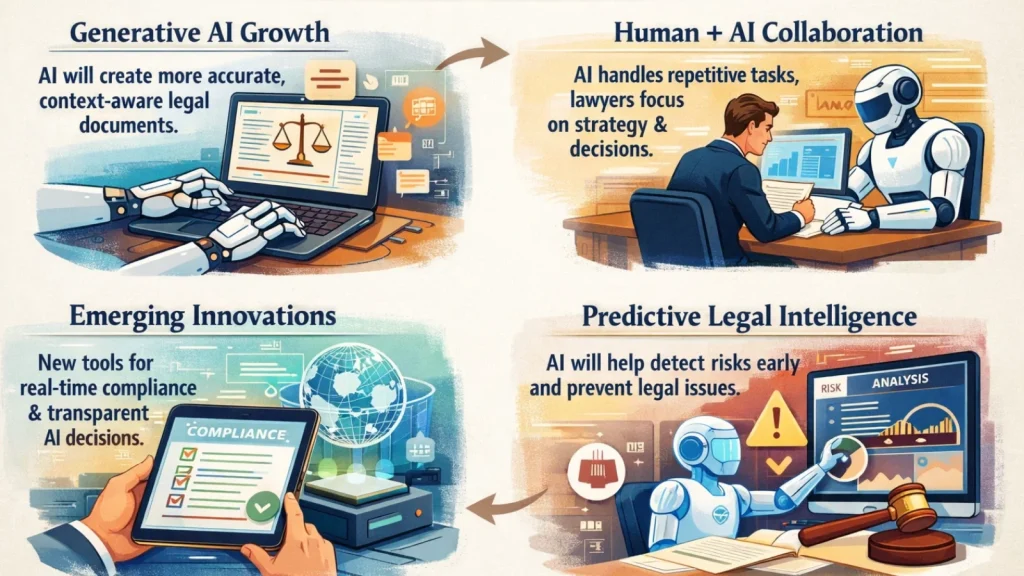
- Generative AI Growth: AI will create more accurate, context-aware legal documents.
- Human + AI Collaboration: AI will handle repetitive tasks while lawyers focus on strategy and decisions.
- Predictive Legal Intelligence: AI will help detect risks early and prevent legal issues.
- Emerging Innovations: New tools will enable real-time compliance tracking and more transparent AI decisions.
Conclusion
As we look toward the remainder of 2026 and beyond, it is clear that AI legal assistance is no longer a futuristic concept; it is a fundamental component of the modern legal geography. From streamlining contract lifecycles to providing instant tax guidance through platforms like LawyerBuddy, AI is successfully lowering the barriers to legal information and operational efficiency.
However, the rapid evolution of these tools serves as a reminder that technology is an augmentative force, not a replacement for human expertise. While legal assistance AI can process data at speeds impossible for humans, it lacks the ethical nuance, strategic empathy, and accountability that define a qualified legal professional.
For businesses, law firms, and individuals, the goal is not to choose between human and machine, but to foster a collaborative workflow. By leveraging AI for data-heavy tasks while maintaining strict human oversight to mitigate risks like hallucinations and bias, the legal industry can achieve a higher standard of accuracy and accessibility.
Frequently Asked Questions (FAQ)
1. Does using AI to draft documents waive the attorney-client privilege?
In 2026, this is a critical distinction. Under recent rulings (such as United States v. Heppner), documents created using public or consumer-grade AI may not be protected by attorney-client privilege if the AI provider reserves the right to use your data for training. To maintain privilege, you must use enterprise-level AI with strict “Zero Data Retention” (ZDR) policies that keep your data within your firm’s secure boundary.
2. Will AI legal assistance make hiring a lawyer cheaper for me?
While AI significantly reduces the time spent on “first drafts” and research, it hasn’t necessarily lowered hourly rates. Instead, many firms are shifting toward value-based pricing. This means you might pay a flat fee for a high-quality, AI-assisted contract that is reviewed and guaranteed by a lawyer, rather than paying for 10 hours of manual research.
3. Can I cite AI-generated research directly in court?
No. Courts in 2026 have become increasingly strict, with many jurisdictions requiring lawyers to sign “AI Disclosure Statements.” Citing a hallucinated or unverified case can lead to heavy financial penalties and professional sanctions. Every AI-generated citation must be manually cross-referenced against official legal databases before being submitted to a tribunal.
4. How do I know if a legal AI tool is “compliant” with 2026 regulations?
Look for tools that explicitly mention compliance with the EU AI Act (the global gold standard for AI regulation) or local standards like the CCPA. A compliant tool should offer “explainability,” meaning it can show you exactly which statute or case it used to generate its answer and provide an audit log of how your data was processed.