


The Short Answer (And Why It’s More Complicated Than You Think)
Legal research AI is not replacing lawyers. It is changing what clients expect from them. Tasks that once took hours now take minutes, which means the value of legal work is shifting away from raw information gathering and toward analysis, judgment, and strategy.
That fear about replacement is understandable. Many junior associates built their careers around deep research work. But the firms gaining the biggest advantage are not eliminating lawyers. They are removing repetitive research bottlenecks.
Here is what is actually happening:
- Legal research AI handles large-scale information review much faster than humans
- Lawyers still make the final judgment calls, strategy decisions, and ethical evaluations
- Firms using AI effectively are raising productivity expectations across the industry
The real divide is not lawyers versus AI. It is lawyers who know how to use these systems versus those who ignore them.
What Legal Research AI Can Actually Do (Without the Marketing Spin)
Some vendors talk about AI as though it can run an entire legal practice on its own. That is not reality. Legal research AI works best when it handles structured, repeatable tasks that depend on pattern recognition and fast retrieval.
Where AI Genuinely Excels
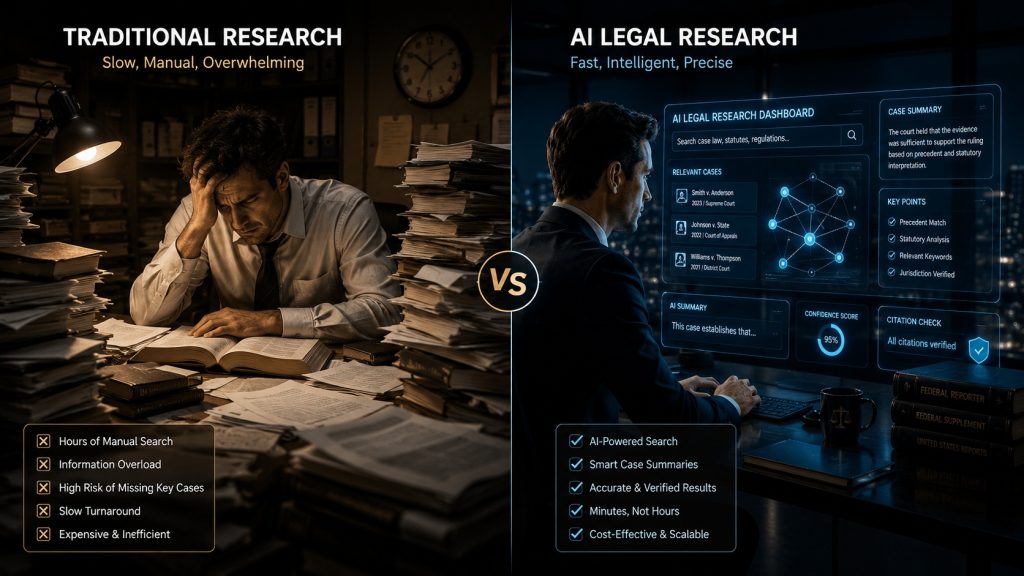
Case law search is one of the strongest use cases. A lawyer can upload a brief or describe a dispute and receive relevant precedents within seconds. That speed matters when deadlines are tight or discovery becomes overwhelming.
Summarization is another major strength. Instead of reading hundreds of pages line by line, lawyers can quickly review condensed findings before deciding what deserves closer inspection. This is especially useful during early-stage litigation preparation.
Many tools also perform well with:
- Statute and regulation cross-referencing
- Citation verification
- Drafting research memos
- Identifying conflicting precedents across jurisdictions
- Issue spotting during intake reviews
One litigation team reportedly reduced research preparation from two days to a few hours by combining human review with legal research AI workflows. The lawyers still verified every citation, but the first-pass workload dropped dramatically.
Where It Still Falls Short
The weaknesses matter just as much as the strengths.
Legal research AI still struggles with nuance tied to local court behavior, judicial tendencies, and strategic interpretation. A system may surface the right precedent while missing why a judge routinely rejects similar arguments.
Hallucinated citations remain a serious risk. Several widely discussed court filings included fake cases generated by AI systems because lawyers failed to verify the output. That problem damaged credibility and sparked broader conversations about professional responsibility.
AI also cannot fully understand:
- Client risk tolerance
- Negotiation psychology
- Ethical gray areas
- Political realities surrounding litigation
- Context hidden between the lines of a dispute
This is why experienced attorneys still matter. The software can gather information quickly. It cannot replace legal judgment.
The Real Shift: From Legal Researcher to Legal Strategist

For decades, junior legal work revolved around document review, precedent searches, and long hours spent organizing information. Legal research AI is compressing those tasks into far shorter workflows.
That changes the economics of legal work.
A first-year associate who once spent 70% of their week searching databases may now spend more time evaluating arguments, preparing strategy recommendations, or advising clients directly. The value is moving higher up the decision chain.
Some firms are already adjusting billing structures because clients no longer want to pay for slow manual research that software can accelerate. They still pay for expertise. They still pay for strategic thinking. But they increasingly question inefficient workflows.
This creates a growing competitive gap.
Law firms adopting AI tools for legal research are often responding faster, reviewing larger volumes of information, and handling smaller matters more profitably. Firms resisting these tools may eventually struggle to justify slower turnaround times.
That does not mean every lawyer must become a technologist. It does mean legal professionals need enough AI literacy to supervise the process intelligently.
How Legal Professionals Are Actually Using AI for Legal Research Today
The conversation becomes much clearer when you look at real workflows instead of theoretical claims.
Solo Practitioners and Small Firms
Smaller firms are using legal research AI to compete with organizations that once had overwhelming research advantages. A solo attorney can now scan case law, summarize rulings, and prepare preliminary research memos without maintaining a massive support team.
That speed is especially valuable in high-volume practice areas where margins are tighter and response time matters.
Litigation Teams
Litigation teams often use AI during discovery preparation and argument development.
For example, a lawyer preparing for a deposition may ask the system to identify contradictions across hundreds of documents, surface related precedents, or generate counterargument frameworks. Human review still controls the final strategy, but the research phase moves much faster.
Corporate Legal Departments
Corporate teams are using ai for legal research to monitor compliance changes, review contracts, and track evolving regulations across multiple regions.
That matters because in-house departments rarely have unlimited resources. Faster research helps legal teams focus attention on higher-risk business decisions instead of repetitive review tasks.
Law Students and Academics
Law students are also adopting legal research AI during moot court preparation, journal work, and case briefing.
The ethical debate is still evolving. Some universities encourage supervised use, while others worry students may rely too heavily on generated summaries instead of developing core research skills.
The balance usually comes down to transparency and verification.
How to Choose the Right AI Tool for Legal Research (Without Getting Burned)
Not every platform marketed as a legal research AI is reliable enough for professional use. Many AItools for legal research look impressive in demos, but reliability matters far more than polished marketing.
Some tools produce polished summaries but fail when asked to explain where information came from. Others perform well in federal research but struggle with state-level coverage.
Before adopting any system, evaluate these areas carefully:
- Jurisdiction coverage and database depth
- Citation accuracy and verification safeguards
- Ability to explain reasoning transparently
- Integration with existing legal workflows
- Privacy and confidentiality protections
- Update frequency for regulations and case law
A useful rule is simple: if a tool cannot clearly show its sources, do not trust it with serious legal work.
You should also test edge cases. Ask how the system handles conflicting precedents or incomplete information. Weak tools often collapse when nuance enters the picture.
The best AI for legal research is usually not the one with the loudest marketing. It is the one that helps lawyers verify information quickly while keeping human oversight central.
Meet LawyerBuddy – AI Built Specifically for Legal Research

General-purpose AI systems can produce impressive language, but legal work requires much more than polished writing. LawyerBuddy was designed specifically around the realities of legal research workflows.
Instead of adapting a general chatbot to legal tasks, the platform focuses directly on how attorneys search, evaluate, and organize information.
Key capabilities include:
- Jurisdiction-aware legal research support
- Explainable case law reasoning
- Research memo drafting assistance
- Workflow support designed for practicing lawyers
This makes legal research AI more practical because the system is built around professional verification rather than generic content generation.
LawyerBuddy is particularly useful for solo practitioners, smaller firms, legal teams managing high research volume, and law students who need structured research assistance without enterprise complexity.
Accessibility also matters. Many firms want modern research support but cannot justify expensive enterprise deployments. LawyerBuddy positions itself as a more approachable starting point.
The Mistakes Lawyers Make When They First Start Using AI
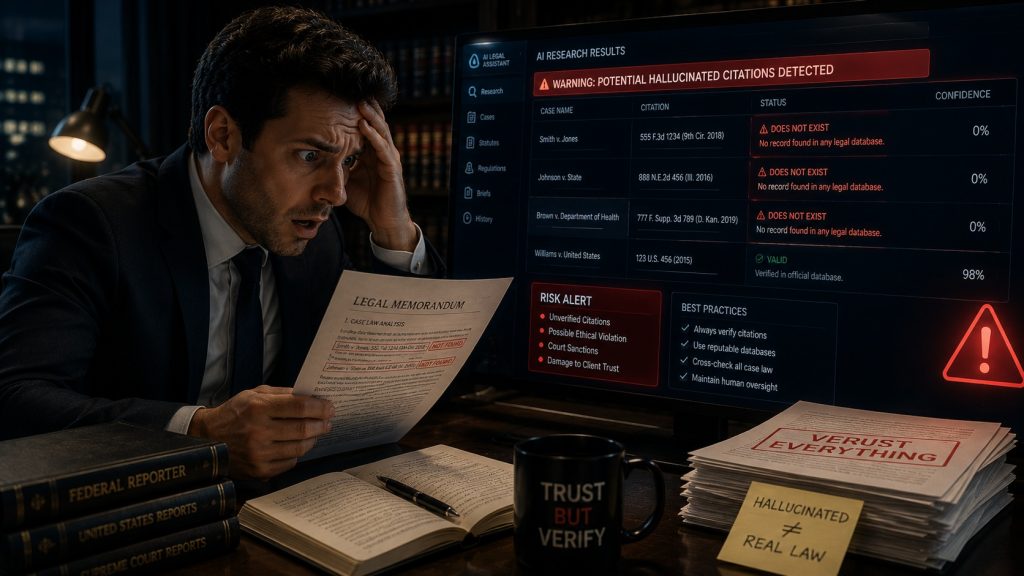
The biggest mistake is trusting AI-generated citations without verification. Legal research AI can accelerate research dramatically, but fabricated cases still appear when lawyers skip the review process.
Another common issue is relying on general AI platforms instead of legal-specific systems. Broad consumer tools may sound confident while lacking reliable legal databases underneath.
Some lawyers also treat AI as a replacement for judgment instead of a research accelerator. That mindset creates risk quickly.
Disclosure rules are another growing concern. Several bar associations have already issued guidance suggesting lawyers may need transparency around AI-assisted workflows in certain situations.
Finally, many users overestimate how well AI understands local legal nuance. State-level procedural culture and judicial tendencies still require human interpretation.
Read More!
What Does an Intellectual Property Lawyer Do? (And Do You Actually Need One?)
AI Tools for Lawyers: Everything You Need to Know (Top Tools)
The Deeper Shift Nobody’s Talking About
Legal culture has long connected professional value with the ability to perform exhaustive manual research. Associates proved themselves through long nights reviewing cases and building research trails from scratch.
Legal research AI disrupts that identity.
The new expectation is not necessarily, “Did you personally read every document?” Increasingly, the question becomes, “Did you validate the findings intelligently and use them strategically?”
That shift feels uncomfortable for some lawyers because it changes how expertise is demonstrated.
Top law schools are already adjusting. AI literacy is becoming part of broader legal competency discussions. Students are being taught not only how to research, but also how to supervise automated systems responsibly.
Over the next several years, refusing to engage with these tools may start looking less like caution and more like a professional limitation.
So, Is AI Replacing Legal Research, or Replacing Bad Legal Research?
The lawyers most at risk are not necessarily the ones using AI. They are the ones relying on slow, surface-level research while competitors work faster and verify more effectively.
Legal research AI is raising the baseline expectation for efficiency. Clients increasingly expect faster turnaround, broader research coverage, and sharper analysis.
Used carefully, these systems are not shortcuts. They are force multipliers.
The firms gaining the most value are not handing control to algorithms. They are combining human judgment with faster information processing.
That balance matters.
The future of legal work will still belong to skilled attorneys. But the definition of a skilled attorney is changing quickly. Adopting legal research AI thoughtfully, verifying rigorously, and building AI literacy now may become one of the biggest professional advantages a lawyer can develop.
For many legal professionals, LawyerBuddy is a practical place to begin.
FAQ – What People Are Actually Asking About Legal Research AI
Can AI replace legal research entirely?
No. Legal research AI can automate large portions of information gathering and summarization, but lawyers still provide interpretation, strategy, ethical judgment, and client-specific analysis.
Is AI-generated legal research ethically acceptable?
Generally, yes, if lawyers verify the output carefully and follow applicable professional conduct guidance. Problems usually arise when attorneys rely on unverified citations.
What is the best AI for legal research in 2025?
The answer depends on jurisdiction coverage, citation reliability, workflow integration, and transparency. Many firms prefer legal-specific systems over general-purpose chatbots.
How accurate is AI for finding case law?
Accuracy varies widely by platform. Legal research AI performs well with retrieval and summarization, but human verification remains essential before filing or advising clients.
Do lawyers need to disclose AI use to clients?
Some jurisdictions and bar associations are actively discussing disclosure expectations. Lawyers should review current ethical guidance carefully.