

**Join free today, get verified →
Your best client work in 2026 may start with a Hindi or Tamil prompt, not an English headnote. The short answer: you can now use ai legal question answering in indian languages to draft first-pass research, spot relevant provisions, and review vernacular documents faster, as long as you verify before filing. These tools respond in Hindi or Tamil, summarize judgments, translate legal ideas across languages, and highlight issues in affidavits and FIRs. They do not replace your skill under the Advocates Act, 1961. They simply cut the time from client call to a verified memo.
If you practice in Lucknow, Gwalior, Patna, Jaipur, Madurai, or Puducherry, you already know the language gap slows research. District courts use Hindi or Tamil for filings and oral exchanges, while most headnotes and treatises stay in English. Multilingual AI helps bridge that gap without breaking your ethics brief. We will work through tools, steps, and safeguards that fit Bar Council duties in 2026, not start-up slogans.
For deeper background on AI in practice, you can scan this primer on ai for legal research. It frames where human judgment must lead.
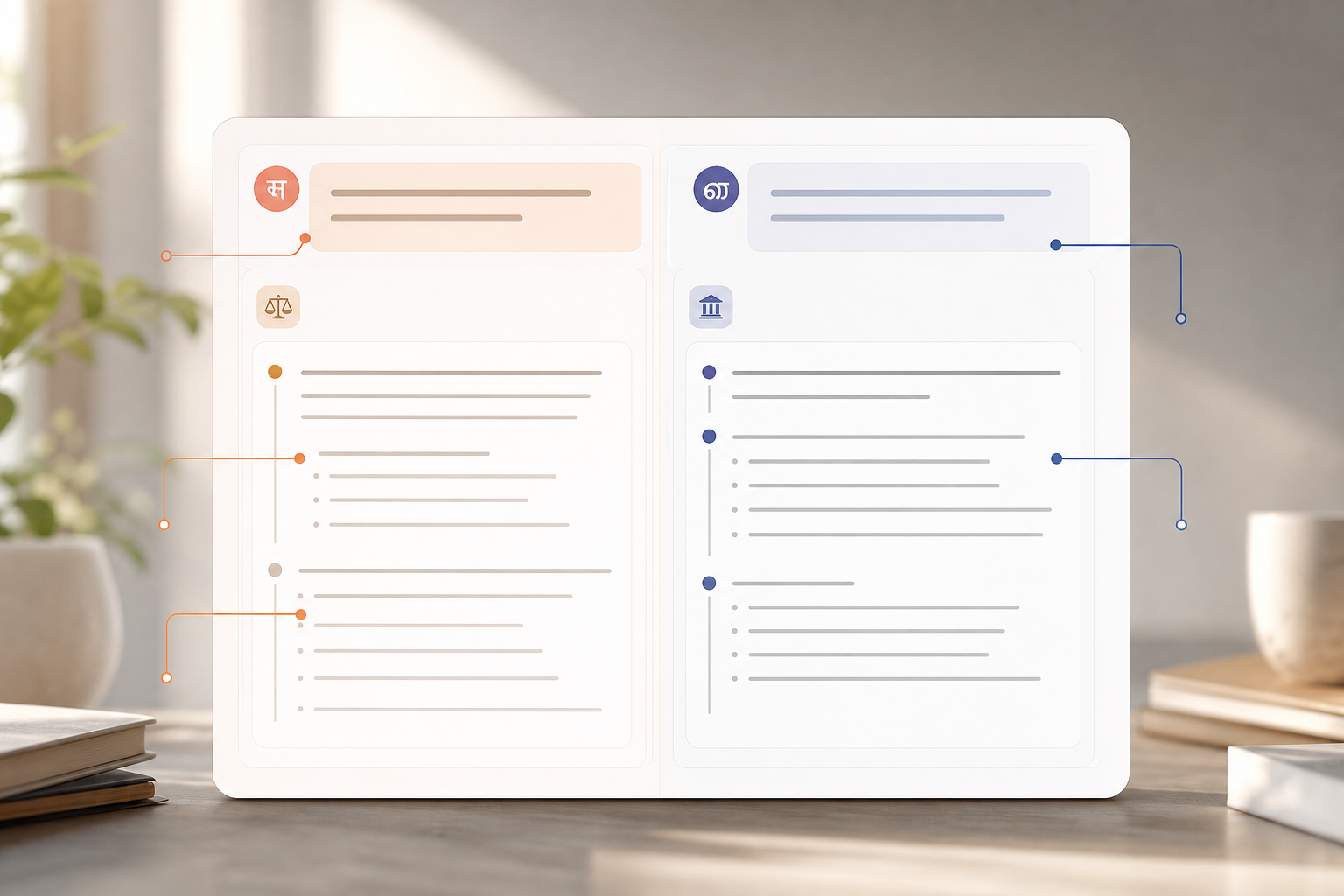
 , and finally to a court-ready memo; Indian legal icons, Devanagari and Tamil scripts visible; neutral law-chamber color palette)
Why Multilingual AI Legal Tools Matter for Indian Advocates Right Now
Let’s be candid. Many seniors distrust AI because they’ve seen wrong citations and generic answers. That skepticism is healthy.
Under the Advocates Act, 1961 and Bar Council of India rules, you remain personally responsible for advice and filings. No tool changes that. However, there is a practical need today: clients speak in Hindi or Tamil, district records arrive in those scripts, and you often handle matters across state lines where local language slows you down.
Here’s what the current crop of tools actually does for you:
- Answer legal queries in Hindi or Tamil script with citations you can cross-check.
- Summarize long judgments into crisp issue-holdings-ratio notes.
- Review vernacular documents (FIRs, complaints, sale deeds) and flag red flags.
- Translate core legal concepts between Hindi, Tamil, and English without losing meaning.
As a result, a tenant-dispute consult in Bareilly or a cheque-bounce brief in Madurai can move from rough notes to a structured memo in hours, not days. You still read the bare act. IPC, CrPC, the NI Act, the Specific Relief Act, and you still confirm the state amendment that governs your forum. But you spend your hours on the parts only you can do: strategy, jurisdiction, and bench craft.
Moreover, the profession’s duty “to act with dignity” and “not to abuse the process of court” aligns with responsible tech use. If AI helps you clarify Sections 41–42 CrPC bail questions in Hindi for a client’s understanding, or compare Section 21 grounds under the UP Rent Control Act, 1972 against facts, you serve the client better while staying within your oath.
What AI should and should not do
- Should: Draft a first-pass note on “UP Rent Control Act, 1972 — S.21 grounds” in Hindi for client clarity.
- Should not: Decide whether to press for S.21(1)(a) or S.21(1)(b) without you reading the latest Allahabad High Court orders.
- Should: Translate a Tamil sale agreement’s key covenants into English for vetting.
- Should not: Certify stamp duty compliance without you checking the state schedule.
In practice, treat ai legal question answering in indian languages as a research accelerator, not a replacement for your court sense.
Also Read!
How to Get AI Legal Advice in Hindi and Tamil for Rural India
Best AI Legal Advice in Hindi & Tamil for Rural India in 2026
Step-by-Step: Setting Up AI Legal Advice in Hindi and Tamil for Your Practice
Start small and keep control. Here’s a six-step playbook you can run this week.
-
Audit your caseload by forum and language
List matters with Hindi-heavy touchpoints: district courts in Uttar Pradesh, Madhya Pradesh, Bihar, and Rajasthan. Do the same for Tamil in Tamil Nadu and Puducherry. Mark where clients expect updates in their language. Tag older files where you lost time waiting for translations or typed copies. -
Choose tools that take Devanagari and Tamil script (not just romanized text)
Test with a real prompt in script, not Hinglish/Singlish.
-
Hindi test: “क्या किरायेदार को बिना नोटिस निकाल सकते हैं? Expected quality: The tool should ask jurisdiction, refer to the applicable Rent Control Act, and explain that eviction without notice is constrained by the statute and contract, with Section references to the correct state law.
-
Tamil test: “குத்தகைதாரருக்கு அறிவிப்பு இல்லாமல் வெளியேற்ற முடியுமா? Expected quality: It should cite the Tamil Nadu Buildings (Lease and Rent Control) Act provisions and flag due process. If the model stumbles on script input or guesses the wrong state, skip it.
-
Start with low-risk research tasks you can verify fast
Use AI to map relevant CrPC or IPC sections or to check whether the NI Act, 1881 Section 138 timelines were met. Then open your database to verify (SCC Online, Manupatra, or bare acts). For instance, ask in Hindi: “CrPC धारा 41ए नोटिस कब देना चाहिए? नवीनतम उच्चतम न्यायालय गाइडलाइंस बताएँ।” A good output lists Section 41A, links it to arrest guidelines, and flags that you must check the latest Supreme Court interpretation before relying on it. Cross-check, always. -
Build reusable prompt templates in Hindi/Tamil for your top-5 matter types
Keep them short and specific to forum and statute.
- Hindi — Tenant dispute (UP): “प्रश्न: UP Rent Control Act, 1972 की धारा 21 के तहत बेदखली के आधार क्या हैं? न्यायालय: लखनऊ, जिला न्यायालय. तथ्यों का सार: [50 शब्द].
अपेक्षित आउटपुट: प्रासंगिक धाराएँ, 3 प्रमुख केस, नोटिस की आवश्यकता, किराया बकाया का आकलन.
- Hindi — Cheque bounce: “NI Act, 1881 की धारा 138 — नोटिस की समय-सीमा, प्रेजेंटेशन, और कॉज़ ऑफ़ एक्शन की गणना करें. तथ्यों का सार: [तारीखें].
अपेक्षित आउटपुट: समय-रेखा तालिका + लागू केस.
- Tamil — Matrimonial (HMA Sec 13): “HMA, 1955 பிரிவு 13 விவாகரத்து காரணங்கள்; சென்னை குடும்ப நீதிமன்றம். உண்மைச் சூழல்: [50 சொற்கள்].
வேண்டிய விளைவு: பிரிவு-வாரி குறிப்பு, 3 முன்னணி தீர்ப்புகள், சமரசம் சாத்தியம் குறிப்பு.
- Tamil — Land revenue: “தமிழ்நாடு நில வருவாய் சட்டத்தின் கீழ் பட்டா பெயர் மாற்றம் நடைமுறை. மாவட்டம்: மதுரை.
வெளியீடு: படிப்படியான நடைமுறை + சமீபத்திய உயர்நீதிமன்ற வழிகாட்டுதல்.
Store these as text snippets. Over time, refine the expected output checklist.
-
Use AI for vernacular document review before drafting
Upload FIR copies, affidavits, or sale deeds in Hindi/Tamil. Ask for a “red-flag” list: missing dates, inconsistent parties’ names, stamp and registration hints, or tenancy duration gaps. Then do your own mark-up. For example, “इस FIR में धारा 420 IPC का उल्लेख उचित है? तथ्यों के अनुसार वैकल्पिक धाराएँ सुझाएँ।” Expect the tool to map facts to sections (e.g., 406/417) but you decide the final framing. -
Create a verification checklist and enforce it
Before any filing or advice goes out, confirm:
- Citation exists on SCC Online or Manupatra (or an official report).
- Section numbers and state amendments match your forum.
- The judgment is not stayed or overruled.
- Translational sense is intact when you move from Hindi/Tamil to English draft.
- Dates and sums in timelines (e.g., NI Act S.138) add up.
Aim for tools that reduce work without locking you in. A good benchmark is “5 free legal questions answered daily”, “5 free document reviews daily”, and “2 follow-up questions per case” during your trials. Those limits keep juniors from overusing prompts and force focus.
For broader context, see the explainer on ai legal assistant. It clarifies where prompts help and where they don’t.
Common Mistakes Advocates Make with AI Legal Tools in Indian Languages
Even strong Hindi/Tamil models make language-specific errors. Here are five traps and how to avoid them.
-
Trusting citations without verification
Hindi and Tamil outputs can misstate neutral citation formats or attribute a holding to the wrong bench. Always verify on SCC Online, Manupatra, or an official reporter. Treat the AI output as a lead, not gospel. Document your check in your file note. -
Using romanized Hindi instead of Devanagari
“kya tenant ko notice dena zaroori hai” is vague. “क्या किरायेदार को नोटिस देना ज़रूरी है?” is clear. Romanization dilutes legal terms (“नोटिस”, “समन”, “धारा”) and drops diacritics that guide meaning. In Tamil, avoid “kutthagaidharar” for “குத்தகைதாரர்”. Script input raises accuracy and reduces back-and-forth. -
Asking vague, India-wide questions
“rent law in India” invites a generic essay. “UP Rent Control Act, 1972 Section 21, बेदखली के आधार और नोटिस आवश्यकता (लखनऊ, जिला न्यायालय)” yields a focused, verifiable note. Name the forum, the statute, and the section. Do the same with “Tamil Nadu Buildings (Lease and Rent Control) Act, eviction on wilful default”. -
Ignoring state-specific variations
Central acts coexist with state tweaks. Tamil Nadu’s rent control setup differs from “model” rent laws. Maharashtra’s stamp schedules differ from Tamil Nadu’s. Ask the tool to confirm the state and year of the amendment. If it cannot, assume the answer is incomplete. -
Over-relying on AI for courtroom language
AI writes in textbook tone. Your bench may prefer concise facts and one controlling precedent. Convert the AI draft into the voice your court expects, and trim to the issues framed. Local standing orders and recent unreported orders matter more than a neat paragraph.
Ethics note: You remain responsible for all filings and advice. AI can draft a first pass, but you sign and argue. Keep a record of prompts, outputs, and verification steps in your brief.
Add one more guardrail: write down your “do not answer” list for juniors, bail strategy under CrPC, 1973 Sections 41 to 60 without you; admissions in family matters; or final settlement figures. For those, the tool may collect facts, but no conclusions go out without your review. That’s how ai legal question answering in indian languages stays an aid, not a crutch.
For a practical lens on tooling choices, this field guide to legal ai technology breaks down trade-offs you’ll face.
Also Read!
Best Lawyer Bidding Marketplace for Advocates in 2026
LawyerBuddy vs LegalKart for Advocates: Which Is the Better Lawyer Bidding Marketplace?
Tools and Resources for Hindi and Tamil Legal AI Research
No single tool covers all needs. Combine two or three.
-
Indian Kanoon
A free, strong database, including many Hindi judgments searchable in Devanagari. Limited AI, but good reach. Use it to confirm quotes and to scan headnotes. Do not rely on user summaries; read the judgment segment you cite. -
Government portals
The e-Courts Services portal shows case status and orders, with Hindi and Tamil interfaces in many districts. Use it for cause lists and basic history. Start here: e-Courts Services. For trend checks, the National Judicial Data Grid helps with pendency snapshots; use it to stress-test case timelines you plan to tell a client. -
General-purpose assistants
ChatGPT, Claude, and Gemini all handle Hindi and Tamil inputs. Gemini has broad Indic language coverage; Claude is careful with reasoning; ChatGPT is fast for drafts. Treat them as conversation partners for issue spotting, then verify. -
Specialized platforms
Tools like LawyerBuddy offer AI-powered legal and tax help for India, with Support for multiple languages including Hindi, Tamil, and Telugu. One useful feature is AI-structured case mandates with jurisdiction, issue, budget, and documents pre-organised. That helps you assess fit before you accept a matter, especially when time is short. It’s Free to register, no subscription fee, and a 100% Bar Council verified panel gives clients and advocates clarity on who’s on the platform. Escrow keeps your fee safe till regulatory cooldown, which reduces payment risk. -
SCC Online and Manupatra
Paid databases with reliable reporters and, in some modules, Hindi translations of select judgments. Use these as your primary verification layer for any AI draft.
Honest take: use a general assistant to draft in Hindi/Tamil, a specialized platform to intake and structure matters, and a paid database to verify citations. That trio keeps ai legal question answering in indian languages accurate, fast, and file-ready.
For tool-by-tool pros and cons from a practical angle, see this review of ai tools for legal research.
 , e-Courts (status), Gemini/Claude/ChatGPT (assistants), LawyerBuddy (specialized platform), SCC/Manupatra (verification); include script icons and “verify before filing” banner)
Key Takeaways for Advocates Using AI in Hindi and Tamil
- Treat ai legal question answering in indian languages as a first draft, never a final word; verify every citation and section.
- Use script input (Devanagari/Tamil) with jurisdiction, statute, and section to raise answer quality.
- Start with low-risk tasks: map CrPC/IPC/NI Act sections, summarize orders, and review vernacular documents.
- Build and refine Hindi/Tamil prompt templates tied to your top matters and forums.
- Combine a general AI, a specialized intake tool, and a paid database for a complete workflow.
What to Do This Week: Building Your Multilingual AI Legal Workflow
- Monday: Choose, for example, tenant dispute (UP), cheque bounce (NI Act S.138), and HMA S.13 divorce. Draft one Hindi or Tamil prompt template for each with an “expected output” line.
- Tuesday: Run your templates on two different assistants. Measure three things: script handling, jurisdiction awareness, and section accuracy. Note where the tool asked the right clarifying questions.
- Wednesday: Take one pending file. Run the core legal question in the client’s language. Time two blocks: AI drafting time and verification time (SCC/Manupatra + bare act). Keep the stopwatch honest. Adjust prompts to cut verification time.
- Thursday: Write four checks: citation exists, section and state match, judgment not stayed/overruled, translation sense intact. Add one forum-specific check (e.g., Allahabad recent orders or Madras High Court stance on your issue).
- Friday: Walk them through the workflow. Assign them to prepare Hindi/Tamil memos with your template and the checklist attached. You do final edits and filings. This is also the day to set guardrails: which issues they can draft versus which need your direct hand.
As you settle into this rhythm, you will see shorter lead times on first opinions and fewer translation bottlenecks. If you want a deeper dive into tooling, this overview of legal ai technology adds context you can use in chambers.