
Every business deal, professional engagement, or property transaction carries risk. The one document that protects all parties from that risk, the contract agreement, is also one of the most misunderstood legal tools in everyday use. Whether you are a freelancer securing a client, a landlord renting out property, or a company onboarding a vendor, a poorly written contract can cost you everything.
This guide breaks down exactly what a contract agreement is, how to format one correctly, which clauses must never be left out, and the common mistakes that make contracts weak or unenforceable. By the end, you will have the knowledge to draft or review any contract with confidence.
What Is a Contract Agreement? (Meaning + Legal Definition)
A contract agreement is a legally enforceable document (or verbal arrangement) between two or more parties that outlines mutual obligations, rights, and remedies. In simple terms, it is a recorded promise, one that the law will uphold if either side fails to keep their end of the bargain.
The Indian Contract Act, 1872 (and equivalent statutes in most common-law countries) defines a contract as “an agreement enforceable by law.” That definition hinges on two words: agreement and enforceable. Not every agreement is a contract; only those that meet specific legal requirements cross that line.
Why does it matter in business and personal life?
- It creates a clear record of what was agreed, preventing memory-based disputes.
- It defines what happens when things go wrong, including termination, penalties, and remedies.
- It protects intellectual property, confidential data, and financial interests.
- Courts can enforce it, giving injured parties real legal recourse.
Essential Elements of a Valid Contract Agreement
A contract is only legally valid when it satisfies all of the following elements. Miss even one, and the agreement may be void or unenforceable.
1. Offer and Acceptance
One party must make a clear offer (to do or not do something), and the other must accept it unconditionally. A counteroffer kills the original offer.
2. Consideration
Both parties must give something of value, money, services, goods, or a promise. A contract without consideration is generally not enforceable. “I will pay you ₹50,000, and you will deliver the software” is a valid consideration on both sides.
3. Free Consent
Consent must be free, not obtained by coercion, undue influence, fraud, misrepresentation, or mistake. Contracts signed under duress can be voided.
4. Legal Capacity
Parties must be of sound mind and legal age (18+ in most jurisdictions). Contracts with minors or persons of unsound mind are voidable.
5. Lawful Object
The purpose of the contract must be legal. A contract to supply counterfeit goods or to commit any illegal act is void from the start.
Contract Agreement Format: The Exact Structure You Should Follow
A well-structured contract is easier to understand, harder to challenge, and far more likely to hold up in court. Here is the standard format used by legal professionals:
1. Title, Date, and Parties
The document title (e.g., “Service Agreement” or “Non-Disclosure Agreement”), the effective date, and the full legal names, addresses, and roles of all parties (“Party A” / “Party B” or “Client” / “Service Provider”) must appear at the top.
2. Recitals (Background of Agreement)
Recitals are the “WHEREAS” clauses that explain the context, why the parties are entering this agreement, their business relationship, and the commercial purpose. They do not create obligations but provide interpretive context.
3. Definitions Section (Avoid Ambiguity)
Define every key term used in the contract. “Deliverables,” “Confidential Information,” “Business Day,” “Intellectual Property”, all of these must be precisely defined to eliminate interpretation disputes.
4. Scope of Work / Purpose
This is the heart of the contract. Describe in specific detail what each party is obligated to do, deliver, or refrain from doing. A vague scope leads to the most common contract disputes.
5. Terms and Conditions
Include timelines, milestones, payment schedules, quality standards, and any conditions precedent that must be met before obligations kick in.
6. Key Clauses Section
This section covers the protective clauses, confidentiality, IP ownership, indemnity, termination, and dispute resolution. These are covered in detail in the next section.
7. Governing Law and Jurisdiction
Specify which country’s or state’s laws govern the contract, and which courts have jurisdiction over disputes. Without this, a cross-border dispute can turn into a procedural nightmare.
8. Signatures and Execution
The signature block must include names, titles, date of signing, and space for signatures of all authorized representatives. For companies, ensure the signatory has the authority to bind the organization.
How to Write a Contract Agreement (Step-by-Step Guide)
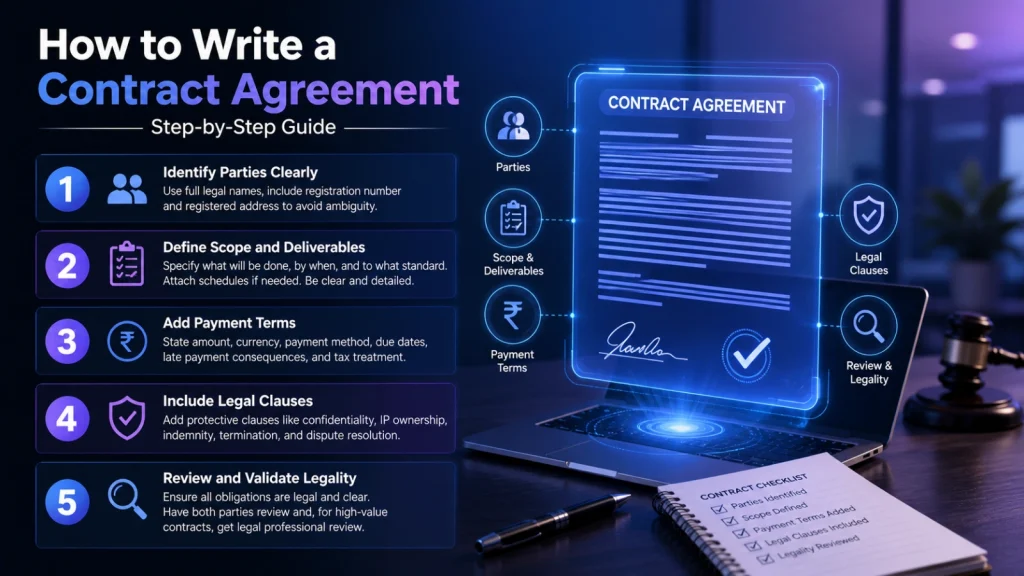
Writing a contract does not require a law degree, but it does require precision, completeness, and an understanding of what can go wrong. Follow these steps:
Step 1: Identify Parties Clearly
Use full legal names, not trading names or nicknames. For companies, include registration number and registered address. Ambiguity about who exactly is a party can invalidate enforcement.
Step 2: Define Scope and Deliverables
What exactly will be done? By when? To what standard? Attach schedules or annexures if the scope is complex. Avoid phrases like “reasonable efforts” without defining what that means in context.
Step 3: Add Payment Terms
State the amount, currency, payment method, due dates, and consequences for late payment. Include GST/tax treatment where applicable. Never leave payment terms as “to be discussed.”
Step 4: Include Legal Clauses
Add all the protective clauses discussed in the next section. These are not optional; they are the difference between a contract that protects you and one that merely legal documents an agreement.
Step 5: Review and Validate Legality
Before finalizing, verify that all obligations are legal, the contract does not violate any local statute, and both parties have reviewed and understood every clause. For high-value contracts, have a legal professional review them.
10 Must-Have Clauses in Every Contract Agreement
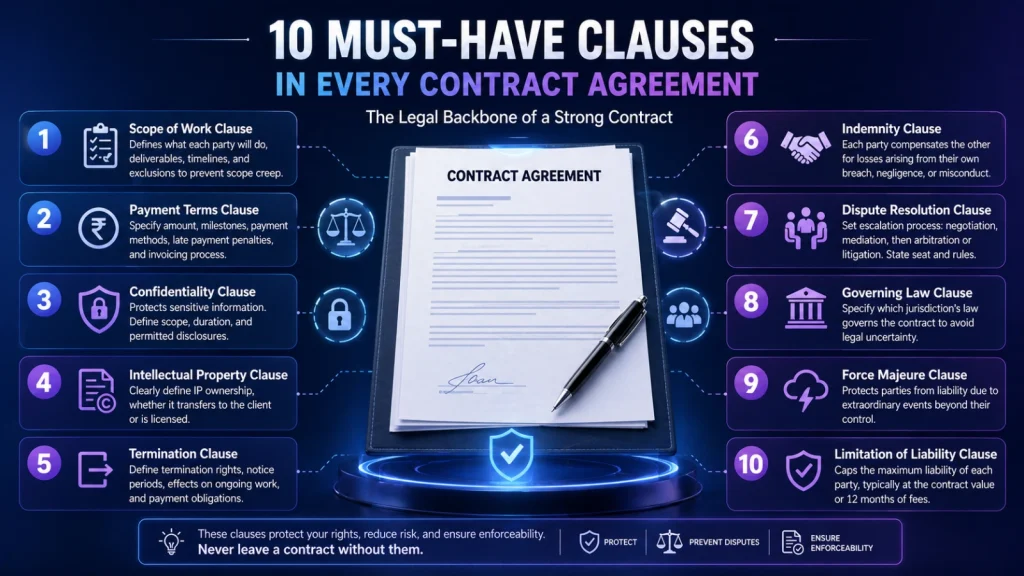
These ten clauses form the legal backbone of any strong contract. Omitting even one can leave a party exposed to serious risk.
1. Scope of Work Clause
This clause defines precisely what each party will do and what falls outside the agreement. It prevents scope creep, the silent budget-killer in service contracts. Include deliverables, timelines, and exclusions.
2. Payment Terms Clause
Specify the total amount, payment milestones, accepted payment methods, late payment penalties (e.g., 18% per annum interest), and the process for raising invoices. Clear payment terms reduce the single most common cause of contract disputes.
3. Confidentiality Clause
Also known as an NDA clause when embedded in a contract, this section prevents either party from disclosing sensitive information shared during the engagement. Define what constitutes confidential information, the duration of the obligation, and permitted disclosures (e.g., to legal counsel).
4. Intellectual Property Clause
Who owns the work product? Does IP transfer to the client upon payment, or does the service provider retain ownership and grant a license? This clause must be explicit; courts do not assume IP transfer unless it is stated.
5. Termination Clause
Outline conditions under which either party can end the contract, with or without cause. Include notice periods (e.g., 30 days’ written notice), what happens to in-progress work, and payment obligations upon termination.
6. Indemnity Clause
Each party agrees to compensate the other for losses arising from their own breach, negligence, or misconduct. Mutual indemnity clauses are standard; one-sided clauses should be scrutinized.
7. Dispute Resolution Clause
Specify the escalation process for disputes: negotiation first, then mediation, then arbitration or litigation. Including arbitration keeps disputes out of lengthy court proceedings. State the seat of arbitration and applicable rules (e.g., ICC, SIAC).
8. Governing Law Clause
State which jurisdiction’s law governs the contract. Critical for cross-border agreements where parties are in different states or countries. Inconsistency between this clause and the dispute resolution clause is a common, and costly, drafting error.
9. Force Majeure Clause
Protects parties from liability when obligations cannot be fulfilled due to extraordinary events beyond their control, such as natural disasters, pandemics, war, and government restrictions. The COVID-19 pandemic brought this clause into sharp focus globally.
10. Limitation of Liability Clause
Caps the maximum liability of each party. Without this, a service provider could theoretically be liable for losses far exceeding the contract value. Typical caps are set at the total contract value or 12 months of fees.
Also Read!
What Does an Intellectual Property Lawyer Do? (And Do You Actually Need One?)
AI Tools for Lawyers: Everything You Need to Know (Top Tools)
Contract Agreement Sample (Free Template Structure)
Below is a basic sample structure that can be adapted for most business service agreements:
SERVICE AGREEMENT
This Agreement is entered into as of [DATE] between:
Party A: [Full Legal Name], [Address] (“Client”)
Party B: [Full Legal Name], [Address] (“Service Provider”)
RECITALS: Whereas the Client requires [description of service] and the Service Provider has the expertise to deliver such services, the parties agree as follows:
1. SCOPE OF SERVICES: [Detailed description of deliverables and timelines]
2. PAYMENT: Client shall pay Service Provider ₹[AMOUNT] as follows: [schedule]
3. CONFIDENTIALITY: Each party agrees to keep confidential all Proprietary Information…
4. INTELLECTUAL PROPERTY: All work product created under this Agreement shall [vest in / be licensed to] Client upon full payment.
5. TERMINATION: Either party may terminate this Agreement with [30] days’ written notice.
6. GOVERNING LAW: This Agreement shall be governed by the laws of [State/Country].
IN WITNESS WHEREOF, the parties have executed this Agreement as of the date first written above.
Client: _______________________ Date: ___________
Service Provider: _____________ Date: ___________
This basic structure can be expanded with annexures for detailed scope, payment schedules, and project specifications. For specialized contracts (software development, construction, employment), additional clauses specific to the industry should be added.
Renters Agreement Contract: Format, Clauses & Example
A rental agreement contract (also called a rental or lease agreement) is one of the most frequently used contract types. It governs the relationship between a landlord and tenant for residential or commercial premises.
Key Clauses Specific to Rental Agreements
• Property Description: Full address and a description of the premises being rented.
• Rent Amount and Due Date: Monthly rent, due date (e.g., 1st of every month), and penalty for late payment.
• Security Deposit: Amount, conditions for deduction, and timeline for return after vacating.
• Maintenance Responsibilities: Who handles minor repairs vs. major structural work?
• Permitted Use: Residential only, subletting restrictions, pet policies.
• Notice Period: Advance notice required before vacating or for rent increases.
• Lock-In Period: Duration during which neither party can exit without penalty.
In India, rental agreements for 12 months or more must be registered under the Registration Act, 1908. Agreements of 11 months (a common workaround) require notarization but not registration, though registration provides stronger legal protection.
Common Mistakes That Make a Contract Agreement Weak or Invalid
Even well-intentioned contracts can collapse under legal scrutiny if they contain these common errors:
Vague Language
Phrases like “as soon as possible,” “high quality,” or “reasonable payment” create disputes. Every obligation must be measurable and specific.
Missing Clauses
Skipping termination, indemnity, or dispute resolution clauses is like building a house without a roof. The structure works until it rains.
No Jurisdiction Specified
Without a governing law clause, parties may end up fighting in multiple courts about which court has jurisdiction, before the main dispute is even addressed.
Copy-Paste Templates
Generic templates downloaded from the internet often do not account for your jurisdiction’s specific laws, your industry’s regulations, or the unique facts of your deal. Always customize.
Not Having Signing Authority
If the person signing on behalf of a company does not have board authorization or a valid Power of Attorney, the contract may not bind the company.
Unsigned Amendments
Verbal changes to a contract are almost impossible to enforce. All modifications must be documented in a written amendment signed by both parties.
Contradictory Clauses
Conflicting provisions in different sections of the same contract create ambiguity. Legal challenges exploit these inconsistencies to argue the clause most favorable to the challenger.
AI-Powered Legal Assistance
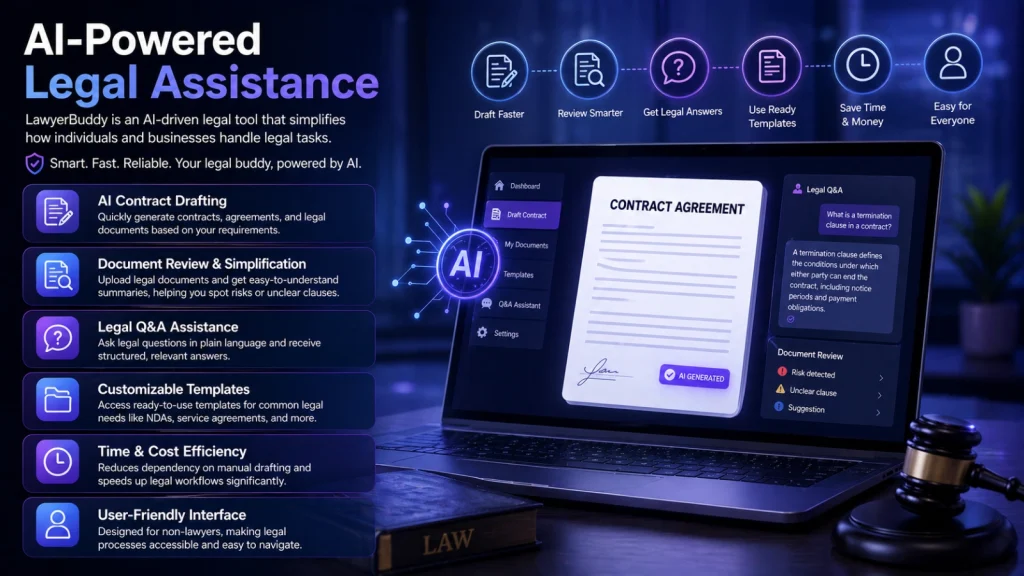
LawyerBuddy is an AI-driven legal tool designed to simplify how individuals and businesses handle legal tasks. Instead of spending hours drafting, reviewing, or understanding legal documents, this platform helps you get clear, structured, and legally relevant outputs in minutes.
It’s especially useful for freelancers, startups, and small businesses that need quick legal support without always relying on expensive consultations.
Key Features
AI Contract Drafting: Quickly generate contracts, agreements, and legal documents based on your requirements.
Document Review & Simplification: Upload legal documents and get easy-to-understand summaries, helping you spot risks or unclear clauses.
Legal Q&A Assistance: Ask legal questions in plain language and receive structured, relevant answers.
Customizable Templates: Access ready-to-use templates for common legal needs like NDAs, service agreements, and more.
Time & Cost Efficiency: Reduces dependency on manual drafting and speeds up legal workflows significantly.
User-Friendly Interface: Designed for non-lawyers, making legal processes accessible and easy to navigate.
Latest Best Practices for Contract Agreements (2025–2026)
Contract drafting is evolving rapidly. Here is what the best legal and business teams are doing differently today:
E-Signatures Are Now Standard
Under the Information Technology Act, 2000 (India) and equivalents globally, electronic signatures are legally valid for most contracts. Tools like DocuSign, Adobe Sign, and Leegality allow secure, auditable remote signing, eliminating the delays of physical courier.
Plain English Contracts
The movement toward plain language contracts is gaining ground globally. Courts have consistently held that ambiguous legalese is interpreted against the party that drafted the document. Clear, readable language reduces disputes and improves compliance.
Data Protection Clauses Are Non-Negotiable
With India’s Digital Personal Data Protection Act, 2023 (DPDP Act) now in force, any contract involving personal data must include data processing obligations, breach notification timelines, and data subject rights provisions. Ignoring this creates significant regulatory exposure.
Contract Automation and CLM Tools
Contract Lifecycle Management (CLM) platforms like Ironclad, Icertis, and SpotDraft are now standard in mid-to-large organizations. They automate creation, review, approval, and renewal tracking, reducing turnaround time from weeks to hours.
AI-Assisted Contract Review
AI tools can now flag missing clauses, identify unfavorable terms, benchmark against industry standards, and summarize complex agreements in minutes. While they do not replace legal review, they dramatically improve the speed and quality of initial analysis.
Conclusion: How to Create a Legally Strong Contract Agreement
A contract agreement is not just paperwork; it is the legal foundation of every professional and commercial relationship. When done correctly, it prevents disputes before they arise, resolves disagreements quickly when they do, and gives every party confidence that their interests are protected.
The key principles are consistency: be specific about obligations, include every essential clause, use plain language, define all key terms, and always specify governing law and dispute resolution. Never rely on a generic template without reviewing it carefully against your specific situation.
For routine agreements, a well-drafted template reviewed against the checklist in this guide will serve you well. For complex, high-value, or cross-border transactions, the cost of professional legal review is almost always less than the cost of a poorly drafted contract that fails when you need it most.
Start with the format, add the clauses, eliminate the ambiguity, and your contract agreement will be both legally strong and practically effective.
FAQs About Contract Agreements
What makes a contract legally binding?
A contract is legally binding when it contains a valid offer and acceptance, consideration from both sides, free consent of competent parties, and a lawful object. All five elements must be present.
Can I write my own contract agreement?
Yes. There is no legal requirement that a contract be drafted by a lawyer. However, for high-value or complex agreements, professional legal review reduces the risk of unenforceable clauses or missing protections.
Is a verbal contract valid?
Verbal contracts are valid in most jurisdictions for transactions below a certain value. However, they are extremely difficult to prove. Written contracts are always preferable because they create a clear, documented record of what was agreed.
What happens if a contract is breached?
The non-breaching party can pursue remedies including specific performance (compelling the breaching party to fulfill their obligation), damages (monetary compensation), rescission (cancellation of the contract), or restitution (returning parties to their pre-contract position).
Do contracts need to be notarized?
Notarization is not required for most contracts to be legally enforceable. However, certain documents, property sales deeds, powers of attorney, and some rental agreements do require registration or notarization under specific statutes.
How long should I keep contracts?
Most jurisdictions have a limitation period of 3–6 years for contract claims (3 years under the Indian Limitation Act, 1963, for most contracts). Best practice is to retain contracts for at least 7–10 years after expiry.