


Here’s the fast answer for rural India: in 2026, ai legal document review lets you scan a land deed, loan form, or court notice on your smartphone, run it through a low‑data tool in your language, get a short, clear summary, and choose your next step. It doesn’t replace a good advocate, it helps you reach one with the right questions.
Start a free AI document check today →
Think of it like getting a second opinion from a knowledgeable friend before you sign or respond.
About 70% of Indians live outside cities, yet most legal notices still arrive in English or formal Hindi. With ai legal document review, you can scan a document on your phone, get a plain-language summary, see key risks, and then decide if you need to speak to a lawyer.
Moreover, this guide respects your time and your reality: spotty internet, unfamiliar tech, and long bus rides to the district court. You’ll learn step-by-step methods that work offline-first, tips to avoid common errors, and safe ways to connect with verified lawyers when the stakes are high.
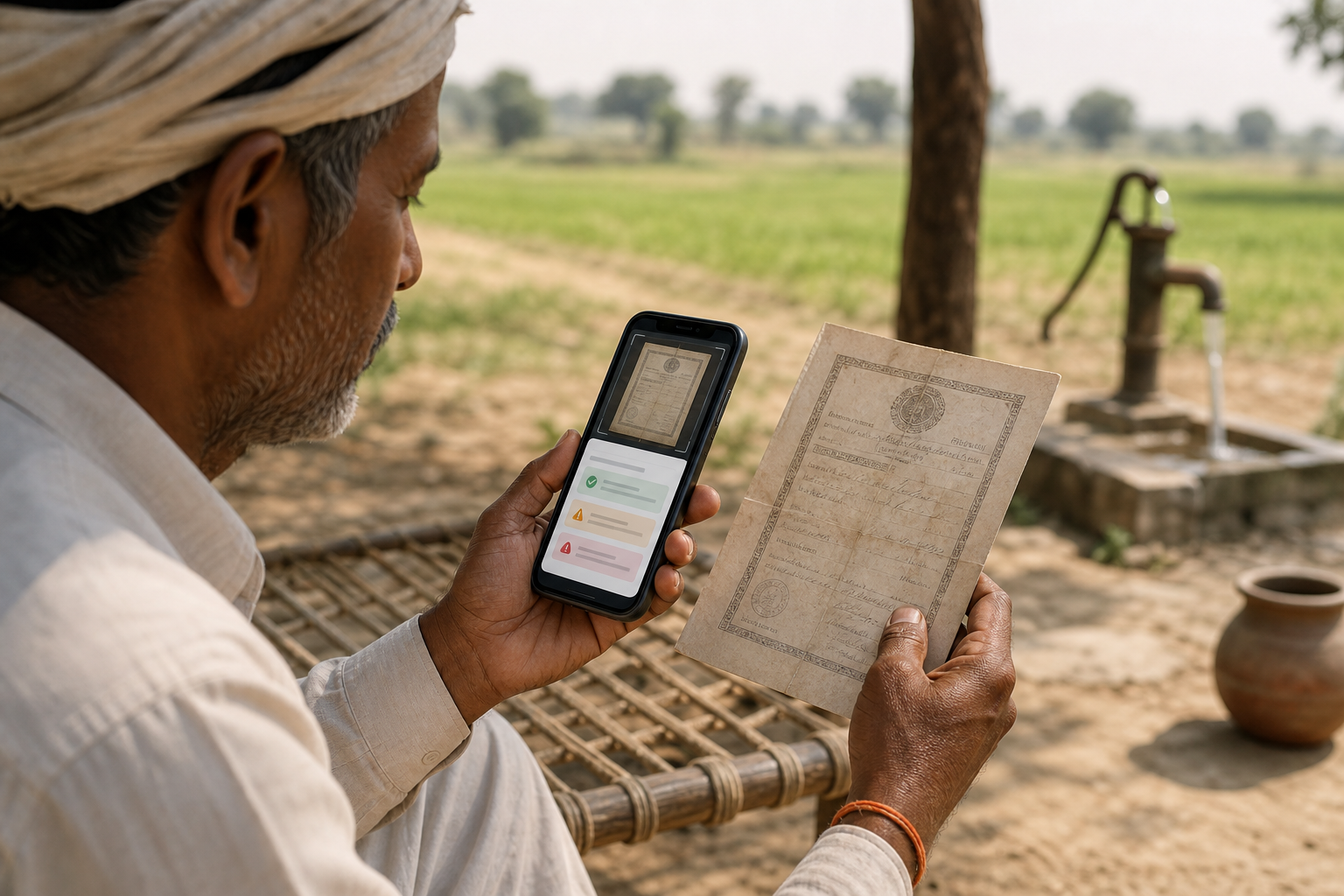
What Is AI Legal Document Review and Why Does It Matter for Rural India?
AI legal document review is simple: software reads your document and explains it in plain words. It can summarize who is involved, what each side must do, key dates, and risky clauses. It can also flag parts that likely need a human lawyer’s attention. You upload a photo or PDF of a land deed, tenancy agreement, court notice, or loan document. Then you get a short, clear note you can understand before you sign or respond.
Why it matters in villages
For rural India, the gap is real. About 70% of the population lives in villages, yet most advocates practice in towns and cities. India has roughly one lawyer per 1,500 people, and access is thinner in blocks and talukas. Many documents arrive in English or in formal legal Hindi that feels like a maze. The result can be harsh: farmers tied to exploitative crop-loan terms, families losing ancestral land due to clauses hidden in a sale deed, or women missing rights in inheritance papers.
However, this does not mean you should avoid legal help. Instead, use AI as a bridge to first understanding. Like asking a trusted friend to read a letter out loud before you visit the sarkari office, AI helps you see the shape of the issue. Then you can choose if you need a verified advocate, what questions to ask, and which papers to carry.
In addition, quick summaries save travel and time. You can scan at home, at a neighbor’s, or at a Common Service Centre. If the summary shows a major risk, you go to an advocate prepared. If it looks routine, you proceed with more confidence.
Common documents AI can explain
- Land records, sale deeds, mutation notices
- Tenancy and lease agreements
- Crop-loan and microfinance forms
- Court summons and notices
For a broad overview of rural demographics, see this background on Rural India. Use it only as context; your own document rules depend on your state and the exact paper in your hand.
Also Read!
LawyerBuddy vs Vakilsearch for Rural India: Which Is Better for AI Legal Document Review?
Step-by-Step: How to Get a Legal Document Reviewed by AI from a Rural Area
Step 1: Photograph or scan the document
First, spread the paper on a flat surface. Use daylight or a bright lamp to avoid shadows. Hold the phone steady; keep the frame parallel to the page. Capture every page, front and back, including stamps, seals, and signatures.
Moreover, free apps like Adobe Scan or CamScanner can help. They work offline and sync later. You can rename files to remember them: “LandDeed_Gauhati_2026-05-01.jpg”. As a rule, clear images lead to better AI results.
Step 2: Choose an AI review tool that supports your language
Second, pick a tool that:
- Supports Hindi, Tamil, Telugu, Kannada, or your local language
- Works on low-bandwidth or intermittent connections
- Runs on a basic smartphone without a desktop
For a primer on the types of software in this space, you can read this guide to legal ai tools. In short, language support is not just the app’s buttons. The AI must read and understand your document language, not only translate the screen menu.
Tip: If you have no internet at home, visit your nearest Common Service Centre (CSC) — over 4 lakh CSCs operate across rural India and many offer digital assistance.
Step 3: Upload and select the document type
Third, upload your scan and choose the document type: land record, court notice, loan agreement, tenancy, or inheritance. Categorization matters. It’s like telling a tailor whether you need a shirt or a blouse, the cut changes. By setting the type, the AI focuses on the right clauses and dates.
In fact, some platforms generate AI-structured case files with jurisdiction, issues, budget, and documents pre-organised. That saves time later if you consult an advocate.
Step 4: Read the AI summary
Fourth, read the summary.
- Parties involved and their roles
- Your key obligations and rights
- Deadlines, dates, and notice periods
- Potential risks or one-sided clauses
- Clauses that should be checked by a human advocate
As you read, mark anything unclear. Compare it with what the lender, broker, or officer told you. If there’s a mismatch, pause. Short, smart pauses can prevent long, painful disputes.
 place document on flat table, 2) align phone camera, 3) capture edges, 4) confirm clarity, 5) select 'Land Record' document type; include bilingual labels and low-data icons)
Step 5: Decide your next step
Fifth, decide based on the risk level. If the AI flags serious risks, court matters, or large sums, consult a verified advocate. If it appears straightforward and low-stakes, proceed with greater confidence.
Furthermore, some India-focused tools provide 5 free document reviews daily, which reduces cost for first checks. You can also explore how an ai legal assistant differs from a pure summarizer so you pick the right help.
Step 6: Save the summary for your records
Sixth, save the AI summary and the original scans. Keep copies in your phone, on a memory card, and with a trusted family member. In rural life, papers get lost to rain, pests, or moves. A digital copy guards your rights. When you later meet an advocate, show both the scans and the AI note. That speeds up advice and reduces fees.
Tip: If you cannot upload at home, ask your CSC operator to help you email or save the files to a secure folder and label them with dates.
Get a low-data AI summary in minutes →
Common Mistakes Rural Users Make with AI Legal Document Review
Accuracy and judgment
AI is not a final legal opinion. It highlights and explains. It does not appear in court for you. So, treat the output like the first reading, not the last word. For complex disputes or anything tied to your land or home, speak to a qualified advocate.
Image quality and completeness
- Mistake 1: Uploading blurry or cropped images. Always scan every page, including stamps and signatures.
- Mistake 2: Skipping annexures or maps. Land attachments can control the deal.
- Mistake 3: Mixing pages from different files. Keep each document in a separate folder.
Local law matters
Land and tenancy rules differ by state. A clause valid in Kerala may not work in Rajasthan. Therefore, ensure your tool handles your state’s laws and flags jurisdiction-specific points. If you’re unsure, add your state name in the tool’s settings or notes.
Verification and privacy
- Mistake 4: Not verifying the advocate or platform when escalating. Work only with a 100% Bar Council verified panel if you move ahead with a lawyer search.
- Mistake 5: Assuming all tools handle your language equally. Some apps translate menus but don’t read Hindi or Tamil documents well. Test with a simple page first.
- Mistake 6: Sharing sensitive documents on unsecured platforms. Look for a secure 1-on-1 workspace for document exchange and clear data privacy terms.
Privacy basics: Use tools that encrypt data in transit, avoid public Wi‑Fi for uploads, and never share Aadhaar copies unless required.
Additionally, keep a small “quality checklist” stuck to your diary: clear scans, full pages, correct document type, your state, and saved copies. Five minutes on this checklist can save five visits to the tehsil.
Also Read!
Tools and Resources for AI Legal Document Review in India
Start with free public services
Begin with what you already have. The Tele-Law programme under the Department of Justice offers free or low-cost advice via CSCs. The e-Courts Services app helps you check case status and hearing dates; you can learn more on the eCourts portal. If you meet income or social criteria, NALSA provides free legal aid through legal services authorities in every state. Your local CSC (see the Ministry of Electronics & IT portal at csc.gov.in) can guide you on access.
Use AI for first-pass understanding
General AI tools like ChatGPT or Google Gemini can summarize English documents and explain concepts. However, they may not read regional languages well and are not trained on Indian legal practice. They also do not offer a safe handoff to a real lawyer.
That’s why the best method is layered: AI first, public aid checks second, and a verified advocate when the stakes are real.
For background reading on how AI supports research and preparation, see this explainer on ai in legal research. It shows where AI helps and where human judgment stays key.
India-specific legal tech
Tools built for India can bridge the last mile. For example, platforms like LawyerBuddy combine AI document review with multilingual support (Hindi, Tamil, Telugu), and a path to Bar Council-enrolled advocates. They are free to register with no subscription fee, and some offer 5 free document reviews daily to lower the cost barrier. If you need to engage a lawyer, a secured escrow payment system ensures funds release only after a regulatory cooldown, protecting you from fee disputes. A secure 1-on-1 workspace keeps your papers and chats in one place. When you post a matter, AI-structured case mandates pre-organise jurisdiction, issues, budget, and documents so advocates can respond faster and more accurately.
Moreover, if you want plain-language legal information, Nyaaya.org publishes easy guides on rights and procedures. For reading actual Acts, the India Code portal aggregates central laws in one place. Use these with your AI summary to form the right questions for an advocate in 2026 and beyond.
Try a multilingual AI review free today →
 scan document, 2) AI summary highlights risks, 3) check eCourts/Tele-Law/aid, 4) connect to verified advocate via secure workspace and escrow; simple icons; bilingual labels)
What to Do Next: Your First AI Document Review This Week
This week, take one small, strong step. Start with a document you already have, not the scariest one. Build the habit and you’ll gain speed.
-
Gather any pending paper, a land mutation notice, crop-loan agreement, tenancy paper, or court summons, and photograph every page clearly.
-
Use your smartphone or visit a CSC to try a free AI document review. Begin with a low-stakes document to learn the process without stress.
-
Compare the AI summary with your own understanding. Note any clauses, dates, or duties you hadn’t noticed. If unsure, write down questions.
-
If the AI flags risks, seek a free consult through Tele-Law or connect with a verified advocate. On some platforms, you can get 5 free legal questions answered daily with 2 follow-up questions per case so you can clarify points without extra cost.
-
Share what you learned with a neighbor or family member who might have unreviewed papers. Knowledge grows when it’s shared, and it protects everyone.
Remember, understanding your own legal documents is a fundamental right. Technology can now meet you where you are, beyond city limits, and on your terms.
Get your first summary in 10 minutes →
Key Takeaways
- Use ai legal document review as a first layer: scan, summarize, flag risks, then decide if you need an advocate.
- Language and bandwidth matter; pick tools that support Hindi or your regional language and work on low data.
- Image quality drives accuracy; capture every page, stamp, and signature, and label your files.
- Layer your help: AI for clarity, public services like eCourts and Tele-Law for checks, then a verified advocate for 2026 matters that affect land, money, or court.
- Protect yourself with verified panels, secure workspaces, and escrow; avoid unregistered “consultants” and unsecured sharing.