


A junior associate spends six hours reviewing case law for a motion due Monday morning. Tabs pile up. Citations blur together. Somewhere around midnight, they realize they missed a precedent buried inside a related appellate opinion.
That situation still happens. Just less often.
Legal research tools are changing how lawyers gather authority, evaluate arguments, and prepare briefs. The biggest shift is not speed alone. Research itself is becoming more strategic. Instead of spending hours locating cases, lawyers can spend more time analyzing how those cases strengthen an argument.
The pressure behind this shift is real. Clients expect faster turnaround times. Firms want greater efficiency. Solo practitioners need enterprise-level capability without enterprise budgets. At the same time, many legal professionals remain cautious about trusting AI-generated research without verification.
That tension matters.
Some tools genuinely improve workflow quality. Others simply repackage keyword search with marketing language attached. Understanding the difference has become part of modern legal practice.
This blog breaks down what legal research tools actually do, where they help, where they fall short, and how lawyers can evaluate them without getting distracted by hype.
Read Aloud!
Quick Answer – What Are Legal Research Tools and Do They Actually Help?
Legal research tools help lawyers find case law, statutes, regulations, briefs, and legal analysis faster and more accurately. Modern platforms use AI to surface relevant precedents, summarize arguments, and organize citations. Yes, they help significantly. The right platform can reduce research time, improve brief quality, and streamline legal workflows across firms of every size.
The Old Way vs. The New Way – How Legal Research Has Actually Changed

Legal research once depended heavily on physical reporters and manual indexing. Lawyers spent hours tracing citations through bookshelves, reviewing digests, and narrowing search terms with Boolean operators.
Digital databases improved access, but the workflow still required extensive manual reading. Finding relevant authority often depended on knowing exactly what keywords to search.
AI changed that dynamic.
Modern legal research tools rely more on semantic understanding than rigid keyword matching. Instead of searching only for exact phrases, these systems analyze meaning, context, and citation relationships across cases.
That distinction matters more than most people realize.
A lawyer researching fiduciary duty disputes may uncover related precedents involving corporate governance or shareholder conflicts, even when the wording differs substantially. Traditional search systems frequently missed those connections.
The real evolution is not simply faster retrieval. It is better contextual understanding.
Research workflows are shifting from “find every possible case” toward “identify the strongest strategic authority.” Lawyers still make the judgment calls. The baseline expectation for thoroughness, however, has increased.
Many firms still verify AI-generated output manually. That caution is justified. Citation hallucinations, outdated references, and incomplete jurisdiction coverage remain legitimate concerns. The technology works best when treated as an assistant, not a replacement for professional review.
What Today’s Legal Research Tools Actually Do (Beyond Keyword Search)
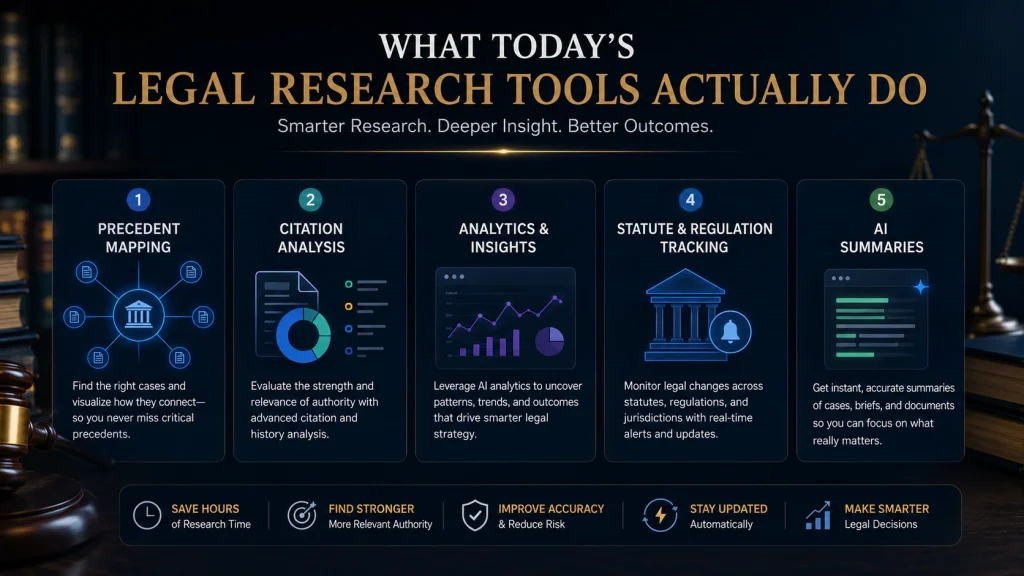
Many lawyers assume legal research tools function like smarter search engines. The reality is broader.
Case Law Discovery and Precedent Mapping
Modern platforms identify relationships between cases through citation analysis and contextual relevance. Instead of returning hundreds of loosely connected results, AI systems prioritize authorities that align closely with factual and procedural similarities.
This helps lawyers uncover non-obvious precedents.
Citation mapping also reveals how courts interpret particular rulings over time. That historical context becomes valuable when evaluating whether a precedent still carries persuasive strength.
Statute and Regulatory Tracking
Certain legal research tools monitor legislative changes automatically. For firms handling compliance-heavy matters, this reduces the risk of relying on outdated statutes or regulatory interpretations.
Jurisdiction-specific alerts are especially useful for employment law, tax law, and financial regulation practices where changes occur frequently.
Brief and Document Analysis
Natural language processing now supports argument summarization, inconsistency detection, and contract review.
That does not eliminate legal reasoning. It removes repetitive review work.
A litigation team reviewing hundreds of contracts during discovery still needs experienced attorneys to interpret risk. AI simply accelerates the identification process.
Predictive Analytics and Outcome Modeling
Some AI tools for legal research evaluate litigation patterns based on judge history, jurisdiction, motion success rates, and case type trends.
These systems are not crystal balls.
Still, they provide useful strategic insight during settlement negotiations or pretrial planning. Understanding how similar motions performed historically can influence litigation strategy long before trial begins.
Top AI Tools for Legal Research – What the Market Actually Offers
Not every platform fits every legal workflow. That is where many firms make expensive mistakes.
Some systems work best for large litigation teams. Others are designed for solo practitioners or smaller firms seeking efficiency without enterprise pricing.
AI-native platforms generally focus on semantic search, rapid summarization, and conversational querying. They appeal to lawyers who want speed and intuitive interfaces.
Traditional databases integrating AI features remain strong in citation depth, historical archives, and jurisdictional reliability. Firms already invested in those ecosystems often prefer gradual workflow changes rather than complete platform replacement.
Specialized tools serve narrower practice areas such as immigration, intellectual property, or litigation analytics. These platforms may offer deeper niche functionality but less flexibility outside their focus area.
Smaller practices often prioritize affordability and ease of adoption. In those environments, simplicity matters more than feature overload.
The best choice depends less on marketing claims and more on workflow alignment.
How to Actually Choose a Legal Research Tool (Without Getting Lost in Feature Lists)
The smartest evaluation process starts with your existing workflow.
Start With Your Research Workflow, Not the Tool’s Homepage
Where does research slow down inside your practice?
Some lawyers struggle with statute lookup. Others spend excessive time reviewing citations or organizing precedent chains. Identifying those bottlenecks makes evaluation far easier.
A flashy demo means little if the platform does not solve your actual friction point.
The 5 Questions to Ask Before Committing
Before adopting legal research tools, ask:
- Does the platform support my jurisdiction and practice area?
- How current is the legal database?
- What training will my team require?
- Does it integrate with existing case management systems?
- Will pricing remain sustainable as usage increases?
Those questions matter more than feature comparisons.
Solo vs. Firm vs. In-House Needs
Solo practitioners usually prioritize speed, breadth, and affordability.
Law firms often need collaboration tools, citation consistency, and workflow integration across teams.
In-house counsel care more about regulatory tracking, contract review, and cross-department usability.
Different workflows create different priorities. That reality gets overlooked constantly.
Mistakes Lawyers Make When Adopting Legal Research Tools
The most common mistake is treating AI-generated output as finalized legal work.
Verification still matters. Every citation should be reviewed carefully, particularly in high-stakes matters or niche practice areas.
Another issue involves buying based on brand familiarity instead of workflow compatibility. A respected platform can still be the wrong fit operationally.
Training gaps also reduce ROI significantly. Firms sometimes purchase sophisticated systems without investing in onboarding. As a result, teams continue using outdated habits while expensive features sit untouched.
Privacy concerns deserve equal attention.
Lawyers handling confidential client information should evaluate encryption standards, storage policies, and vendor data practices carefully before adopting any AI-enabled platform.
Why LawyerBuddy Is Built for How Lawyers Actually Research

Many legal technology products feel designed primarily for procurement teams rather than practicing lawyers.
LawyerBuddy approaches the problem differently.
The platform focuses on how legal professionals research, draft, and verify information during real working conditions. That workflow-first design matters because research speed alone is rarely the true bottleneck.
Several features reflect that practical focus:
- Jurisdiction-aware case law search for Indian and common law systems
- Plain-language summaries that preserve legal precision
- Fast statute and section lookup without unnecessary navigation layers
- Citation formatting support that reduces drafting errors
- Accessible pricing designed for solo lawyers and growing firms
Instead of overwhelming users with technical complexity, the platform emphasizes usable efficiency.
That distinction becomes valuable quickly inside fast-moving practices.
The Deeper Shift – What AI Legal Research Tools Mean for the Profession
The long-term impact reaches beyond productivity.
Junior lawyers historically learned through repetition-heavy research work. As legal research tools automate portions of that process, firms may need new approaches to training and mentorship.
That creates both risk and opportunity.
AI can accelerate learning curves dramatically. At the same time, younger lawyers still need to develop judgment, strategic reasoning, and procedural understanding independently of automated systems.
The value of human analysis is becoming more concentrated, not less.
Another pressure point involves billing models. When research that once required six hours now takes ninety minutes, firms face difficult pricing questions. Hourly billing becomes harder to justify when efficiency improves substantially.
Access to justice may also change.
Smaller firms and independent practitioners can now access research capability that previously required massive database subscriptions and institutional resources. That shift could reshape competition across parts of the legal market over time.
Read More!
Top 7 Benefits of Using an AI Lawyer Free Tool
AI Advocate: The Ultimate Guide to Navigating AI Legal Frameworks
The Research Is Changing. The Judgment Is Still Yours.

The associate buried in case law until 2 a.m. still exists. The difference is that modern research workflows no longer require quite as much time spent searching blindly for authority.
Legal research tools are changing the mechanics of legal work. They are not replacing legal judgment.
That distinction matters more than any product feature list.
The strongest lawyers will likely be the ones who combine fast research capability with sharper strategic thinking. AI can surface information quickly. Deciding what actually matters remains a human skill.
If you are evaluating your current workflow, start with a simple question: where is research consuming unnecessary time right now?
That answer usually points toward the right tool decision.
For firms and practitioners looking for a workflow-focused approach, LawyerBuddy offers a practical starting point built around how lawyers actually research, draft, and work under pressure.
FAQ – Real Questions Lawyers Are Searching For
What is the best AI tool for legal research in India?
The best option depends on jurisdiction coverage, Indian case law access, statute databases, and workflow needs. Lawyers handling Indian litigation should prioritize platforms with reliable local authority coverage rather than generic global databases.
Are AI legal research tools accurate enough to trust?
They are useful but not infallible. Lawyers should always verify citations, especially in emerging practice areas or jurisdiction-specific matters where training data may be limited.
How do AI legal research tools differ from traditional databases?
Traditional databases rely heavily on Boolean search logic. AI systems use semantic understanding, contextual analysis, and citation relationships to surface relevant authority more efficiently.
Can a solo lawyer afford AI legal research tools?
Many newer platforms offer pricing tiers designed for solo practitioners. The time saved on research and drafting often offsets subscription costs relatively quickly.
Is using AI for legal research ethical?
Most bar associations allow responsible AI usage when lawyers maintain competence, confidentiality, and independent professional judgment. Human oversight remains essential.