

Start secure case setup, free today → In 2026, a secure lawyer-client case workspace helps you move fast and stay private from day one. You also need proof of who said what and when, in case a dispute arises.
For NRIs, trust is the real issue. You may have faced patchy updates, fees sent upfront with no receipts, or PDFs floating across WhatsApp threads. None of that scales for a case that spans months. You need structure. More than that, you need verification.
In this guide, you’ll learn how to spot the right portal, step by step. You’ll see where generic tools help and where they fall short. And you’ll get a weekly plan so you can act this week, not “someday”.
 , a document vault labeled 'sale_deed. pdf' and 'POA_draft. pdf', a calendar with 'High Court hearing', and a shield icon indicating escrow payment protection; clean, modern UI mockup, India map watermark)
Why NRIs Need a Dedicated Secure Portal for Indian Legal Matters
A typical cross-border scenario and why it breaks down on email
Picture this: You’re in San Francisco with a property dispute in Chennai. The buyer claims the boundaries in your sale deed are wrong. Your advocate needs a clear copy plus site photos and prior tax receipts.
The next Madras High Court date is in two weeks, but the listing moved. You can’t fly. You also shouldn’t email scanned IDs or POA drafts across three inboxes and two phones.
Here’s where a secure lawyer-client case workspace matters. In plain terms, it’s a private, identity-verified 1‑on‑1 place where you and your advocate can exchange documents, track tasks, and keep a clean message trail. Good portals protect files with encryption in transit and at rest. They also prove your advocate’s Bar Council enrollment (the license to practice in India) and keep your case mandate organized by court, issue, and budget.
From chaos to clarity: four early wins
Scattered documents across email and WhatsApp create version confusion and guarantee missed details, so the first win is a single source of truth with clearly labeled versions and timestamps. The second win is identity assurance: when your counterpart is Bar Council–verified inside the workspace, impersonation and off-platform advice become less likely, and you gain the confidence to approve actions faster. Third, the time-zone gap stops being a blocker when updates are tied to tasks with due dates and reminders, so you can approve drafts while you sleep and wake up to progress rather than questions. Finally, escrow-backed payments make it explicit when money moves and why, generating a clean paper trail that protects both sides and sharply reduces disputes over fees or deliverables.
What a secure workspace looks like in practice
The time zone gap hurts most when updates are ad hoc. A dedicated portal fixes that by structuring work. On the portal home screen, you see a case timeline, next hearing date, and pending tasks, so you always know what’s next without late-night calls.
When your advocate uploads a draft affidavit, you get a timestamped note. If you approve or comment, that’s logged too. No more hunting through WhatsApp media folders. You can filter by “Affidavit,” “Sale deed,” or “POA” to locate the exact version your counsel used in court.
The trust deficit is real. It improves when identity is verified and money moves through escrow. With an escrow-backed mandate, funds are set aside but only released after milestones or a regulatory cooldown. That adds a layer of accountability your gut will appreciate.
Core benefits to look for, explained
A secure 1‑on‑1 workspace for document exchange and communication should feel focused on your case and your case alone, with access tightly limited to you and your advocate. A 100% Bar Council–verified panel of advocates is non-negotiable; the portal should surface each lawyer’s State Bar Council enrollment details so you can verify before sharing anything sensitive. AI-structured case mandates take the friction out of setup by pre-organising jurisdiction, issue, budget, and documents, which means less back-and-forth and fewer misfiled attachments during crunch time. Together, these benefits replace scattered, informal workflows with a verifiable, auditable environment designed for legal work rather than general chat.
“Secure doesn’t have to be complex. It just means your files and messages stay between you and your verified advocate, with a record to back you up.”
Moreover, dedicated portals reduce mistakes caused by version chaos. Your sale deed’s “final” version should not be “IMG_8231-final2. jpg”. It should be a single document in a case folder with versions tracked and access controlled. That is how you avoid preventable delays.
Extra clarity features that help NRIs
Hearing-aware folders bring the right exhibits to the surface automatically by letting you tag evidence to specific dates, which saves time the night before a listing. Multilingual notes enable your counsel to draft in Tamil, Telugu, or Hindi while you receive English summaries, reducing misreadings without slowing down local drafting. Jurisdiction presets ensure you choose the court and bench once so every new document inherits correct headers and formatting, which is crucial when filings span multiple forums. Finally, an exportable audit trail with hashes for integrity lets you generate a one-click PDF of who uploaded what and when, giving you a defensible record if any process is ever questioned.
Also Read!
LawyerBuddy vs LegalDesk for NRIs: Which Is Better for Secure Lawyer-Client Portals?
How to Hire a Lawyer with Escrow Payment Protection as a Small Business
Step-by-Step: How to Evaluate and Select the Right Secure Portal
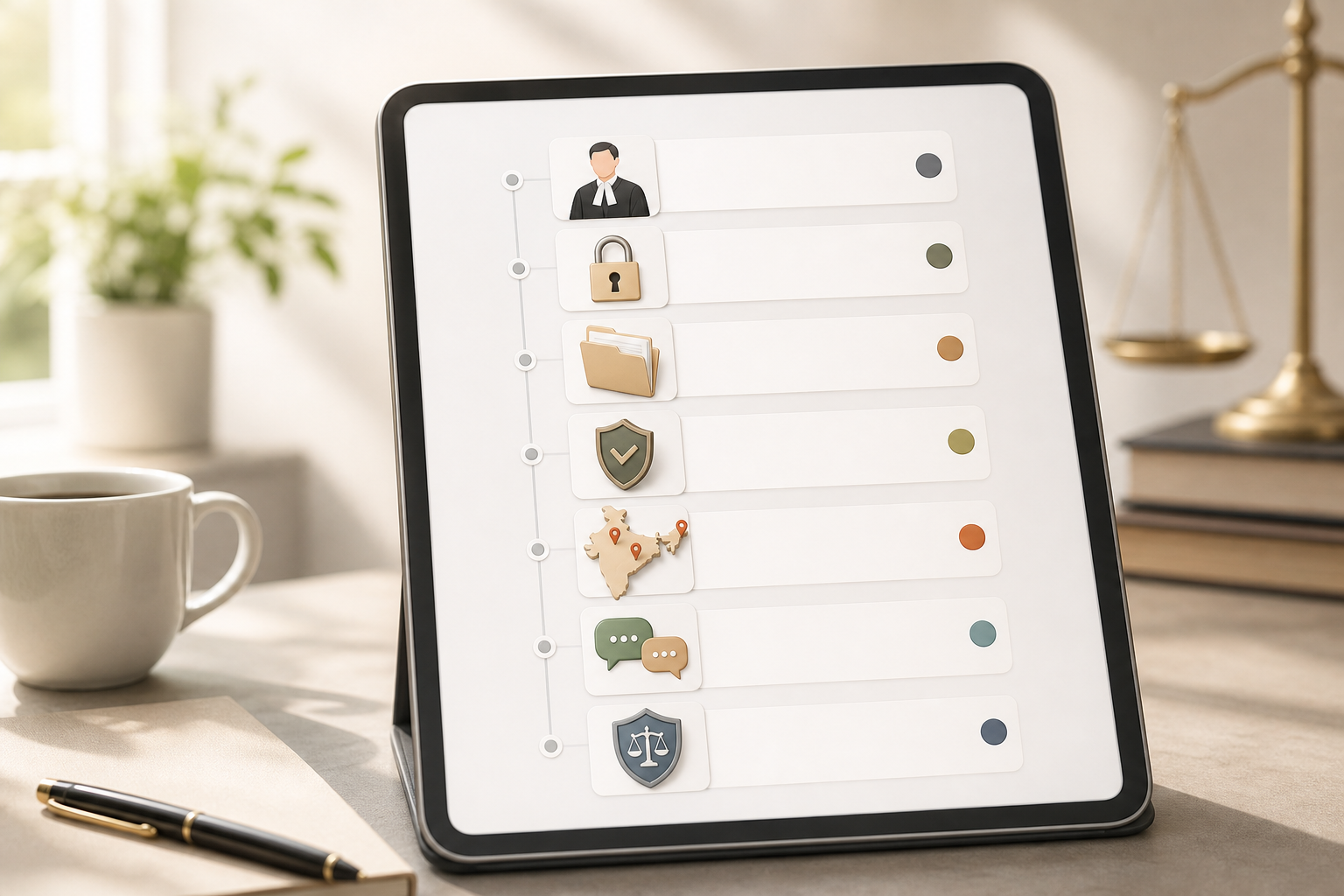
You can shortlist portals fast with a simple 7-step method. Use it as a checklist before you upload any sensitive file to a secure lawyer-client case workspace.
The 7 checks explained
-
First, verify advocate credentials. Every practicing lawyer in India must be enrolled with a State Bar Council and, after qualifying, appears on rolls maintained under the Bar Council of India framework. A solid portal will verify enrollment on your behalf and keep the record visible inside the workspace. That one step weeds out impersonators. If a portal lets you click through to public enrollment details or displays the advocate’s State Bar Council number with validation date, that’s even better.
-
Second, check encryption standards. End-to-end encryption (E2EE) means only you and your advocate can read the message or file, even if someone intercepts it. Encryption at rest means files are stored encrypted on the server. 3 for data in transit and AES‑256 for storage at rest. 3 in the IETF RFC 8446 here: https://www.rfc-editor.org/rfc/rfc8446 and learn about AES in NIST FIPS 197 here: https://nvlpubs.nist.gov/nistpubs/FIPS/NIST. 197.
pdf. If the portal offers optional E2EE for chat and document comments, that further narrows access to just you and your advocate. Ask how keys are managed, whether Perfect Forward Secrecy is enabled, and if audit logs are tamper-evident via hashing.

-
Third, assess document management. You should be able to upload PDFs, JPG scans, and DOCX files used in Indian legal work. Versioning, access controls, OCR for scanned PDFs, and easy retrieval are a must. If the portal can tag documents by hearing, court, or issue, you’ll save hours. Bonus points if the system supports Indian file-naming conventions, bulk upload from cloud drives, and per-document view/download permissions for co-counsels or clerks.
-
Fourth, evaluate payment security. Escrow is safer than a straight bank transfer to a new advocate. Funds sit with a regulated intermediary and release only after acceptance or a cooldown window in line with RBI‑regulated payment flows (speak to your bank if unsure). That structure discourages bad actors and gives you a documented payment trail. Look for automated invoices, TDS/GST-ready receipts, and milestone-based releases that match your mandate.
-
Fifth, confirm jurisdiction and language support. India has 25+ High Courts and many lower courts. Your portal should cover the right state and city, and ideally support languages like Hindi, Tamil, or Telugu so local filings and notes are clear.
Bonus points if it supports Indian date formats and cause list references. If you have mixed forums (e. , consumer commission plus civil court), ensure the workspace can maintain distinct folders and hearing calendars per forum.
- Sixth, test communication features. Plain chat is not enough. You want structured messaging tied to the case, with tasks, due dates, and attachments all in one place.
Asynchronous notes and summaries help across time zones. Look for read receipts, message pinning, and the ability to turn a chat message into a task with a deadline. A searchable archive with filters (document type, hearing, participant) reduces time wasted on retrieval.
- Seventh, review data residency and privacy compliance. Ask where your data lives and how it’s protected under India’s Digital Personal Data Protection Act, 2023. Read background here: https://en.wikipedia.org/wiki/Digital_Personal_Data_Protection_Act,_2023 Also ask about data retention, breach notification timelines, and options to export or delete your data when your matter closes. Clarify whether data is processed by sub‑processors, what audit logs are kept, and how cross‑border transfers (if any) are governed.
Trust but verify—then encrypt. Identity verification and escrow set the floor; TLS 1.3, AES‑256, and audit logs raise the ceiling.
Your 7-Step Comparison Table
| Step | What to Look For | Red Flags |
|---|---|---|
| 1. Advocate Check | 100% Bar Council verified panel with visible enrollment | “Trust me” claims, no enrollment proof |
| 2. Encryption | TLS 1.3 in transit; AES‑256 at rest; optional E2E for chat | “Military-grade” jargon with no specs |
| 3. Documents | Versioning, access control, PDF/JPG/DOCX support | Email-only uploads; no version history |
| 4. Payments | Secured escrow payment system ensuring payment after regulatory cooldown | Full fees upfront via wire to personal account |
| 5. Jurisdiction | Coverage for your state/city; language support (Hindi/Tamil/Telugu) | One-size-fits-all, English-only |
| 6. Messaging | Case-tied threads, tasks, timestamps, and audit trail | WhatsApp-only; no searchable archive |
| 7. Privacy | DPDP Act 2023 alignment; clear data residency | Vague “we care about privacy” policy |
Common pitfalls to avoid during selection
A surprising number of NRI matters derail because the workspace is not truly per-case, and documents from one dispute bleed into another. Another frequent error is accepting vague “bank-grade security” claims without specifics like TLS 1.3 or AES‑256, which leaves you guessing about actual protections. Paying full retainers to a personal account with no escrow or GST/TDS-compliant invoices is also risky; you sacrifice use and end up with a weak financial trail. Finally, people often assume jurisdiction coverage and only discover too late that no panel advocates are available in their city or that export options for the entire audit trail and files are limited or missing.
You can avoid these headaches by doing a 10-minute sandbox test before sharing anything sensitive. Create a draft matter, upload a redacted utility bill, and see whether versioning works as promised; if you can’t find your own message or history in two clicks, that’s a sign to move on. Check that exports bundle timestamps, user IDs, and version links into a coherent PDF, because this is what you’ll rely on months later when memories fade. Lastly, ask support a simple, specific question about cause list references or Indian date formats; the speed and accuracy of the reply is a leading indicator of how the vendor handles real-world issues.
Test workflows, not just websites. A two-file, two-message rehearsal will reveal more than any marketing page.
Furthermore, run a 10-minute test. Create a draft case, upload a non-sensitive file (like a redacted utility bill), and send one question to see how the trail appears. If you can’t find your own message or version history in under two clicks, move on.
Pro tip: Rename your test upload “SaleDeed_sample_v1. pdf” and then upload “_v2. pdf” after counsel feedback. If the portal can’t show a side‑by‑side diff or at least a clear version ladder, keep evaluating.
Finally, check whether the portal offers a secure 1‑on‑1 workspace per case. If your property dispute ends up mixing with a separate consumer complaint, you’ll lose clarity. Separate workspaces keep evidence clean.
To go a step further, simulate a mini‑workflow:
- Assign yourself a task with a due date and attach your redacted file.
- Ask the advocate (or a test contact) to upload a revised version labeled “v2”.
- Add a private note, then export the message trail as a PDF.
- Review the export for timestamps, user IDs, and version links. This is what you’ll rely on months later.
**[Get secure case workspace, no card →]
How it compares at a glance
| Feature | Generic tools (email/chat) | Government portals (status) | Dedicated legal portal |
|---|---|---|---|
| Identity verification | None | N/A (public info only) | Bar Council enrollment verified and displayed |
| Secure workspace | Basic chat threads | No private workspace | Per-case, access-controlled workspace |
| Document control | Attachments with no versioning | Downloads only | Versioning, OCR, tags, and audit logs |
| Payments | External/manual | Not applicable | Escrow, GST/TDS invoices, milestones |
| Jurisdiction fit | Not modeled | Court status lookups | Court- and forum-aware structure |
| Language support | Varies, mostly English | English/regional for status pages | Multilingual notes and summaries |
Quick Fit Guide
Generic tools like email and consumer chat apps are fine for quick communication, but they are not built for legal workflow, access control, or escrow-backed payments. Government portals excel at public case status lookups and cause lists, yet they don’t provide private, per-case workspaces where you can collaborate securely with counsel. A dedicated legal portal fills that gap by adding identity verification, auditable structure, jurisdiction-aware organization, and payment safety that maps to your mandate. If your advocate prefers drafting in Tamil or Telugu, the right platform will let them work locally while you see clear English summaries, shrinking the risk of misinterpretation.
Additionally, check for language support. If your advocate prefers Tamil or Telugu for notes, the platform should support it. You’ll reduce misreadings and speed up drafts.
Also Read!
Best AI Legal Advice in Hindi & Tamil for NRIs in 2026
Can Small Businesses Trust Escrow Payment Lawyer Hiring? A Compliance Guide
Key Takeaways and What to Do This Week

A secure lawyer-client case workspace gives you encrypted files, verified advocates, auditable trails, and escrow-backed payments, all inside a per-case context that reduces noise. WhatsApp and email scatter evidence across threads and devices, while a portal centralizes documents, versions, and approvals so you can reconstruct decisions at any time. Jurisdiction fit should come first and specialization second, because India’s 25+ High Courts and assorted forums demand coverage before expertise can be put to work. When vendors tout “bank-grade” security, ask specifically for TLS 1.3 and AES‑256 and read a short primer on the DPDP Act 2023 so you know how your data is handled.
Most importantly, test before you trust. Create a case, upload a non-sensitive file, and inspect the audit trail export for timestamps, user IDs, and version links, those details are what stand up later if there’s a dispute. Once you’ve run a rehearsal and confirmed escrow is in place, you can safely move into substantive work and share sensitive IDs and drafts with confidence that the record protects you.
What to Do This Week
- Day 1–2: Write your issue in one page. Include jurisdiction (court/city), type (property, family, consumer), timeline, and a list of documents you already have.
- Day 3–4: Shortlist 2–3 platforms using the 7-step checklist. Confirm 100% Bar Council verification, TLS 1.3/AES‑256, escrow, jurisdiction coverage, and language support.
- Day 5: Create a test account on your top choice. Upload a redacted, non-sensitive file to test versioning and search.
- Day 6–7: Book your first consultation. Ensure escrow is active before sharing full details or IDs. Keep all messages inside the workspace.
Thousands of NRIs manage Indian legal matters from abroad each year. Your goal is simple: set up a secure, verifiable, and structured channel before any sensitive share. Once that’s in place, you can move fast without losing sleep, distance and time zones included.
To close the loop, set calendar reminders for key case dates and schedule a biweekly async update in the portal. Small routines compound into fewer mistakes and faster outcomes.
Mini-glossary for faster decisions
- Escrow: A neutral, regulated intermediary holds funds and releases them only on milestones or after a cooldown, reducing payment disputes.
- TLS 1.3: The current standard for encrypting data in transit between your device and the server; specified in RFC 8446.
- AES‑256: An encryption standard widely used to secure data at rest, recognized by NIST FIPS 197.
- DPDP Act 2023: India’s data protection law setting rules for consent, processing, retention, and breach notices.
- OCR: Optical Character Recognition; converts scanned PDFs/images into searchable text to speed up drafting and retrieval.
Quick FAQ for NRIs
- Q: Can I add a family member to view-only access?
- A: Look for granular permissions at the document and workspace level. Good portals allow “viewer,” “commenter,” and “editor” roles, and can limit access to specific folders.
- Q: What if my case spans the civil court and a consumer commission?
- A: Use distinct workspaces or sub-folders with separate hearing calendars and issue tags so evidence and filings don’t cross-contaminate.
- Q: How do I preserve attorney–client privilege when abroad?
- A: Keep all communications and files inside the secure workspace with E2EE where available. Avoid forwarding privileged content via personal email or group chats.
- Q: What happens at matter close?
- A: Export your complete audit trail and files. Confirm the portal’s retention period, deletion policy, and how to request data erasure consistent with the DPDP Act.